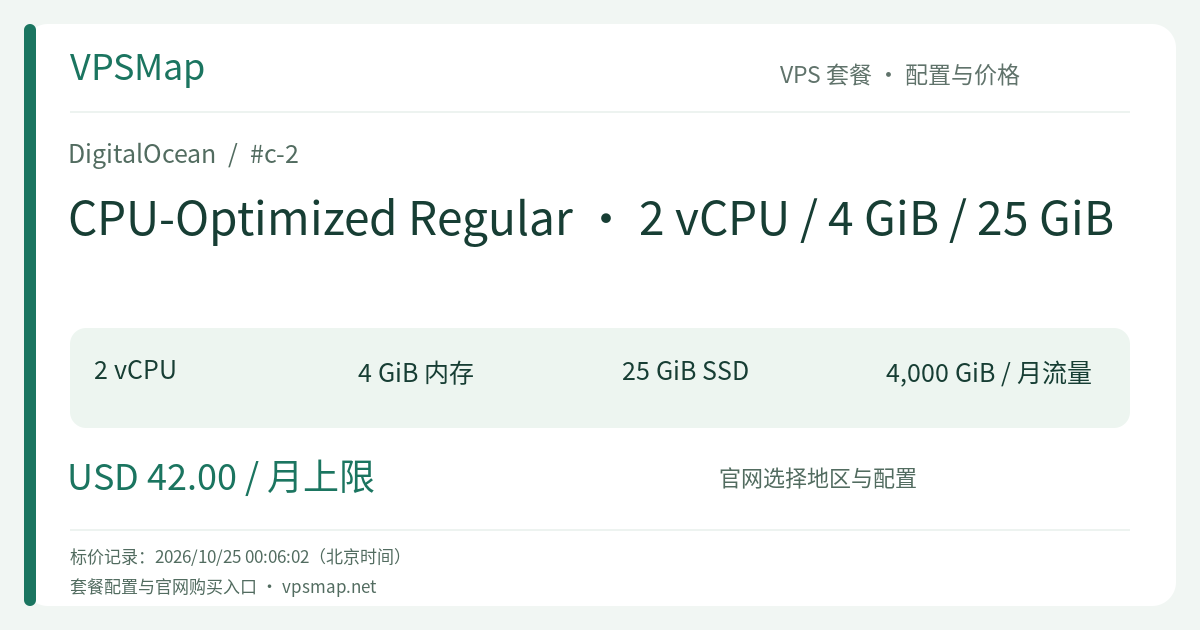
DigitalOcean c-2 Review: Lean-Storage, High-Value 2-Core Dedicated Compute
Updated
The Case for Dedicated Compute in Production#
A frequent pitfall in cloud infrastructure planning is hosting SLA-sensitive production applications on Shared CPU virtual machines. Under a shared hypervisor model, physical processor threads are distributed among multiple tenants. When neighboring workloads spike, your instance suffers from CPU steal, causing unpredictable P95 and P99 latency spikes in your API endpoints.
DigitalOcean's CPU-Optimized Regular Droplet lineup is engineered to eliminate this unpredictability. As the foundation of this family, the c-2 tier provides 2 full dedicated hyper-threads backed by Intel processors with base clock speeds exceeding 2.6 GHz. Regardless of the time of day or sustained load, 100% of the hardware execution capacity remains reserved for your workload.
The 2:1 Compute-to-Memory Ratio: Efficiency by Design#
Standard cloud configurations frequently impose a 4:1 RAM-to-CPU ratio (e.g., 2 vCPUs paired with 8 GiB RAM). However, many workloads are purely compute-bound rather than memory-hungry:
- API Gateways & Reverse Proxies: Deployments running Envoy, HAProxy, Nginx, or Traefik spend substantial CPU cycles on TLS termination, SSL handshakes, and routing tables, yet comfortably operate within 1–2 GiB of resident memory.
- Asynchronous Background Workers: Task consumers like Celery, Sidekiq, or BullMQ crunching mathematical transformations, hashing, data verification, and PDF generation.
- Continuous Integration Runners: Lightweight CI/CD agents focused on compilation, linting, and automated unit testing.
By pairing 2 vCPUs with 4 GiB of RAM, the c-2 plan eliminates the cost penalty of paying for unneeded memory, directing your cloud spend directly into execution throughput.
Engineering with 25 GiB Local Storage#
A 25 GiB local SSD boot drive might seem compact, but in modern decoupled cloud architectures, it is intentional:
- Stateless Compute: A standard Linux distribution occupies roughly 3–5 GiB. With runtime dependencies and container images, your operational footprint rarely exceeds 10–12 GiB, leaving comfortable room on a 25 GiB drive for scratch files and logs.
- Decoupled Persistence: Production databases belong on Managed Databases or dedicated DigitalOcean Volumes block storage, while static assets belong in Spaces object storage. This ensures instances can be created, resized, or destroyed without risking data state.
- Optimal Price Entry: By trimming local storage overhead, the
c-2plan provides the lowest monthly spending cap for dedicated hardware compute across the platform.
Billing Mechanics & Pooled Bandwidth#
DigitalOcean structures resource billing with predictability:
- Per-Second Metering with a 672-Hour Monthly Cap: Droplets are billed per second with a 60-second ($0.01) minimum. Monthly charges are capped at 672 hours (28 days). Running continuously beyond 672 hours in a calendar month incurs no additional hourly Droplet charge.
- Power-Off Billing Rule: Powering off a Droplet does not cease billing because hypervisor CPU cores and memory remain dedicated to your instance. To completely stop charges, the Droplet must be destroyed.
- 4,000 GiB Outbound Bandwidth Pool: Each
c-2adds 4,000 GiB of free outbound public transfer to your team's aggregate transfer pool. Inbound transfer is entirely free, and overage transfer is priced at a modest $0.01 per GiB.
Deployment Recommendation#
If your service requires unwavering CPU cycles, rock-solid response times, and minimal memory overhead, the c-2 Droplet represents the cleanest, most focused entry point.
Notice: Capacity in specific regions is subject to hypervisor availability. Verified allocations are finalized inside the management console.
- Direct Link: Deploy a c-2 Droplet on DigitalOcean