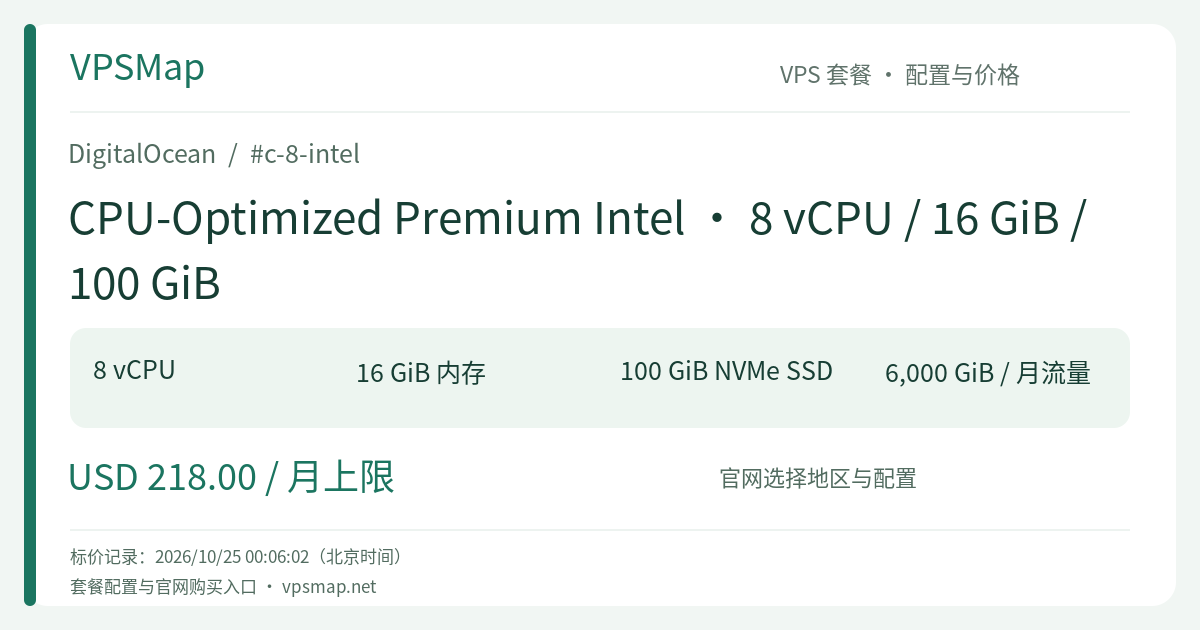
DigitalOcean c-8-intel Review: 8 Dedicated Cores & 16 GiB RAM for Heavy Multi-Threaded Scale
Updated
Stepping into 8 Dedicated Cores: Eliminating Latency Spikes at Scale#
As your applications scale from early growth into serious production volume, 4-core servers often begin to hit their ceilings during traffic spikes: request queues back up, P99 latency charts show severe outliers, and background batch jobs compete directly with user-facing APIs. If your stack still relies on shared-CPU nodes, host-level neighbor contention exacerbates the volatility.
The c-8-intel Droplet is DigitalOcean's focused compute flagship for heavy-traffic production backends. Engineered with 8 dedicated Intel Ice Lake vCPUs, 16 GiB of RAM, and a 100 GiB local NVMe SSD, it delivers the hardware isolation essential for uninterrupted scale.
Why does 8 dedicated cores represent a true architectural leap? Having 8 dedicated hardware hyper-threads means your operating system can run 8 heavy execution threads in true parallel synchronization. Whether you are running multi-worker runtimes (like PHP-FPM, Gunicorn, Puma, or Node.js cluster processes) or high-throughput reverse proxies, each mission-critical process is guaranteed dedicated compute cycles, flattening tail latency percentiles.
The Precision 2:1 Ratio: Why 16 GiB RAM is Perfectly Sized for Compute#
In standard general-purpose cloud plans, an 8-core machine is commonly bundled with 32 GiB or 64 GiB of memory. If your architecture is primarily compute-bound—such as JSON serialization, cryptographic signing, dynamic image rendering, high-volume reverse proxying, or parallel mathematical calculations—your stack might only consume 10 to 14 GiB of RAM. The remaining memory sits idle while inflating your monthly hosting bill.
The c-8-intel Droplet maintains a disciplined 2:1 compute-to-RAM ratio (8 vCPU / 16 GiB). This design provides ample working memory for high-concurrency multi-process stacks while eliminating unnecessary memory premiums, significantly driving down the total cost of dedicated multi-core computing.
Double Advantage: 10 Gbps Pipe and 6,000 GiB Bandwidth Pool#
As an upper-tier Premium Intel configuration, c-8-intel provides top-tier I/O and network specifications:
- 10 Gbps Network Interface: Enjoying a 5x boost over standard 2 Gbps instances, the 10 Gbps pipe ensures that intra-cluster microservice RPC traffic and massive public traffic spikes traverse the network interface without packet queuing.
- 6,000 GiB Team Pooled Transfer: Includes an extensive 6,000 GiB outbound transfer quota per monthly cycle. All bandwidth pools automatically at the team account level; inbound traffic is always free, and private VPC data transfers incur zero cost. This model cushions against unforeseen spikes across distributed services.
- 100 GiB Local NVMe SSD: Directly connected to the physical PCIe lanes of the hypervisor host. It provides rapid random read/write IOPS and near-zero seek times for container root filesystems and active runtime logs.
Ideal Workload Architectures#
- High-Traffic API Gateways & Microservice Core Nodes: Serving high-concurrency HTTP/gRPC traffic across multiple co-located microservices. Eight dedicated threads maintain sub-10ms response times even during heavy burst windows.
- Multi-Worker Web Stacks: Backends running Python (Django/FastAPI + Gunicorn), Ruby on Rails, PHP-FPM, or clustered Node.js. Spawning 8 worker processes directly utilizes the 8 dedicated cores, doubling your concurrency compared to 4-core servers.
- Parallel Automated Testing and Build Runners: Executing multi-suite parallel test pipelines within CI/CD. Dedicated cores dramatically compress verification times for active software teams.
- Real-Time Media Routing & SFU Relays: Applications such as WebRTC selective forwarding units (MediaSoup, Janus, LiveKit) or high-volume WebSocket message buses that require continuous thread scheduling alongside massive network bandwidth.
Storage Topology: Best Practices for 100 GiB Local NVMe#
For a machine operating with 8 cores and 16 GiB of RAM, the 100 GiB NVMe drive functions as an ultra-fast runtime launchpad:
- The operating system, Docker daemon, runtime caches, and active rotating logs live on the native 100 GiB NVMe, benefiting from physical drive latencies.
- Static media, large build artifacts, and long-term logs should be streamed to Spaces object storage via the VPC-local DNS resolver (zero bandwidth cost).
- Large persistent datasets should ideally be offloaded to Managed Databases or dedicated network Block Storage volumes to keep compute nodes completely stateless and easily horizontally scaled.
Billing Mechanics & Cost Optimization#
- Per-Second Billing with a 672-Hour Monthly Cap: DigitalOcean bills Droplets down to the second, capping charges at 672 hours (28 days) per calendar month. Continuous usage beyond 672 hours in a month is not billed.
- Hardware Reservation Notice: Because 8 physical hyper-threads and NVMe blocks are dedicated exclusively to your Droplet on the host machine, a "Powered Off" server continues to accrue charges. Destroy the instance when decommissioned.
Final Evaluation & Deployment Link#
If your service is outgrowing 4-core limitations or requires substantial multi-threaded capacity, dedicated hardware isolation, and top-tier 10 Gbps throughput, the DigitalOcean c-8-intel Droplet is an exceptionally robust foundation.
Real-time datacenter availability is verified inside the management console. Provision your server directly via the link below:
Deploy the c-8-intel 8-Core Dedicated Droplet on DigitalOcean