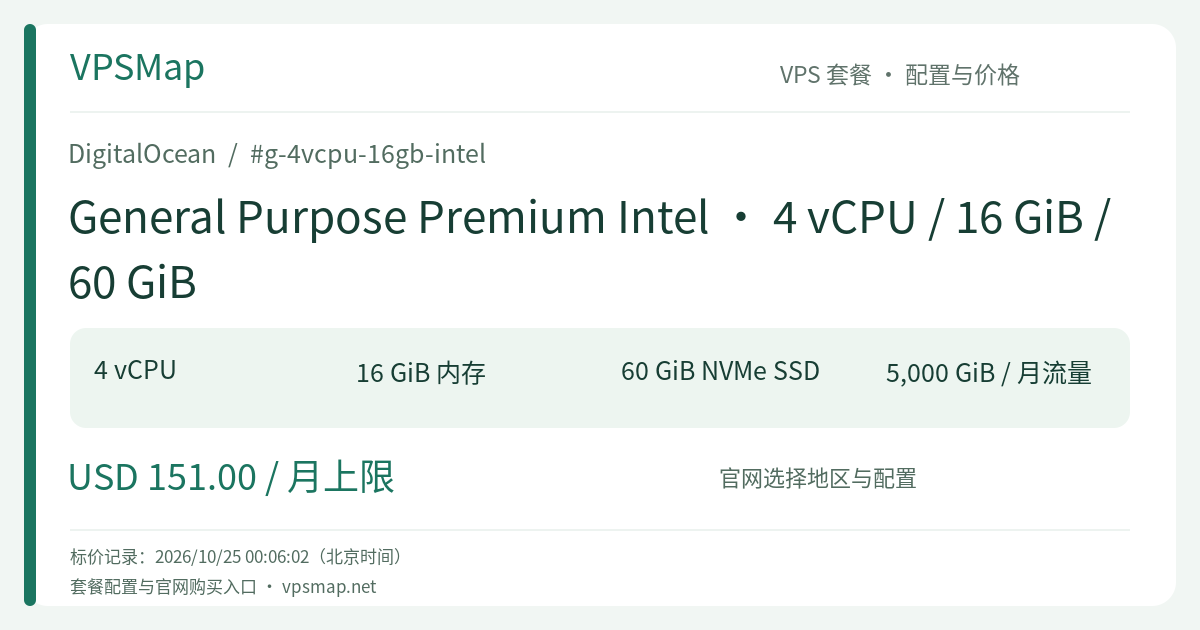
DigitalOcean 4 vCPU 16 GiB Premium Intel Droplet: Dedicated Backbone for High-Concurrency Production
Updated
The Gateway to Scaled Production: Why 4 vCPU / 16 GiB Matters#
As your application transitions beyond the early growth phase into high-volume production, infrastructure demands fundamentally shift. Systems no longer face sporadic bursts; they encounter sustained concurrent HTTP traffic, complex multi-threaded workloads, and relentless background queues. On a 2 vCPU machine, a single heavy reporting query or data aggregation task can spike CPU usage to 100%, causing the primary request pipeline to queue and latency to degrade.
DigitalOcean General Purpose Premium Intel (Slug: g-4vcpu-16gb-intel) represents the proven production standard for growing engineering teams. Featuring 4 dedicated 3rd Gen Intel Xeon Scalable cores and 16 GiB of enterprise-grade RAM, it doubles both compute power and memory capacity, comfortably absorbing concurrent thread contention and delivering rock-solid operational stability.
Architecture and Hardware Advantages#
1. 4 Dedicated Intel Xeon Cores: Seamless Concurrency#
As a dedicated CPU Droplet, the 4 vCPUs correspond to 4 reserved physical hyper-threads on 3rd Gen Intel Xeon Scalable processors (Ice Lake). Your workloads never contend with other tenants on the host:
- Effortless Process Scaling: Run 4 to 8 active application workers (e.g., Node.js cluster processes, Python Gunicorn/Celery workers, Ruby Puma threads, Go routines) simultaneously.
- Separation of Concerns: Dedicate 2-3 cores entirely to mission-critical API routing with tight P99 latency SLAs, while remaining cores process background queues and scheduled cron jobs without starvation.
2. 16 GiB Enterprise RAM: Broad Operational Headroom#
Modern enterprise frameworks (such as Java Spring Boot, .NET Core, large-scale Redis instances, or analytical tools) require generous memory footprints. 16 GiB of memory provides abundant breathing room:
- Eliminates unpredictable Linux kernel Out-Of-Memory (OOM) kills.
- Leaves ample room for the Linux OS page cache, dramatically reducing physical disk read operations and caching hot working sets in memory.
3. 10 Gbps Backbone Networking & 5,000 GiB Transfer Pool#
This configuration includes up to 10 Gbps of network throughput capacity—5x the speed of standard 2 Gbps instances. Backed by 5,000 GiB (5 TB) of complimentary outbound transfer (and 100% free inbound traffic), data transfer bandwidth is pooled at the team account level. This provides high-throughput pipelines for API gateways, microservice communication, and outbound media delivery.
4. 60 GiB High-Speed NVMe Storage#
Equipped with a 60 GiB hypervisor-attached NVMe SSD boot disk, the drive delivers rapid read/write speeds over PCIe channels. It ensures instantaneous server reboots, rapid Docker image pulling, and swift application deployment cycles.
Best-Fit Workloads & Architecture Patterns#
- High-Concurrency API Gateways & Microservices: Serving as the primary computational backbone behind load balancers, serving millions of daily requests with low latency.
- Enterprise Java / .NET / Go Applications: Running complex enterprise backends that require dedicated CPU execution guarantees and sizable memory heaps.
- DigitalOcean Kubernetes (DOKS) Worker Nodes: Acting as heavy-duty worker nodes inside container clusters, capable of hosting dozens of microservice pods smoothly.
- Middleware & Message Brokering: Running robust message queues (RabbitMQ, Kafka) or high-throughput in-memory caches (Redis cluster nodes).
Storage Strategy and Architecture Guidelines#
The 60 GiB local NVMe drive provides plenty of space for the operating system, container runtimes, and local scratch caches. For persistent storage, decoupled cloud architecture is highly recommended:
- Decoupled Relational Databases: Pair this compute node with DigitalOcean Managed Databases (PostgreSQL or MySQL) to hand off replication, maintenance, and automated failover.
- Elastic Block Storage: Attach DigitalOcean Volumes whenever your workloads need elastic, resizable network-attached block storage.
- Direct Large NVMe Alternatives: If your architecture demands large-scale local storage on the host itself for maximum I/O performance, consider the 120 GiB (
gd-4vcpu-16gb-intel) or 330 GiB (g5_5-4vcpu-16gb-intel) variants within the same family.
Billing Mechanics & Cost Predictability#
- Per-Second Billing with a 672-Hour Monthly Cap: Droplets are billed per second and capped at 672 hours (28 days) per calendar month. Continuous 24/7 workloads never pay beyond 672 hours, while ephemeral batch jobs are billed purely for the seconds they run.
- Billing While Powered Off: Keep in mind that powered-off Droplets remain billed because your dedicated hyper-threads, RAM, and 60 GiB NVMe space remain reserved on the physical host. When decommissioning a project, destroy the Droplet to cease charges.
- 5,000 GiB Team Bandwidth Pooling: Outbound bandwidth accrues second-by-second into your team’s unified pool. Low-traffic droplets subsidize active nodes, with any excess billed at an economical $0.01 per GiB.
- Backup and Disaster Recovery: Protect your investment by enabling automated weekly backups (20% fee) or daily backups (30% fee), or integrate SnapShooter for unified snapshot policies.
Summary#
The g-4vcpu-16gb-intel Droplet hits the gold standard for dedicated enterprise compute. With 4 dedicated Intel Xeon cores and 16 GiB of memory, it eliminates noisy neighbor risks and equips your team to scale high-concurrency production applications with total confidence.
Availability Note: Real-time server capacity varies across data center regions. Confirm live availability directly inside the DigitalOcean control panel during deployment.