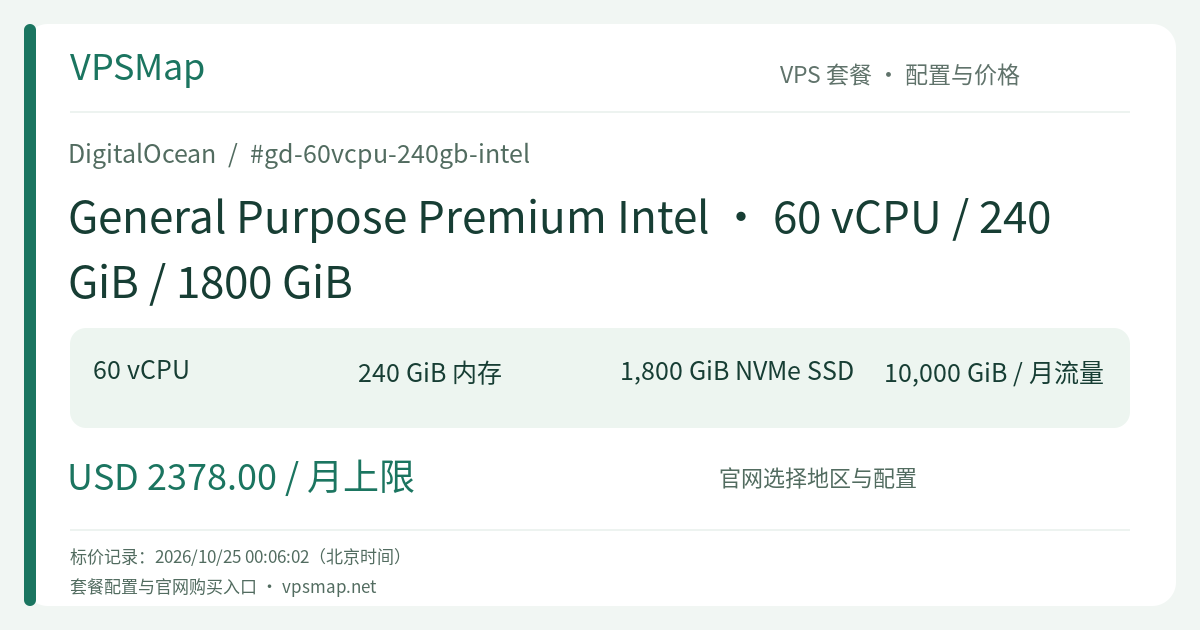
DigitalOcean 60 vCPU / 240 GiB General Purpose Premium Intel (1,800 GiB NVMe): Expanded Storage Performance Guide
Updated
Architecture Overview: Doubling Local NVMe Storage for Negligible Marginal Cost#
High-throughput production architectures often confront a challenging infrastructure dilemma: the workload genuinely requires 60 dedicated cores and 240 GiB of RAM to satisfy concurrency demands, yet a standard 900 GiB disk proves too restrictive for self-hosted database engines, extensive search indices, or intense CI/CD build caches. Turning to network-attached block storage solves the capacity problem, but introduces network latency, volume management overhead, and separate billing lines.
DigitalOcean's gd-60vcpu-240gb-intel specifically targets this scenario. It preserves the exact foundational advantages of the General Purpose Premium Intel series—60 dedicated 3rd Generation Intel Xeon Scalable vCPUs, 240 GiB of physical RAM, and 10 Gbps network capacity—while doubling the direct-attached NVMe local storage to 1,800 GiB (approx. 1.8 TB).
From an economic standpoint, upgrading from the 900 GiB baseline (g-60vcpu-240gb-intel) to this 1,800 GiB edition increases monthly costs by roughly $109 (from ~$2,269 to ~$2,378). In exchange for a price variance under 5%, your infrastructure gains an additional 900 GiB of local hypervisor-attached NVMe storage. This eliminates the operational friction of provisioning network volumes, configuring persistence mount scripts, and managing latency variations over storage networks.
Targeted Workloads: Capitalizing on 1.8 TB of Local NVMe#
1. High-Transaction Self-Hosted Relational Databases (PostgreSQL / MySQL)#
Mission-critical transaction backends, high-traffic SaaS backbones, and gaming core databases demand elevated Transactions Per Second (TPS) paired with rigorous write-latency predictability. Direct-attached NVMe harnesses deep hardware queuing and parallelism, giving Write-Ahead Logging (WAL), InnoDB Redo Logs, and complex temporary tables substantially lower latency compared to network-attached alternatives. 1,800 GiB of local disk provides comfortable runway to scale production data safely on a single node before sharding becomes necessary.
2. Dedicated Log Search & Analytics Nodes (Elasticsearch / OpenSearch)#
Search and analytics engines heavily utilize both compute and disk resources. Generating inverted indices consumes massive core capacity; aggregations and heap requirements demand generous memory; and storing weeks of active logs requires extensive, high-speed storage. A unified node offering 60 cores, 240 GiB of memory, and 1.8 TB of direct NVMe acts as a high-density analytics workhorse, processing heavy ingestion pipelines without cluster management fragmentation.
3. High-Throughput CI/CD Runners & Compilation Pipelines#
Large monorepos, multi-architecture container builders, and native compilation pipelines (such as modern C++, Rust toolchains, and mobile OS builds) place immense stress on disk I/O. Constant image pulls, package caching, and intermediate artifact generation quickly exhaust small disks. With 1,800 GiB of rapid NVMe workspace, multiple parallel build workers run concurrently with zero disk contention, drastically shortening deployment lead times.
Operational Safeguards & Billing Nuances#
1. Local Storage Data Protection#
Because NVMe storage is physically attached to the hypervisor, system operators must follow standard best practices for disaster recovery:
- Automated Incremental Backups: Enabling automated Droplet backups adds native disaster protection. Weekly backups (4-week retention) cost 20% of the Droplet baseline; daily backups (7-day retention) cost 30%. Because DigitalOcean uses block-level incremental technology after the initial baseline backup, runtime impact is minimal.
- Manual Snapshots & Offloading: Administrators can take manual point-in-time snapshots for indefinite retention, or write automated cron jobs to stream database dumps and cold artifacts over the private VPC network into Spaces object storage.
2. Network Pipe & Bandwidth Pooling#
This plan features 10,000 GiB of outbound bandwidth, pooled cumulatively across your team. With Premium Intel's 10 Gbps network ceiling, operations like streaming replication to secondary standby instances, offloading snapshots, or handling spikes in API requests complete without network throttling. Inbound traffic is free, and traffic routed over the private VPC interface does not consume bandwidth pool allowances.
3. Billing Boundaries#
The plan adheres to DigitalOcean's 672-hour monthly billing cap (with an hourly rate of approximately $3.53869). Because the 1.8 TB NVMe drive, dedicated Xeon cores, and 240 GiB of RAM remain strictly reserved on the physical hypervisor, stopping or powering off the Droplet does not pause billing. Temporary evaluations or load-testing instances must be completely destroyed when finished to halt charges.
Decision Matrix: 900 GiB vs. 1,800 GiB#
| Evaluation Metric | g-60vcpu-240gb-intel (900 GiB) | gd-60vcpu-240gb-intel (1,800 GiB) |
|---|---|---|
| Monthly Budget | ~$2,269 / month | ~$2,378 / month |
| Incremental Cost | Standard baseline | ~$109 for +900 GiB NVMe SSD |
| Optimal Workload | Pure computation, ephemeral microservices | Persistent databases, search clusters, builds |
| Storage Architecture | Requires Volumes for large datasets | Self-contained on single ultra-fast local disk |
[!TIP] Selection Advice: If your projected data footprint will approach 600–700 GiB within the next few months, starting with
gd-60vcpu-240gb-intelis the pragmatic choice. For a cost increase under 5%, doubling your local NVMe storage prevents the operational headaches of future disk resizing or volume migration.