DigitalOcean m-2vcpu-16gb In-Depth Review: Maximizing Database and Cache ROI with an 8:1 Memory-to-Core Ratio
Updated
The Problem with Running Databases on Balanced Compute Plans#
Engineering teams frequently hit a predictable hurdle as their data tier matures: the active working set exceeds 8 GiB, memory saturation alerts trigger continuously, and background database routines risk unceremonious termination by the Linux OOM Killer.
On conventional general-purpose cloud instances, stepping up to 16 GiB of RAM usually forces you to purchase 4 dedicated vCPUs. For workloads with modest CPU requirements—such as relational databases dominated by index lookups, session-management stores, or Redis caches—those 4 vCPUs often sit at 15% to 20% average utilization. You end up paying a continuous premium for compute cores your architecture does not actually consume.
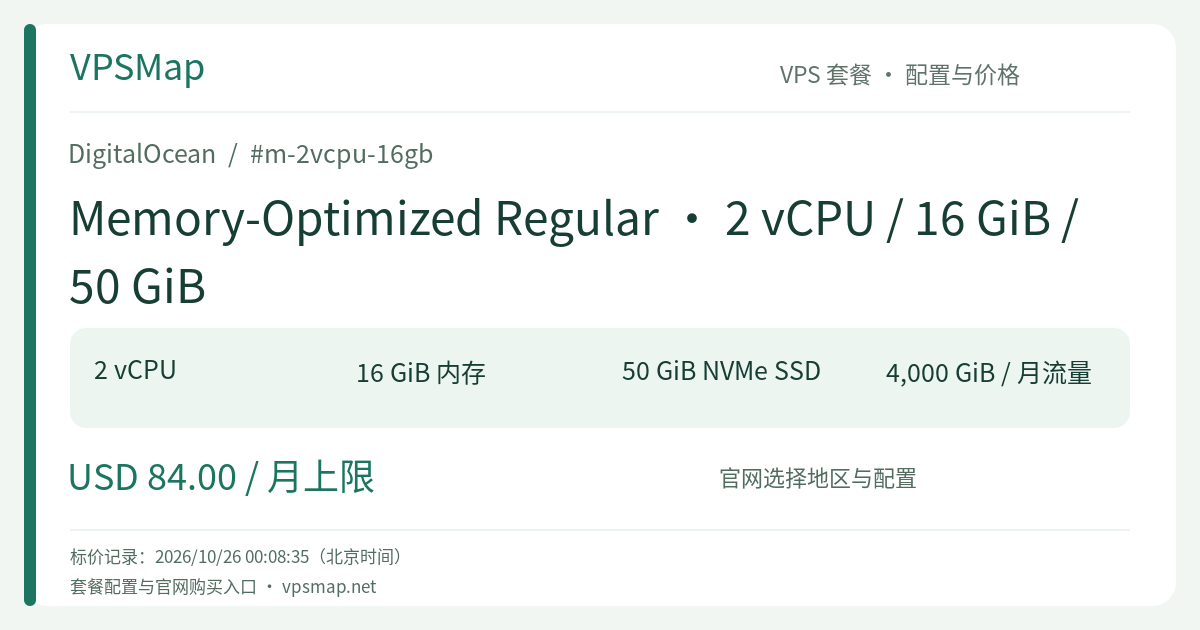
The DigitalOcean Memory-Optimized Regular · 2 vCPU / 16 GiB / 50 GiB plan (m-2vcpu-16gb) directly addresses this imbalance by providing a high-capacity RAM footprint coupled with lean, dedicated execution cores.
Architectural Advantages#
1. Dedicated vCPU Isolation Against Noisy Neighbors#
Unlike shared-CPU Droplets where thread scheduling is subject to dynamic hypervisor multiplexing, Memory-Optimized instances allocate dedicated hyper-threads on enterprise-grade Intel Xeon Scalable or AMD EPYC hosts. In transactional systems, consistent CPU execution is vital to prevent erratic P99 query spikes and lock contention. With 2 isolated hardware threads, query processing remains steady and predictable under heavy connection loads.
2. The 8:1 RAM Ratio for Memory-Resident Working Sets#
Providing 8 GiB of dedicated system memory per vCPU allows you to structure high-performance services without overpaying for compute:
- PostgreSQL / MySQL: Dedicate 10–12 GiB directly to
shared_buffersor the InnoDB Buffer Pool. This ensures that indexes and hot relational tables remain entirely resident in memory, eliminating repetitive disk read overhead. - In-Memory Caches (Redis / Valkey): Safely accommodate high-throughput caching tiers with millions of keys while retaining sufficient OS buffer margin to perform non-blocking fork operations during AOF rewrites or RDB snapshots.
- JVM Business Applications: Allocate healthy 8–10 GiB heaps with abundant overhead for native memory, container daemons, and OS page cache, effectively mitigating garbage collection pauses.
3. Low-Latency Local NVMe Storage#
Equipped with 50 GiB of local NVMe storage, m-2vcpu-16gb delivers direct bus-attached throughput. Because the disk bypasses network storage virtualization layers, sequential writes such as database Write-Ahead Logs (WAL) and binary logs achieve exceptionally rapid fsync completion times.
Ideal Workload Fits#
- Dedicated Primary or Replica Relational DBs: Power medium-scale web and mobile application databases requiring deep caching for multi-table JOIN operations.
- Central Application Caching: Host standalone Redis or KeyDB deployments serving microservice architectures that require zero lock contention and strict low-latency round-trips.
- Memory-Heavy Microservices: Ideal for modern container hosts executing Java, Scala, or Node.js services with noticeable memory overhead but predictable baseline CPU demands.
Sizing Trade-Offs to Keep in Mind#
- Local Disk Footprint: The 50 GiB boot disk leaves roughly 35–40 GiB for application data after OS overhead. If your relational tables or log archives exceed this capacity, pair the node with DigitalOcean Block Storage Volumes or evaluate the
m3-2vcpu-16gbvariant, which triples local NVMe capacity to 150 GiB. - Compute Limitations: Workloads that demand intensive parallel calculations, such as video rendering or machine learning inference, will run into bottlenecks on 2 vCPUs and are better suited for CPU-Optimized Droplet families.
Networking and Fleet Efficiency#
The Droplet includes a 2 Gbps network interface and 4,000 GiB of monthly outbound data transfer, with all inbound traffic free of charge. Bandwidth is pooled across your entire team account, meaning that low-traffic worker nodes automatically buffer bandwidth spikes from your database node, minimizing operational surprises.
To provision this configuration with dedicated compute guarantees, you can deploy this instance on DigitalOcean.