DigitalOcean 1 vCPU / 2 GiB Premium AMD Guide: The Sweet Spot for Standalone Web Stacks
Updated
Why 2 GiB of Memory Is the Critical Dividing Line#
For solo developers, technical founders, and webmasters, a 1 GiB cloud server often proves just narrow enough to cause production anxiety. Running a package install, compiling assets, or serving an unoptimized database query can rapidly exhaust available RAM, triggering Linux Out-Of-Memory (OOM) errors that abruptly take critical services offline.
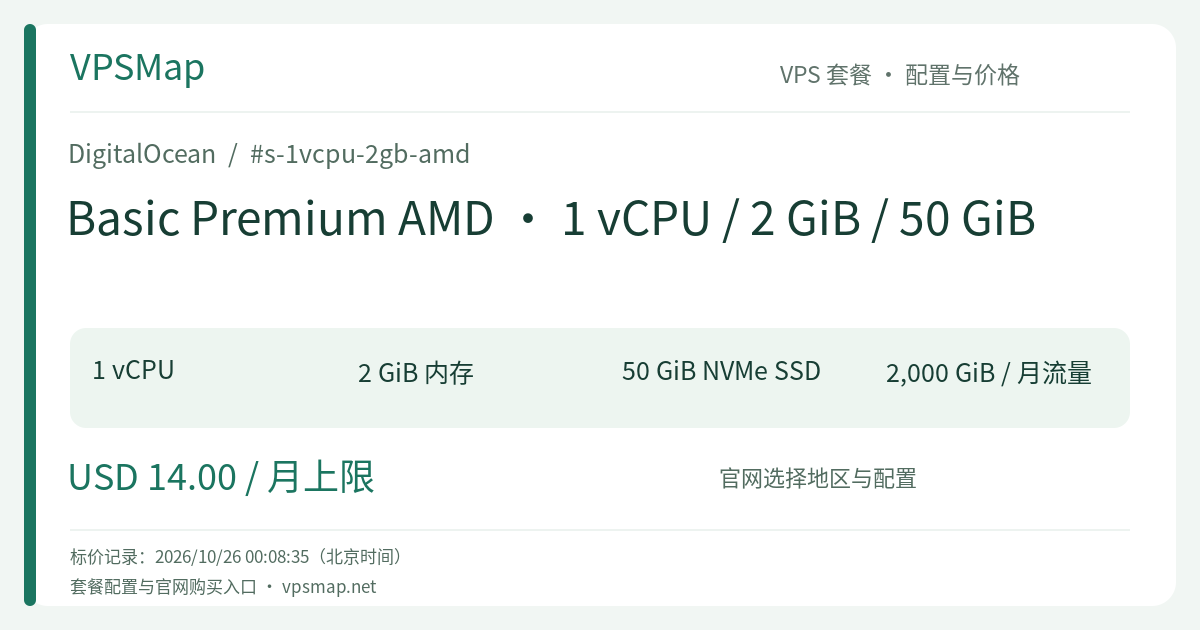
DigitalOcean's Basic Premium AMD 1 vCPU / 2 GiB Droplet (slug s-1vcpu-2gb-amd) directly resolves this friction. Built on a shared high-frequency AMD EPYC core, it doubles physical memory to 2 GiB (3,200 MHz) and expands NVMe storage to 50 GiB. That additional gigabyte of memory gives Linux Page Cache and database buffer pools the necessary breathing room to handle daily production demands reliably.
What Problems Does It Solve? Primary Scenarios#
1. Standalone Production CMS Stacks (WordPress, Ghost, Strapi)#
This is an optimal sweet-spot deployment for business landing pages, content portals, and personal publications. 2 GiB of RAM allows Nginx/Caddy, PHP-FPM or Node.js runtimes, and local MySQL/MariaDB to coexist stably on a single node. Adding a lightweight Redis object cache further cuts database load and delivers rapid Time To First Byte (TTFB).
2. Full-Stack Web MVPs and Solo Developer SaaS#
Applications built on frameworks like Laravel, Django, Rails, or Next.js—paired with SQLite or a localized PostgreSQL database—run smoothly without fighting memory starvation. The 50 GiB NVMe disk provides adequate headroom for user uploads, temporary media staging, and regular backup archives.
3. Self-Hosted Privacy and Productivity Hubs#
Deploy essential internal business services such as Vaultwarden password managers, PocketBase backend instances, or lightweight analytics engines (Plausible, Umami). These utilities maintain a low operational footprint, remaining reliably active on a 2 GiB memory budget.
Architectural Synergy: AMD EPYC and NVMe Storage#
- 3,200 MHz RAM Acceleration: Memory frequency directly affects cache lookup speed. Whether fetching keys from Redis or traversing indices in MySQL's InnoDB Buffer Pool, the high-clock memory minimizes computational latency.
- NVMe Parallel I/O Throughput: Traditional SSDs can bottleneck under simultaneous read/write cycles. The parallel architecture of NVMe drives ensures that background logging, automated snapshotting, and database writes do not stall frontend request handling.
- Core Boundary Awareness: Because this tier allocates a single shared vCPU, long-running CPU-bound workloads (such as simultaneous image conversions or bulk data exports) will queue up sequentially. When monitoring indicates persistent CPU saturation above 80%, a frictionless upgrade to a 2 vCPU plan is recommended.
Predictable Cost & Network Bandwidth#
- Clear Second-by-Second Billing: Billed per second at approximately $0.02083/hour, capped at 672 hours ($14/month). Spin up, test, or run continuously with complete cost transparency. Remember that powering off retains hypervisor allocation and continues billing, while destroying halts billing immediately.
- 2,000 GiB Pooled Bandwidth: The included 2,000 GiB outbound quota accrues continuously into your team's cumulative bandwidth pool. Inbound transfer is free, and private VPC networking carries zero transfer charges.
- Reliable Automated Backups: Enable system-level incremental backups (20% of Droplet cost for weekly retention, or 30% for daily retention) to safeguard databases and customer files against data loss.
Verdict & Getting Started#
If you need a cost-effective cloud server that runs your web server, database, and background processes without the persistent worry of running out of RAM, DigitalOcean's s-1vcpu-2gb-amd Droplet is a dependable workhorse.
Visit the DigitalOcean Console to confirm regional capacity and deploy your instance.