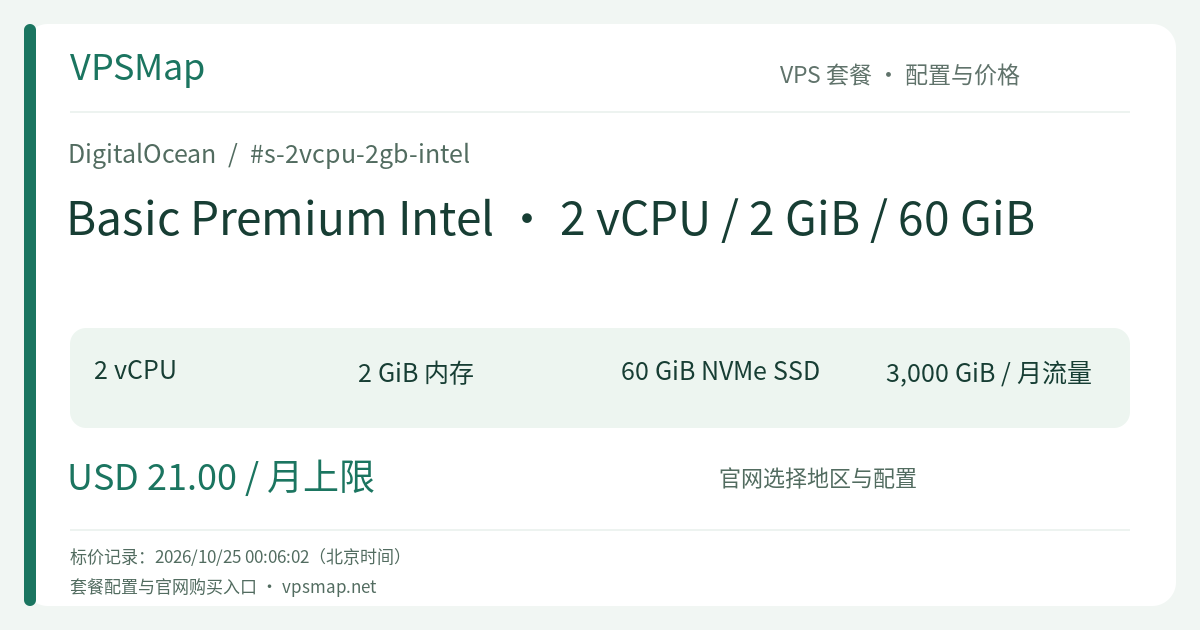
DigitalOcean Basic Premium Intel 2 vCPU / 2 GiB: Unlocking Dual-Core Concurrency for Lightweight Apps
Updated
Running on a single virtual CPU frequently leads to subtle performance degradation: even if your average CPU usage looks low, a burst of TLS handshakes, an intensive JSON parsing loop in Node.js, or an hourly cron job can temporarily lock the single core and freeze incoming web requests. The DigitalOcean Basic Premium Intel (2 vCPU / 2 GiB / 60 GiB NVMe) plan exists to resolve this exact bottleneck by bringing genuine dual-core execution to cost-conscious architectures.
The Operational Impact of Two vCPUs#
Adding a second hyper-thread fundamentally shifts how the Linux scheduler distributes system tasks:
- Process Decoupling: One core can dedicate cycles to your web server (Nginx or Caddy) and reverse proxy routing, while the second core absorbs database queries, background workers, or system telemetry without stalling user connections.
- Concurrency Optimization: Frameworks supporting cluster or multi-worker architectures (such as Node.js Cluster mode or Python Gunicorn/Uvicorn) can run two parallel worker threads, doubling raw HTTP request concurrency.
- Modern Hardware Acceleration: Powered by 2nd or 3rd Generation Intel Xeon Scalable CPUs, 2,933 MHz RAM, and 60 GiB of PCIe NVMe storage, command-line operations, software updates, and asset packaging run with noticeable velocity.
Best-Suited Workloads#
- High-Concurrency API Endpoints: Services written in Go, Rust, or optimized Node.js that have minimal RAM footprints but process dense streams of concurrent requests.
- Edge Routers & SSL Terminators: Edge nodes managing SSL certificates, rate-limiting rules, authentication checks, and routing traffic to internal backend networks over private VPCs.
- Event Consumers & Webhook Ingestors: Asynchronous processors receiving real-time payloads from external SaaS platforms, verifying signatures, and persisting entries without latency spikes.
- Self-Hosted CI/CD Runners: Dedicated nodes for GitHub Actions or GitLab CI runners handling automated testing and container linting.
Bandwidth Pooling & Economic Benefits#
This configuration includes a substantial 3,000 GiB of monthly outbound transfer allowance. Under DigitalOcean's pooled billing model, outbound transfer aggregates across all Droplets on your team. If this machine uses only a fraction of its allocation, the remaining quota safeguards other high-traffic droplets from exceeding bandwidth limits (with any overages billed at a predictable $0.01 per GiB). Inbound traffic is always zero-cost.
Because memory is calibrated at 2 GiB, this configuration favors compute throughput over expansive in-memory caching. For JVM-based stacks or heavy database engines, stepping up to the 4 GiB tier is prudent. But for fast, concurrent microservices, this 2-core option represents peak efficiency. Review live datacenter availability in the DigitalOcean Console to deploy.