DigitalOcean 8 vCPU / 16 GiB Premium AMD Droplet: High-Parallelism Engine for CI/CD and Microservices
Updated
The Transformative Power of Multi-Core Parallelism#
In modern web engineering and data processing, system bottlenecks are rarely caused by raw clock speed alone; they are frequently bound by the number of concurrent processing channels. When hundreds of incoming connections or parallel compile jobs hit a two-core virtual machine, the kernel spends an exorbitant amount of time on CPU context switching rather than executing actual instructions.
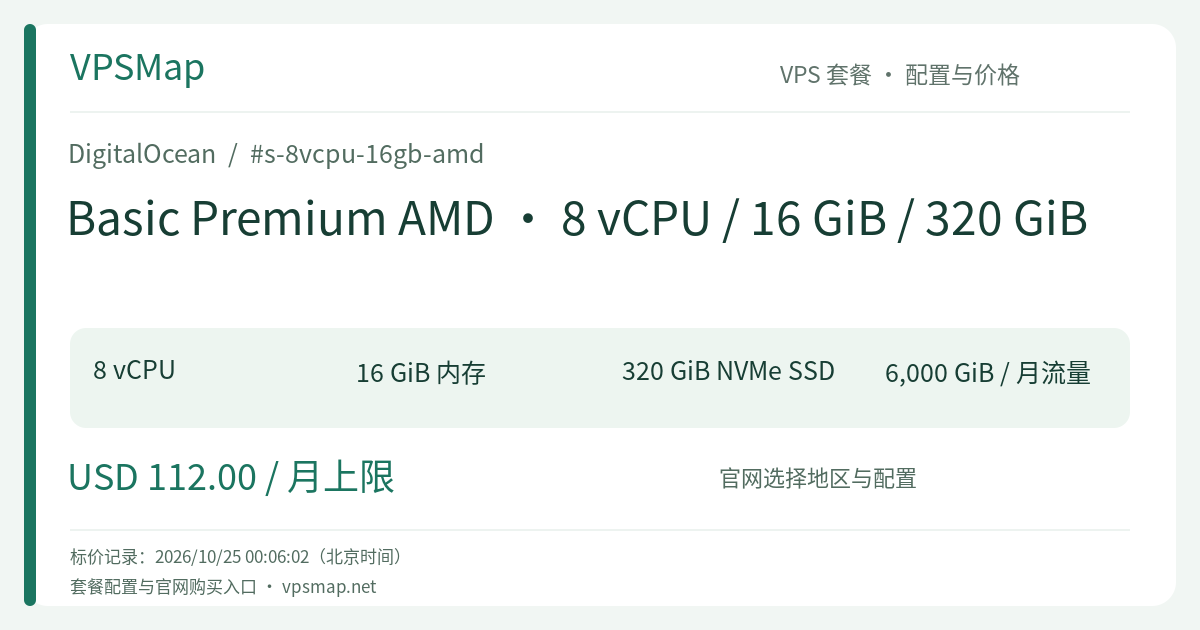
The DigitalOcean Basic Premium AMD · 8 vCPU / 16 GiB / 320 GiB instance (s-8vcpu-16gb-amd) is engineered specifically for high-parallelism workloads. Delivering 8 AMD EPYC virtual cores alongside 16 GiB of 3200 MHz RAM and a 320 GiB local NVMe SSD, it unlocks massive multi-threaded processing power without enterprise hardware overhead.
Architectural Strengths: Parallel Compute Meets High-Speed I/O#
- 8 AMD EPYC Virtual Cores: Ideal for workloads that scale across processes or threads—such as Go routines, Node.js cluster processes, Python Celery queues, or parallel build steps. Tasks that used to serialize on smaller VMs now execute concurrently.
- 320 GiB Local NVMe Boot Storage: High core counts generate substantial I/O traffic. Backed by PCIe NVMe storage directly on the hypervisor, this instance provides lightning-fast read/write operations for building large Docker containers, handling database write-ahead logs, and caching heavy build dependencies.
- 6,000 GiB Pooled Transfer Allowance: Outbound bandwidth is pooled at the team level across all your active Droplets, while inbound bandwidth is always free. This makes the node an excellent choice for distributed data ingestion and API coordination.
Workloads That Excel on 8 Cores#
1. Dedicated CI/CD Runners (GitHub Actions & GitLab CI)#
Continuous integration pipelines can become massive developer bottlenecks. TypeScript type-checks, Rust/C++ compilation, and simultaneous unit test suites all benefit exponentially from multi-core parallelization:
- Execute
make -j8or parallel test runners to slash pipeline execution times by up to 70%. - The 320 GiB NVMe drive stores extensive Docker layer caches and dependencies locally, removing the need for aggressive cache-purging cycles.
2. Microservice Ingress & API Aggregation Layers#
Deploying API gateways (Kong, Traefik, Envoy) or proxy layers that terminate SSL, inspect headers, handle rate limiting, and route requests to downstream microservices requires significant multi-threaded horsepower. Eight EPYC cores process tens of thousands of requests per second effortlessly.
3. Media Processing & Batch Transformation Pipelines#
For SaaS applications generating on-the-fly PDF reports, compressing user-uploaded media via FFmpeg or ImageMagick, or running asynchronous background ETL scripts, 8 cores allow multiple heavy workers to run in parallel without choking incoming API traffic.
Understanding the Shared CPU Model#
- Burst Capacity & Efficiency: As part of the Basic Droplet family, this instance utilizes shared CPU hyper-threads. Because build runners, API gateways, and web servers typically experience bursty traffic followed by idle periods, the shared model delivers remarkable cost efficiency.
- When to Consider Dedicated Options: If your application is designed to pin all 8 cores at continuous 100% load 24 hours a day (e.g., perpetual crypto hashing or uninterrupted 4K video encoding), you may experience hypervisor cycle balancing over time. For non-stop, continuous-load compute, evaluate DigitalOcean's CPU-Optimized dedicated instances instead.
Flexible Operations and Billing Mechanics#
- Per-Second Billing Flexibility: If you only need this heavy compute instance for weekly batch runs or seasonal releases, you can automate its creation via the DigitalOcean API or CLI (
doctl), run your workload for a few hours, snapshot the disk, and destroy the server—paying only for the seconds used. - Automated Incremental Backups: Protect configurations and project states by opting into automated backups at 20% (weekly) or 30% (daily) of the base Droplet cost.
Operational Note: Machine availability across worldwide datacenters is determined dynamically inside the cloud console. Select the region that places your services closest to your end users or central database.