DigitalOcean 8 vCPU / 16 GiB Basic Regular Guide: High Multi-Core Concurrency with Generous Local Storage
Updated
Why Choose Basic Regular for an 8 vCPU / 16 GiB Deployment?#
When applications demand 8 processor cores and 16 GiB of memory, many engineering teams instinctively jump to premium Dedicated Droplet plans. However, not every multi-threaded workload runs at constant 100% CPU utilization around the clock. Background job processors, asynchronous task queues, integration staging stacks, and build systems often exhibit bursty computational patterns: they sit idle or under moderate load for long intervals, then require an abundance of cores to chew through queued tasks simultaneously.
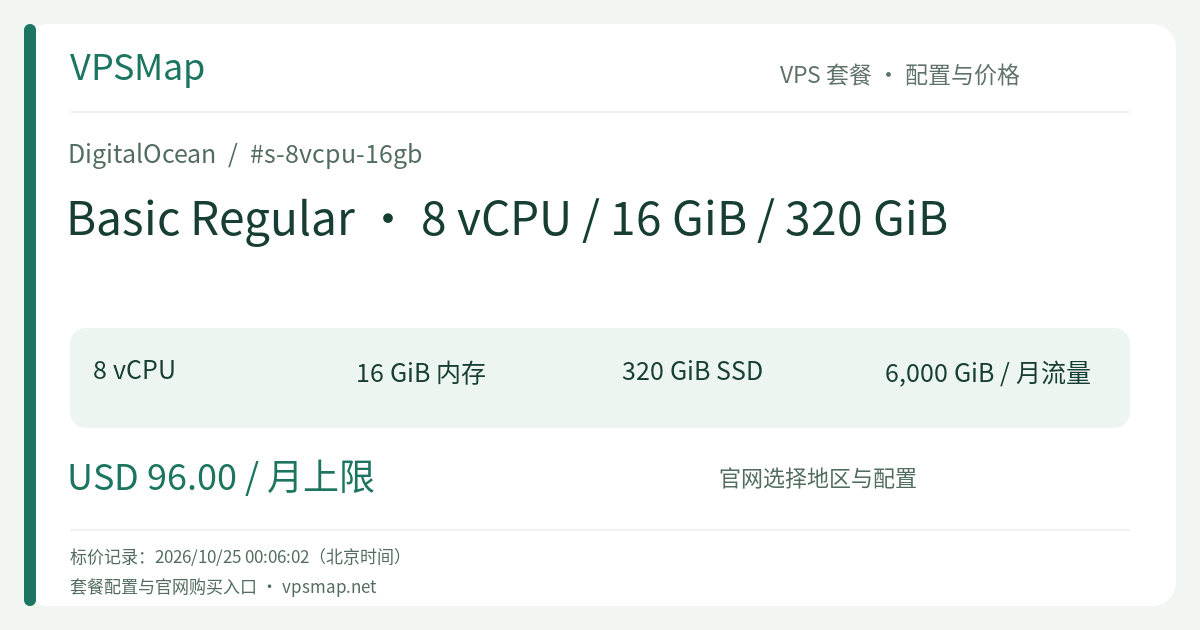
DigitalOcean's Basic Regular 8 vCPU / 16 GiB (size slug s-8vcpu-16gb) fills this exact strategic niche. It delivers 8 shared vCPUs, 16 GiB of memory, and a massive 320 GiB local SSD boot drive paired with 6,000 GiB of outbound transfer, allowing teams with bursty parallel workloads to avoid paying dedicated CPU premiums.
Practical Use Cases: What Real Problems Does It Solve?#
1. High-Throughput Asynchronous Task Queues#
If your architecture relies on task queues like Celery, BullMQ, Sidekiq, or RabbitMQ to handle batch reporting, image transformation, or data scraping pipelines, core count directly dictates throughput. 8 vCPUs allow you to run multiple worker threads in parallel to flatten job spikes rapidly, while 16 GiB of RAM easily accommodates concurrent task execution contexts.
2. Multi-Service Staging and Pre-Production Environments#
Replicating modern microservice topologies often requires multiple services to run side-by-side. Instead of managing a fleet of tiny VPS instances with fragmented resources, this Droplet lets you run complete Docker Compose stacks featuring API gateways, internal service containers, a staging database, and queuing middleware on a single host without encountering CPU lockups or OOM kills.
3. Storage-Dependent Data Processing and Local Artifact Caching#
The included 320 GiB local solid-state disk is a distinct operational advantage. Rather than provisioning and attaching additional network-based block storage volumes, the integrated local storage provides ample headroom for Docker build caches, dependency trees, artifact staging, and localized data ingest pipelines.
Architecture Characteristics & Necessary Trade-offs#
To make an informed architectural decision, it is essential to understand the underlying infrastructure:
- Shared CPU Hyper-threading: Resources are allocated across physical hyper-threads managed by hypervisors. When neighboring VMs are idle, your Droplet bursts to full performance; under host contention, allocated CPU time can vary. For latency-critical financial engines or uninterrupted 24/7 video rendering, Dedicated General Purpose or CPU-Optimized plans remain the ideal choice. For bursty and queue-based workloads, however, the shared model offers optimal economics.
- Regular vs. Premium Baseline: Regular plans use a blend of first-generation or older Intel Xeon Scalable and AMD EPYC processors paired with standard SSDs. If your software requires maximum single-thread clock speed or ultra-low latency NVMe I/O, evaluate the Premium AMD family. But if your bottleneck is aggregate thread count and local storage capacity at a low monthly cap, Regular delivers outstanding value.
Billing Flexibility and Bandwidth Economics#
- Per-Second Billing with Monthly Caps: Billed per second with a 60-second minimum charge, this Droplet caps billing at 672 hours (28 days) per month. For ephemeral batch jobs or scheduled test runs, you can create the machine, finish your pipeline, and immediately destroy it to pay only for the exact runtime. Keep in mind that a powered-off Droplet still reserves hypervisor resources and continues to accrue charges until explicitly destroyed.
- Cumulative Bandwidth Pooling: The generous 6,000 GiB outbound bandwidth allowance accrues continuously and pools across your entire DigitalOcean team. Inbound traffic is completely free, and intra-VPC communication over private networking does not count against your transfer allowance.
- Automated Incremental Backups: Protect your instance with optional native backups (20% of Droplet cost for weekly retention, or 30% for daily retention). After the initial full image, backups run incrementally to minimize performance overhead.
Conclusion & Getting Started#
DigitalOcean's s-8vcpu-16gb Droplet is a workhorse engineered for teams that need significant multi-thread capacity and spacious local disk without dedicated-tier pricing. It turns bursty, parallel tasks into manageable, cost-controlled workflows.
To review regional availability and deploy this configuration to your infrastructure, head over to the DigitalOcean Console.