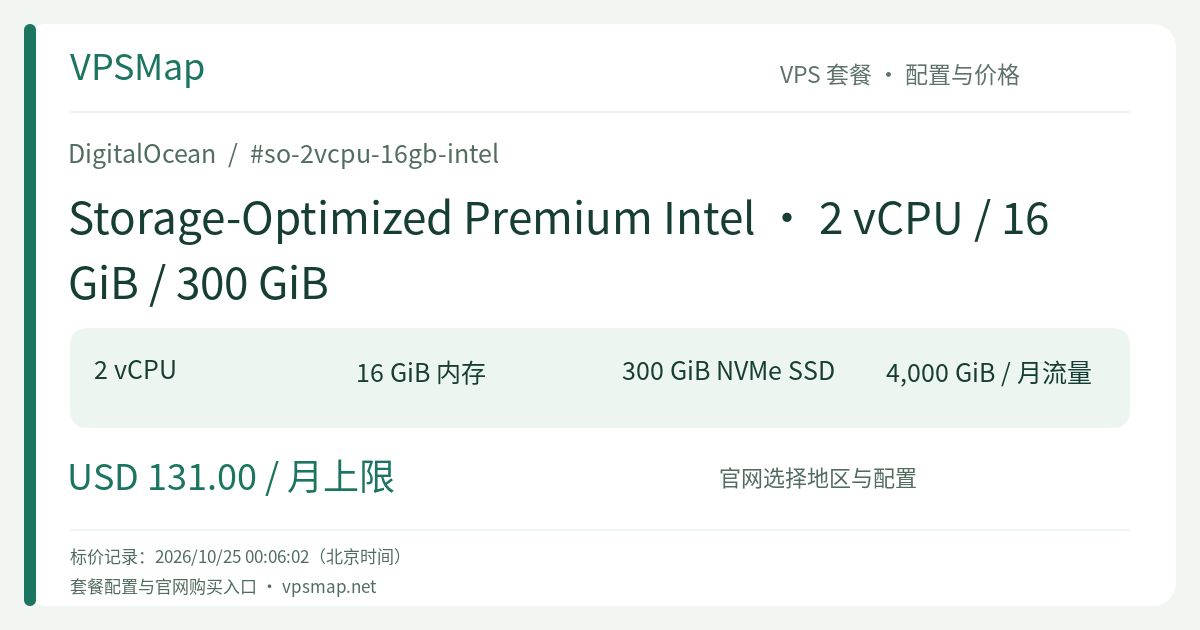
DigitalOcean Storage-Optimized 2 vCPU / 16 GiB / 300 GiB NVMe Review: The Low-Latency Database Sweet Spot
Updated
In cloud computing, the most common bottleneck for production systems is rarely raw CPU power—it is almost always disk I/O wait. While standard network-attached block volumes provide elastic attachment, traversing a network virtualization layer inevitably introduces microsecond-to-millisecond latency fluctuations during intense random I/O, commit flushes, or WAL updates.
The DigitalOcean Storage-Optimized Premium Intel Droplet (2 vCPU / 16 GiB / 300 GiB) is specifically designed to eliminate this exact pain point. By delivering direct-attached NVMe storage integrated straight into the hypervisor, combined with dedicated 3rd Gen Intel Xeon processing and an abundant 1:8 core-to-memory ratio, it forms a high-throughput bedrock for I/O-sensitive architectures.
Core Engineering Highlights#
- Direct Hypervisor-Attached NVMe Storage (300 GiB): Unlike network-routed virtual disks, direct-attached local NVMe communicates over PCIe lanes natively on the host machine. This unbridled parallel bus yields significantly higher IOPS, drastically lower access latencies, and predictable transaction write times.
- Optimized 1:8 vCPU-to-RAM Ratio: Allocating 16 GiB of dedicated memory to 2 vCPUs addresses data-heavy server configurations. Relational engines like MySQL InnoDB can reserve substantial Buffer Pool memory, while MongoDB WiredTiger maintains deep working sets in RAM, minimizing unnecessary disk roundtrips.
- 100% Dedicated Compute Cores: Powered by 3rd Gen Intel Xeon Scalable processors, every vCPU maps to a dedicated hyper-thread. You are completely immune to noisy-neighbor CPU throttling or unexpected clock throttling during critical execution windows.
- Up to 10 Gbps Public/Private Network: The Premium tier raises network throughput from standard 2 Gbps up to 10 Gbps—a crucial factor when synchronizing database replicas, handling cluster peer chatter, or piping data into object storage without choking interface bandwidth.
Best-Suited Workloads#
- Core Relational Databases (PostgreSQL / MySQL): Production transactional backends holding up to 150–200 GiB of data that demand sub-millisecond query returns and fast commit acknowledgments.
- NoSQL & Document Datastores: Workloads such as standalone MongoDB nodes, dedicated Elasticsearch ingestion nodes, and Redis deployments utilizing intense AOF persistence.
- Time-Series Ingestion Engines (Prometheus / TimescaleDB): Systems that continuously ingest thousands of metric series per second and require sustained local disk write capacity without backpressure.
- High-Throughput Streaming & Queuing: Kafka or RabbitMQ nodes logging batches directly to local disk while benefiting from the 10 Gbps networking pipeline.
Reliability Architecture & Trade-Offs#
Because storage is physically attached to the hypervisor, performance is maximized at the expense of automated disk migration. Should an underlying host fail, the disk cannot be instantly unmounted and reattached to a remote host as a network volume would. To build a robust production setup:
- Implement Application-Level Clustering: Run primary-replica pairings (e.g., streaming replication) across separate Droplets to ensure service continuity at the data layer.
- Automate Snapshot Backups: Leverage DigitalOcean Backups or SnapShooter to periodically dump point-in-time images into Spaces object storage.
- Team-Level Bandwidth Pooling: The included 4,000 GiB outbound bandwidth contributes directly to your team's cumulative bandwidth allowance, with completely free inbound traffic and zero transfer charges across private VPC interfaces.
For engineers seeking deterministic NVMe speed, zero noisy-neighbor degradation, and sufficient RAM to protect active working sets, this 2-core / 16 GiB Storage-Optimized Droplet is one of the cleanest, highest-value infrastructure picks on the market.