DigitalOcean Storage-Optimized 8 vCPU / 64 GiB / 1170 GiB NVMe Review: The Heavy-Duty Flagship for Enterprise Databases
Updated
In complex microservices and enterprise backends, the data tier invariably bears the brunt of real-world traffic: tens of thousands of concurrent API requests, constant transaction commits, intensive analytical aggregations, and log streaming operate around the clock. When active datasets exceed half a terabyte, any resource contention, page swapping, or network disk latency jitter can trigger cascading performance slowdowns across the platform.
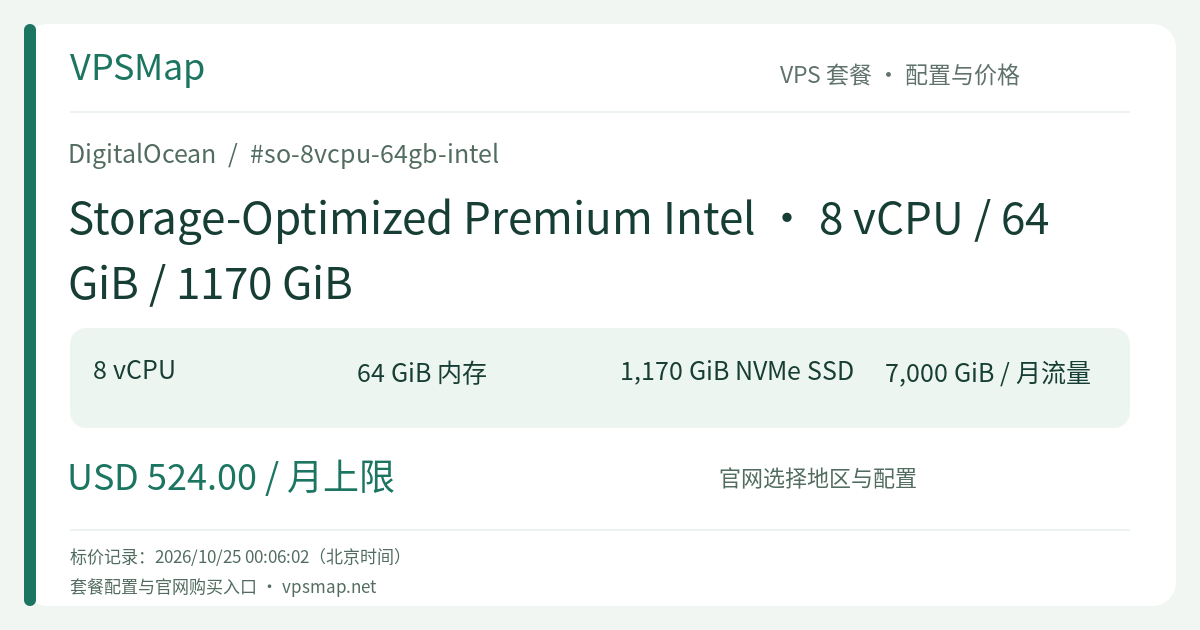
The DigitalOcean Storage-Optimized Premium Intel Droplet (8 vCPU / 64 GiB / 1170 GiB) is engineered precisely for these demanding enterprise environments. Unifying 8 dedicated 3rd Gen Intel Xeon compute cores, 64 GiB of RAM, and 1,170 GiB (~1.17 TB) of physical hypervisor-attached NVMe storage, it delivers immense single-node processing capability.
Engineering Highlights#
- 1,170 GiB Direct-Attached NVMe Flash: Over 1.1 TB of pure NVMe storage directly wired to host PCIe lanes eliminates virtual network block storage bottlenecks. It provides a massive IOPS headroom and locks disk access latency to the microsecond range, effortlessly absorbing sudden write storms.
- 64 GiB RAM Transforms In-Memory Performance: The 8:1 memory-to-core ratio allows deep indexing structures to reside entirely in memory. For JVM-heavy platforms like Elasticsearch, Cassandra, or Kafka, you can allocate adequate JVM heap while leaving over 30 GiB to the OS filesystem cache (Page Cache) for smooth read operations.
- 8 Dedicated Xeon vCPUs: Every single vCPU corresponds to a guaranteed hardware hyper-thread. Multi-table analytical queries, parallel batch jobs, and cryptographic operations run without interference from neighboring virtual machines.
- 10 Gbps Pipeline & 7,000 GiB Bandwidth Pool: Features up to 10 Gbps networking and contributes 7,000 GiB of outbound transfer to your team's collective bandwidth pool. Inter-node cluster rebalancing and remote backup synchronization never saturate the network interface.
Recommended Architecture Scenarios#
- Core Enterprise Relational Backends (PostgreSQL / MySQL): Primary production databases handling millions of active users and critical transaction records where single-digit millisecond latency is non-negotiable.
- Elasticsearch / OpenSearch Data Nodes: Hosting dense search indices and high-frequency cluster logging, where 64 GiB of memory and 1.17 TB of NVMe provide instant full-text search results.
- Enterprise Message Brokers (Apache Kafka / Pulsar): Core broker instances persisting tens of thousands of messages per second, leveraging sequential NVMe writes and the 10 Gbps pipe.
- Distributed NoSQL Clusters (Cassandra / ScyllaDB / MongoDB): Multi-node clusters storing up to 1 TB of active unstructured data per node with predictable high IOPS.
Reliability & Operational Governance#
- Build High Availability at the Cluster Layer: Direct-attached storage offers superior speed, but drives cannot be dynamically detached between hypervisors in an unexpected host outage. Design your architecture with application-layer redundancy (e.g., PostgreSQL streaming replicas, Kafka partition replicas, or Elasticsearch replica shards).
- Bandwidth Pooling Benefits: The 7,000 GiB outbound quota automatically pools across your team account, effectively subsidizing data distribution for lighter frontend Droplets.
- Predictable Billing with a 672-Hour Cap: Billed per second and capped at 672 hours per monthly billing cycle. Once the cap is reached, additional uptime within that month incurs zero incremental compute charges.
For enterprise systems requiring terabyte-scale local NVMe flash, 64 GiB of high-speed RAM, and 8 dedicated Intel Xeon cores on a single high-performance node, this Storage-Optimized Droplet delivers rock-solid reliability and performance.