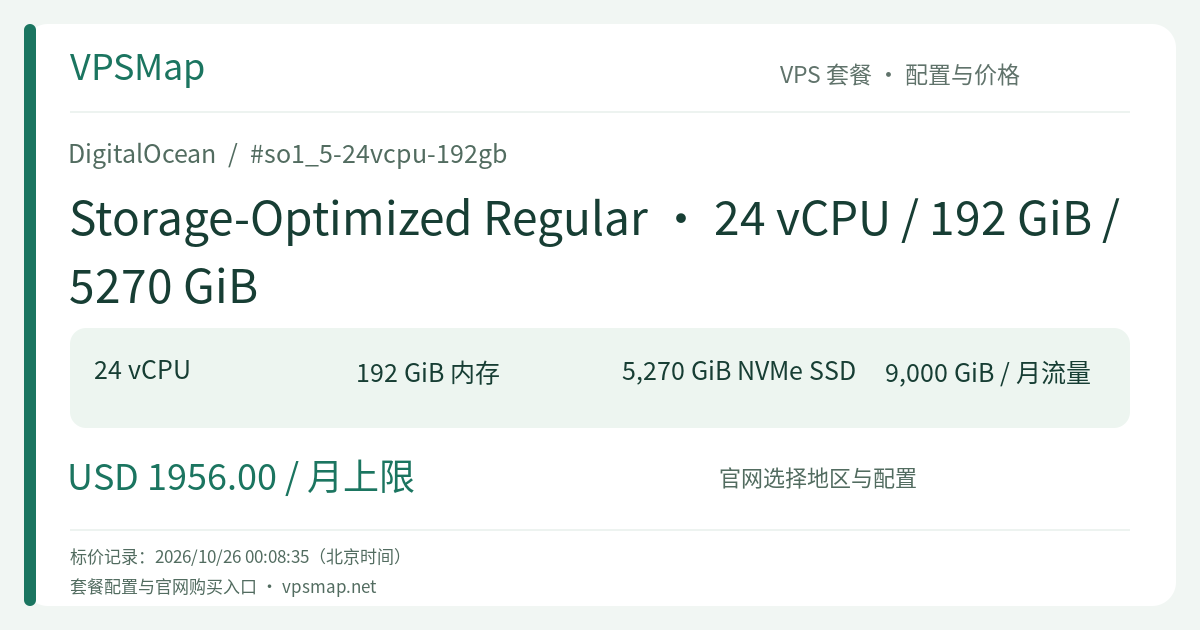
DigitalOcean Storage-Optimized 1.5X 24 vCPU / 192 GiB Guide: 5.27 TB Ultra-Dense Local NVMe for Heavy Hot-Tier Workloads
Updated
Pushing Storage Density Boundaries: The Tactical Edge of 5.27 TB Local Flash#
In modern data-intensive infrastructure, data volume frequently expands at a much faster rate than computational complexity:
Consider an APM tracing and security audit cluster that writes hundreds of gigabytes of telemetry every day, or a ClickHouse analytics node processing billions of clickstream events that must remain on hot NVMe to ensure sub-second query responses. In conventional cloud environments, securing more than 5 TB of ultra-fast flash storage usually leaves you with two unfavorable choices: overprovisioning into expensive 32-core or 64-core compute tiers, or attaching remote network block storage that throttles your I/O and inflates tail latencies.
DigitalOcean's 1.5X Storage-Optimized so1_5-24vcpu-192gb plan shatters this compromise. Retaining the robust 24 dedicated vCPU and 192 GiB RAM compute foundation, it expands direct-attached hypervisor NVMe SSD storage to 5270 GiB (~5.27 TB).
With an exceptional ratio of ~220 GiB NVMe per dedicated core, a single droplet can anchor massive hot working sets without remote storage bottlenecks.
Hardware Architecture and Technological Edge#
- Physical Advantage of 5.27 TB Direct NVMe Unlike cloud block storage volumes that pass through network virtualization layers, these 5270 GiB sit directly on the physical host bus. Sustained write operations, heavy background merges (such as ClickHouse MergeTree parts), and high-frequency writes proceed with zero network congestion and sub-millisecond latencies.
- 24 Dedicated Enterprise Cores Exclusive access to 24 dedicated hyper-threads delivers sustained compute power for multi-threaded analytical queries, JSON parsing, and heavy background compression without noisy neighbor interference.
- 192 GiB Multi-Tier Memory Defense Even across a 5.27 TB data footprint, 192 GiB of memory provides a powerful buffer. Linux Page Cache keeps active table indices and frequent query partitions memory-resident, shielding physical flash from unnecessary random read cycles.
Recommended Production Scenarios#
- Columnar Analytics & Time-Series Hubs (ClickHouse / StarRocks) ClickHouse thrives on vectorized multi-core execution but demands high disk throughput during batch inserts and partition compactions. With 5.27 TB of direct NVMe, a single node can retain months of granular, un-aggregated raw events while serving real-time analytics.
- Enterprise Logging & SIEM Hot Tiers (Elasticsearch / OpenSearch Data Nodes) High-throughput logging environments quickly exhaust smaller disks. This droplet supports the recommended 31 GB JVM heap while allocating ~160 GB of RAM to the Page Cache, allowing 5.27 TB of active indices to be queried rapidly and reducing cluster node count.
- Blockchain Full Nodes and Archive Nodes (Ethereum / Solana RPC) Blockchain client state tries require relentless random I/O. Network block volumes frequently desynchronize due to IOPS throttling, but 5.27 TB of direct NVMe comfortably handles expanding ledger states and rapid block replays.
- High-Capacity Streaming Brokers (Apache Kafka Clusters) Host high-throughput partitions with multi-day retention buffers, allowing downstream processing teams ample time to handle consumer backlogs without risking disk exhaustion.
Operational Reliability and Infrastructure Planning#
To maximize the value of direct-attached storage density, follow structured operational principles:
- Application-Level Clustering: Because direct-attached storage is bound to the underlying host hardware, mission-critical systems should always be deployed as clustered members (e.g., ClickHouse replicated tables, Elasticsearch replica shards) to ensure seamless availability during host maintenance.
- Disaster Recovery and Snapshots: Implement DigitalOcean automated backups (with daily 7-day or weekly 4-week retention options) and stream continuous logical or snapshot backups across private networks to Spaces object storage.
- Network Performance: Equipped with a 2000 Mbps interface and 9000 GiB of monthly team-pooled outbound data transfer (inbound is free). Intra-datacenter private VPC communications remain completely free and unmetered.
Economic Assessment and Conclusion#
Billed per second at approximately $2.91071 per hour, usage caps at $1956.00 per month (based on 672 hours / 28 days), with any additional hours within the month running at no extra compute charge.
Compared to the standard 1X version (3.52 TB / $1572.00), an additional $384/month secures 1.75 TB of additional dedicated hypervisor-direct NVMe storage. Attempting to add equivalent high-speed storage via secondary nodes introduces network latency and higher administrative costs.
For engineering teams requiring dense local storage coupled with heavy multi-threaded processing, so1_5-24vcpu-192gb provides an exceptional, highly predictable enterprise solution. Verify local datacenter availability and deploy via the DigitalOcean Console.