DigitalOcean Storage-Optimized 1.5X 2 vCPU / 16 GiB / 450 GiB NVMe Review: Expanding Local NVMe by 50% for Unbeatable Value
Updated
When architecting a high-performance database instance, systems engineers often encounter an awkward dilemma: a 2 vCPU / 16 GiB footprint satisfies CPU and memory demands comfortably, but as transaction logs, temporary tables, and index trees grow, a baseline 300 GiB local disk approaches maximum capacity. Scaling up to a 4 vCPU tier merely to gain disk space doubles the monthly budget and leaves compute capacity idle.
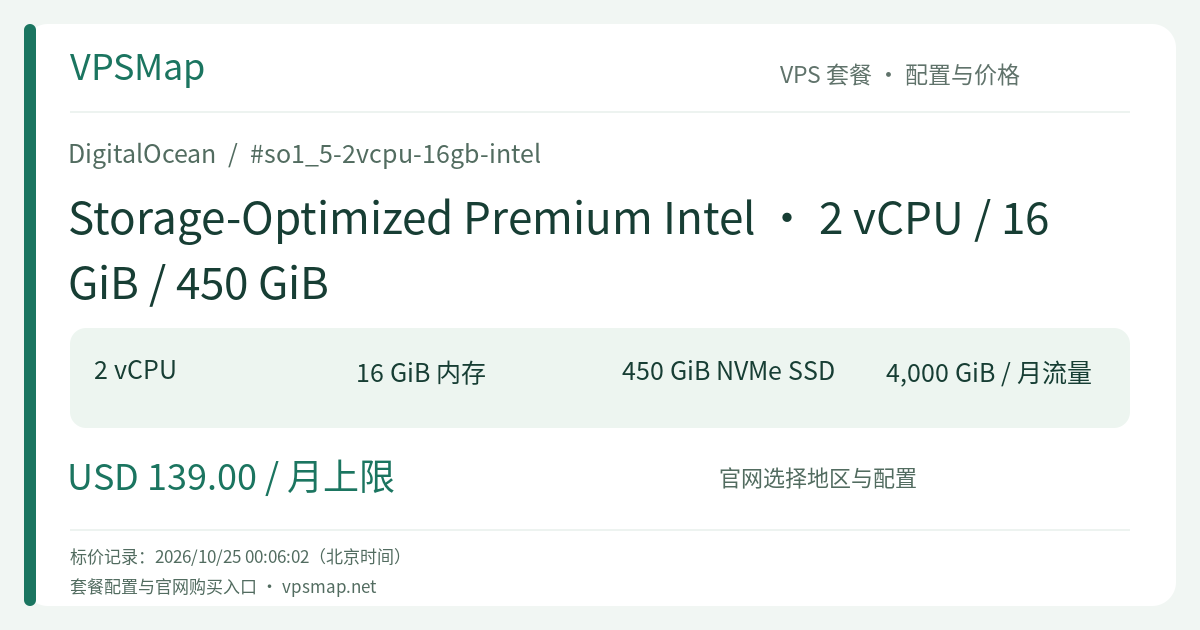
The DigitalOcean Storage-Optimized 1.5X Droplet (so1_5-2vcpu-16gb-intel) neatly solves this imbalance. While holding the dedicated 2-core 3rd Gen Intel Xeon configuration and 16 GiB of RAM steady, it increases host-attached NVMe disk capacity from 300 GiB to 450 GiB. For a negligible price increment, you unlock an additional 150 GiB of top-tier, low-latency flash storage.
Why Choose the 1.5X Tier?#
- Highly Cost-Effective Storage Scaling: Instead of forcing you into a larger compute tier, the 1.5X profile provides 50% more raw NVMe storage at an exceptional marginal rate per gigabyte, keeping overall infrastructure spending lean.
- Crucial Overhead for Maintenance & Compaction: Intensive database operations—such as PostgreSQL
VACUUM FULL, MySQL table defragmentation, or Elasticsearch Lucene segment merges—often require temporary disk headroom equal to the size of the table being processed. A 450 GiB drive provides the necessary safety margin for a 200 GiB dataset without risking out-of-disk crashes. - Uncompromised Physical NVMe Performance: Just like its 1X sibling, this 450 GiB storage drive is wired directly to the hypervisor host via PCIe. You get consistent microsecond-level latency and sustained high IOPS, eliminating network storage jitter entirely.
- 10 Gbps High-Throughput Egress: Powered by the Premium Intel networking stack, this Droplet can push up to 10 Gbps, ensuring cluster syncing, snapshot uploads, and log replication never hit an interface bottleneck.
Primary Workloads & Use Cases#
- Expanding Relational Databases (MySQL / PostgreSQL): Production backends currently managing 100–250 GiB of data with steady monthly growth, needing 1–2 years of operational runway without disk-resizing downtime.
- Log Indexing & Search Engines (Elasticsearch / OpenSearch): Clusters requiring 30–60 days of retention for operational logs and access traces where 300 GiB is too tight but 450 GiB fits comfortably.
- Metrics Storage & APM Servers (VictoriaMetrics / InfluxDB): Time-series nodes absorbing thousands of metric submissions per second with sustained retention periods.
- CI/CD Build Artifact Caching: Build servers running repeated containerized compilation pipelines that benefit directly from high-speed local NVMe scratch space.
Operational Practices#
- Data Protection Discipline: As host-attached NVMe storage is bound to the physical host, it cannot be dynamically detached to another VM if a hardware incident occurs. Implement an active-passive or primary-replica architecture alongside DigitalOcean automated backups or SnapShooter.
- Network & Transfer Allowance: The included 4,000 GiB of outbound transfer pools across all Droplets on your team. Private VPC traffic between Droplets within the datacenter is completely free and unmetered.
- Per-Second Billing with 672-Hour Cap: Billed per second with a predictable 672-hour monthly price ceiling. Once reached within a billing month, additional runtime incurs no compute charges.
For systems that need more room to breathe without inflating CPU and RAM costs, this 1.5X Storage-Optimized model represents the sweet spot of capacity, speed, and budget efficiency.