DigitalOcean 2 vCPU / 16 GiB (450 GiB NVMe) Storage-Optimized Droplet Review: Expanding Storage Without Paying the Compute Tax
Updated
During infrastructure planning, engineering teams frequently confront a frustrating cloud tiering dilemma:
Your database is performing smoothly. The 2 dedicated vCPUs rarely exceed 40% utilization, and 16 GiB of RAM easily accommodates current database buffer requirements. However, natural data accumulation is pushing the 300 GiB local disk toward capacity. In standard virtual machine catalogs, the only way to obtain additional high-speed local disk is to upgrade directly to a 4 vCPU / 32 GiB instance. Doing so doubles your monthly hosting costs, leaving newly provisioned compute and memory resources largely idle.
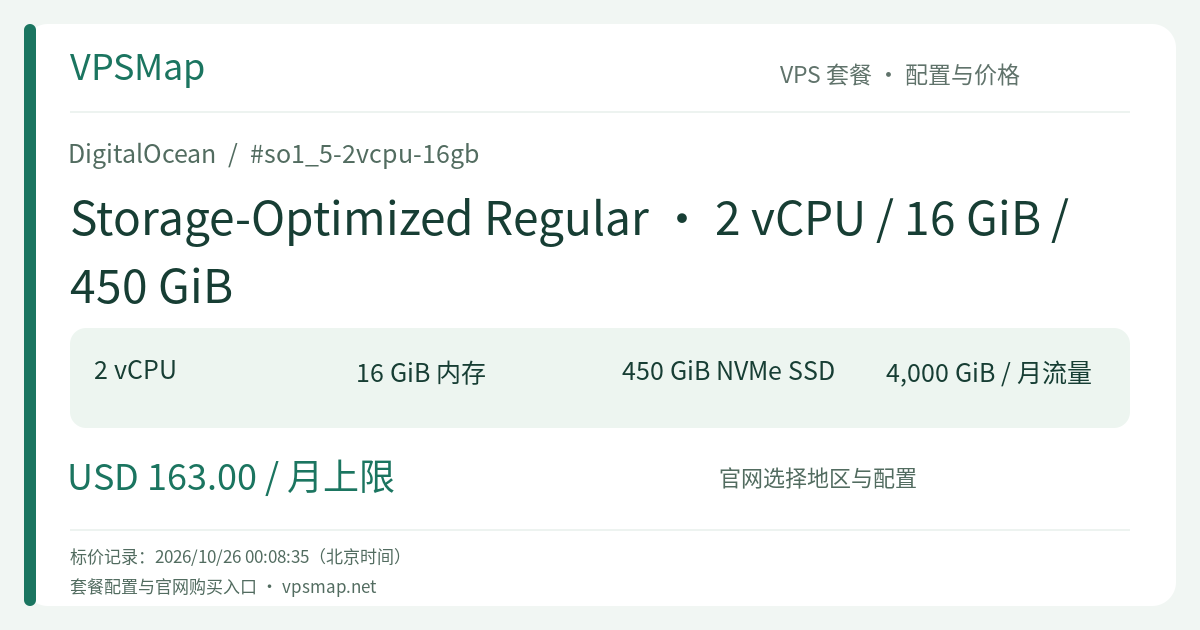
The DigitalOcean Storage-Optimized Regular · 2 vCPU / 16 GiB / 450 GiB plan (slug so1_5-2vcpu-16gb, the 1.5X SSD variant) is engineered specifically to eliminate this dilemma. By retaining 2 dedicated compute cores and 16 GiB of RAM while expanding host-direct NVMe capacity to 450 GiB, it ensures your cloud budget is invested strictly where your workload needs it most: ultra-fast local storage.
The Economics of the 1.5X Variant: Avoiding Compute Over-Provisioning#
Comparing the 1.5X model with standard 1X configurations and cross-tier upgrades highlights clear economic advantages:
- Versus Standard 1X (300 GiB vs. 450 GiB): For a modest price difference, you receive an extra 150 GiB (+50%) of direct-attached NVMe storage. In terms of cost per gigabyte for host-attached physical flash, this expansion offers exceptional marginal value.
- Versus Upgrading to 4 vCPUs (450 GiB vs. 600 GiB): Jumping to a 4-core tier doubles your recurring monthly commitment. If your application's compute utilization is comfortable and your only pressure point is disk capacity,
so1_5-2vcpu-16gbresolves your storage bottleneck while preventing hundreds of dollars in unnecessary infrastructure overhead.
What Does 450 GiB of Direct NVMe Solve in Practice?#
An extra 150 GiB of direct-attached physical NVMe flash changes operational realities across several common scenarios:
1. Extended Retention for Time-Series and Telemetry Hubs#
When ingesting metrics with Prometheus or VictoriaMetrics, 2 dedicated cores easily process ingestion from hundreds of endpoints. The primary constraint on data history is disk capacity. Expanding from 300 GiB to 450 GiB allows you to extend high-resolution metric retention from 30 days to 60 or 90 days on local storage, eliminating premature downsampling and keeping trend queries responsive.
2. Preventing Elasticsearch High Disk Watermarks#
In search and logging clusters, crossing the 85% disk usage threshold triggers high-watermark defenses, blocking shard relocation and risking read-only index states. A 450 GiB disk provides a much wider operational buffer, allowing logging stacks to retain more indices locally before invoking ILM (Index Lifecycle Management) rollover policies.
3. Handling Heavier Document and Metadata Stores#
Document databases like MongoDB and CouchDB accumulate substantial index overhead and nested document structures. 450 GiB comfortably handles larger operational collections, while direct NVMe access times prevent latency spikes during multi-field index traversals.
Key Architectural & Technical Specifications#
| Specification | Details | Engineering Impact |
|---|---|---|
| Compute Cores | 2 Dedicated vCPUs | Guaranteed hardware threads; zero noisy-neighbor interference |
| System Memory | 16 GiB RAM | 8 GiB/vCPU allocation ensures healthy database buffer pools and OS page cache |
| Local Storage | 450 GiB Direct NVMe SSD | 225 GiB/vCPU; microsecond seek times; bypasses network latency |
| Network Port | 2000 Mbps (2 Gbps) | High-throughput intra-VPC communication and customer-facing connectivity |
| Bandwidth Pool | 4,000 GiB / month | Included in team-wide bandwidth pool; free inbound data; $0.01/GiB overage |
| Billing Cap | 672 hours / month | Billed per second with a 60-second minimum; predictable monthly billing cap |
Reliability and Data Protection Guidelines#
While direct-attached NVMe provides class-leading throughput and latency, its host-bound nature requires structured operational practices:
- Automated Incremental Backups: Enable DigitalOcean Backups during provisioning. Backups run incrementally after the initial baseline, enabling rapid recovery and painless instance cloning.
- Private Network Archiving via VPC: Within the same region, communication between your Droplet and DigitalOcean Spaces object storage over private VPC DNS incurs zero bandwidth charges. Schedule regular snapshots or logical database dumps directly to Spaces for cost-effective off-site disaster recovery.
- Proactive Disk Monitoring: Utilize DigitalOcean Monitoring to establish automated alert policies via email or Slack when disk utilization reaches 80%, providing adequate lead time for log pruning or cold-storage archiving.
Final Recommendation#
If your current infrastructure is caught in the gap where compute capacity is plenty, but 300 GiB of local storage is running out, and jumping to 4 cores is financially wasteful, the so1_5-2vcpu-16gb plan is the tailored answer. It expands your physical NVMe headroom by 50% without forcing you to pay for unused CPU cycles.
Note: Datacenter capacity for Storage-Optimized plans is validated in real time within the DigitalOcean Control Panel upon creation.
Deploy the 2 vCPU / 16 GiB (450 GiB NVMe) Droplet on DigitalOcean