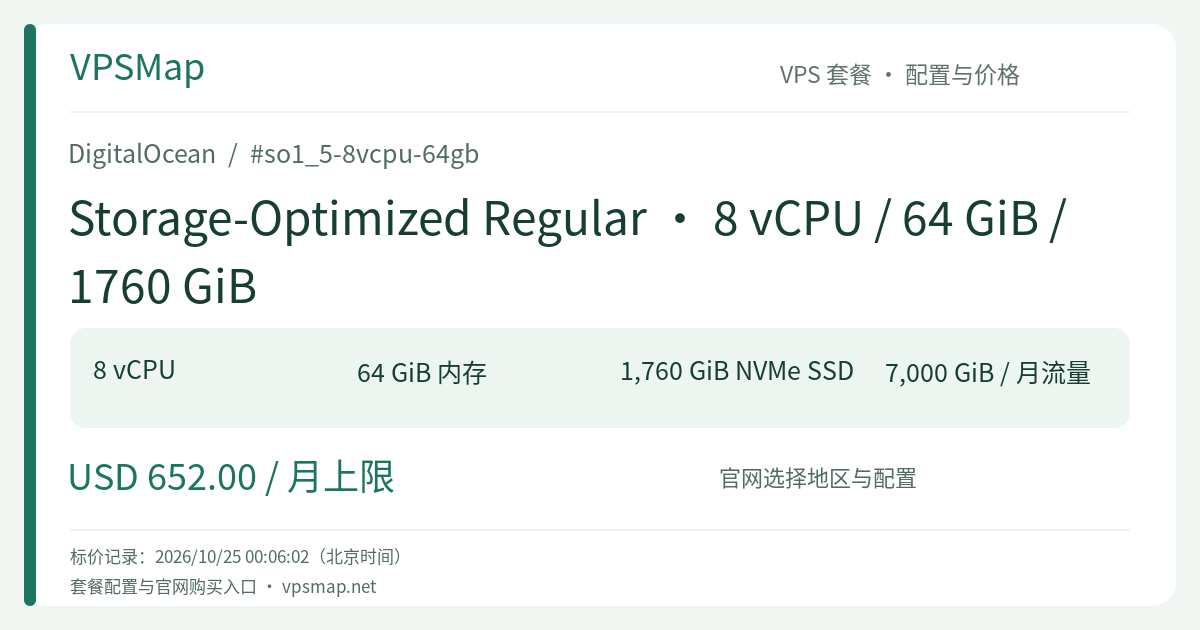
DigitalOcean 8 vCPU / 64 GiB (1,760 GiB NVMe) Review: The Ultimate 1.76 TB Local High-Throughput Workhorse
Updated
In enterprise systems architecture, addressing the need for over 1.5 TB of active, latency-sensitive data often leads teams into frustrating trade-offs:
Attaching conventional network block storage easily scales capacity, but network hop latency and IOPS ceilings throttle high-concurrency systems. Conversely, upgrading to a 16-core or 32-core instance simply to obtain larger local disks pushes monthly infrastructure spending into four-figure territory, leaving CPU utilization hovering below 20%.
The DigitalOcean Storage-Optimized Regular · 8 vCPU / 64 GiB / 1760 GiB plan (slug so1_5-8vcpu-64gb, the 1.5X SSD flagship) resolves this structural challenge. Retaining 8 dedicated compute cores and 64 GiB of system memory while scaling direct-attached NVMe storage to a massive 1,760 GiB (1.76 TB), it delivers exceptional marginal value, turning a single virtual machine into a local throughput powerhouse.
The Strategic Value of 1.76 TB Direct-Attached NVMe: Keeping Hot Data on the Local Bus#
Compared to the standard 1,170 GiB tier, the extra 590 GiB (+50%) of host-direct physical NVMe changes application architecture in critical ways:
- Deferring Premature Sharding Complexity: When single-node disks fill up, engineering teams are often forced to invest weeks re-architecting data layers, sharding tables, or building complex cold-storage eviction policies. Having 1.76 TB of local flash allows systems to maintain a clean, single-node architecture longer, reducing operational complexity.
- Sub-Millisecond Response Across a 1.76 TB Dataset: Traversing network volumes during massive table scans or complex index joins can saturate virtualized network interfaces. On this instance, your entire 1.76 TB dataset connects directly via PCIe/NVMe physical bus lanes, delivering consistent microsecond response times.
- Eliminating Compute Over-Provisioning: For most operational databases, search clusters, and telemetry hubs, 8 dedicated cores and 64 GiB of RAM easily handle thousands of concurrent queries. This 1.5X tier lets you deploy near-terabyte local flash without paying for unused CPU hyper-threads.
Ideal Enterprise Use Cases#
1. Terabyte-Scale Columnar & Telemetry Engines (ClickHouse / Doris / VictoriaMetrics)#
In high-frequency telemetry, ad attribution, and IoT time-series analytics, datasets expand by tens of gigabytes daily. 8 dedicated cores deliver parallel multi-threaded query scans, 64 GiB of RAM processes memory-intensive hash aggregations, and 1.76 TB of direct NVMe holds months of raw, uncompressed operational data locally for real-time reporting.
2. High-Retention Security & Compliance Log Hubs (Elasticsearch / OpenSearch)#
In fintech and enterprise SaaS platforms subject to stringent regulatory retention mandates, event logs must often be retained for 90 to 180 days. With a 31 GiB JVM heap utilizing compressed OOPs and 33 GiB allocated to OS filesystem caching, 1.76 TB of NVMe handles billions of searchable log documents without triggering disk high-watermark warnings.
3. High-Concurrency E-Commerce and Financial Cores (PostgreSQL / MySQL)#
As a high-volume transactional primary database, 1.76 TB easily accommodates hundreds of millions of historical order rows, account ledgers, and rich JSON documents. Direct NVMe write-ahead log (WAL) flushing and rapid transaction commits ensure the system absorbs promotional traffic spikes smoothly.
Detailed Hardware & Network Architecture#
| Specification | Details | Production Significance |
|---|---|---|
| Compute Cores | 8 Dedicated vCPUs | 100% dedicated hardware hyper-threads; zero CPU contention |
| System Memory | 64 GiB RAM | 8:1 ratio; supports 31GB JVM optimization and ample OS page cache |
| Local Storage | 1,760 GiB (1.76 TB) Direct NVMe | 225 GiB/vCPU ratio; direct PCIe bus connection; microsecond latency |
| Network Port | 2000 Mbps (2 Gbps) | High-throughput interface for intra-VPC clustering and client ingress |
| Transfer Quota | 7,000 GiB / month (Team Pool) | Free inbound data; substantial 7 TB outbound bandwidth pooled across your team |
| Billing Model | Monthly cap at 672 hours | Billed by the second with a 60-second minimum; zero long-term commitments |
Data Resilience & Operational Best Practices#
When managing 1.76 TB of production data on host-local flash, systems must adhere to sound disaster-recovery practices:
- Implement High-Availability Streaming Replication: Physical hardware maintenance cannot be avoided indefinitely. Mission-critical primary databases should continuously replicate to a secondary replica within the same private VPC, enabling seamless automated failover.
- Enable Automated Droplet Backups: Turn on DigitalOcean Backups to capture automated incremental disk images on a daily or weekly schedule, providing a dependable baseline for rapid disaster recovery.
- Automate Private Archiving to Spaces: For archived or cold datasets, take advantage of free intra-region VPC routing to DigitalOcean Spaces object storage. Schedule automated off-site dumps to combine high-speed local flash performance with resilient cloud object storage.
Verdict#
The DigitalOcean Storage-Optimized 8 vCPU / 64 GiB (1,760 GiB) Droplet delivers premier local storage density on the cloud. By decoupling storage expansion from forced compute upgrades, it gives engineering teams a high-throughput, sub-terabyte flash architecture tailored to demanding production workloads.
Note: Datacenter capacity for Storage-Optimized plans is confirmed in real time within the DigitalOcean Control Panel upon creation.
Deploy the 8 vCPU / 64 GiB (1760 GiB NVMe) Droplet on DigitalOcean