Evoxt Premium VM-3 Review & Buying Guide: 4 High-Frequency Cores at $14.99/mo on Premium Asian Routes
Updated
When selecting high-performance cloud servers in the Asia-Pacific region, developers often face an annoying trade-off: entry-level plans lack multi-threaded processing muscle, while enterprise instances from hyperscalers quickly inflate infrastructure budgets.
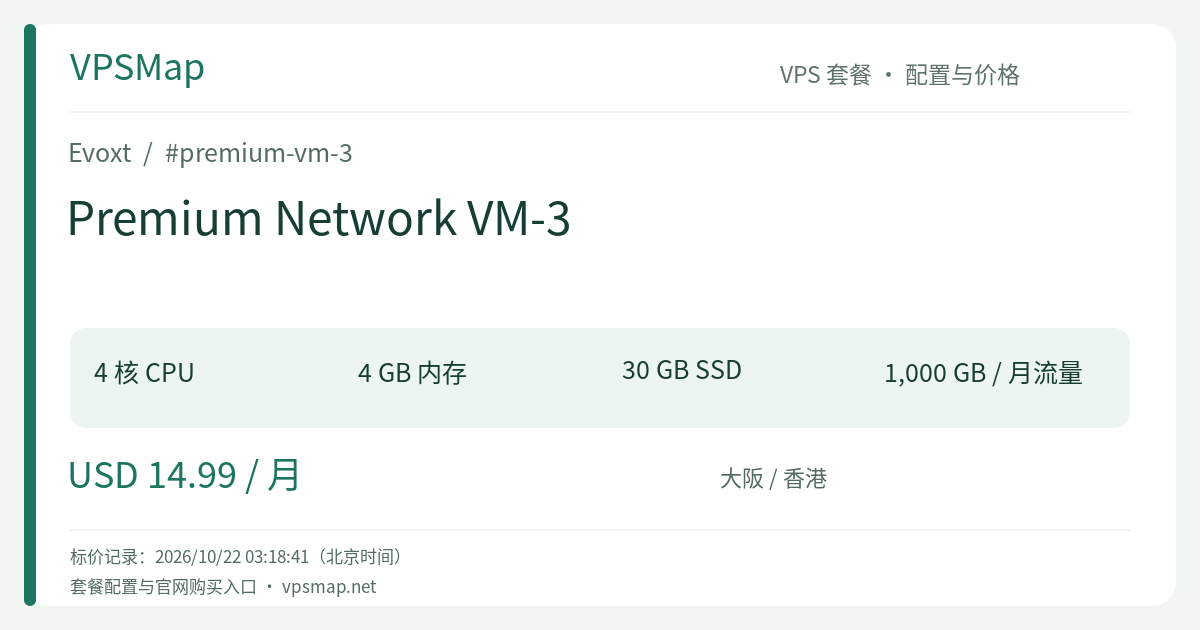
The Evoxt Premium Network VM-3 hits the optimal sweet spot. Priced at $14.99 / month, it bundles 4 vCPUs (up to 6.0 GHz Turbo Clock) + 4GB RAM + 30GB High-Speed Storage + 1000GB Premium Bandwidth. For projects that demand genuine multi-core compute combined with low-latency Asia routing, this tier delivers exceptional real-world value.
Core Specifications & Hardware Architecture#
| Feature | Technical Specification | Practical Benefit |
|---|---|---|
| Processor (CPU) | 4 vCPUs (Up to 6.0 GHz Turbo) | Outstanding single-core frequency coupled with 4 concurrent threads |
| Memory (RAM) | 4096 MB (4 GB) | Comfortable capacity for containerized microservices and databases |
| Disk Storage | 30 GB High-Speed NVMe | Fast I/O responsiveness for OS execution and transaction processing |
| Monthly Transfer | 1000 GB (1 TB) / month | 1Gbps uplink on premium carrier backbones |
| Premium Regions | Hong Kong / Japan (Osaka) | Optimized direct routing across mainland China and East Asia |
| Data Protection | Free Weekly Offsite Backups | Built-in zero-cost disaster recovery provided natively by Evoxt |
| Current Pricing | $14.99 / month | Flexible billing from monthly up to 3 years; scale-on-demand |
The Real Value of Evoxt Premium Network#
Unlike standard US and European data centers, bandwidth cost across East Asia is traditionally high. Evoxt's Premium Network tier specifically connects you to top-tier regional backbones:
Hong Kong:
- Features optimized routing into mainland China via the enterprise-grade CN2 network.
- Delivers ultra-low latency throughout Greater China and Southeast Asia without requiring local website filing (ICP).
- An ideal location for regional e-commerce stores, international SaaS frontends, and cross-border API gateways.
Japan (Osaka):
- Directly connected to Softbank as primary upstream transit, complemented by local peering at BBIX and JPIX.
- Compared to congested Tokyo nodes, Osaka provides consistent packet delivery and lower jitter, making it a reliable hub for Japanese regional audiences.
While the monthly 1000GB data quota is more conservative than standard US plans, the premium connectivity and stable latency across the Pacific more than justify the allocation.
Target Workloads: What Problems Does VM-3 Solve?#
Equipped with 4 snappy CPU cores and 4GB memory, the VM-3 plan easily handles intermediate development and production duties:
- Dynamic Web Platforms & WooCommerce: Modern web frameworks and CMS platforms rely heavily on single-thread clock speed for PHP-FPM rendering and database query resolution. The 6.0 GHz burst capability ensures fast Time-to-First-Byte (TTFB) during traffic spikes.
- Docker Stacks & Microservices: Comfortably run a production stack with Nginx/Traefik, a couple of Node.js/Go backend containers, a Redis cache instance, and a lightweight PostgreSQL or MariaDB service.
- Multi-Threaded Bots & Automation Pipelines: Background workers, Discord/Telegram bots, and data collection scripts thrive on core count. Four virtual cores prevent background threads from starving real-time networking.
- Private VPN & Cloud Development Bastions: Enjoy high-speed command line responsiveness and low round-trip times when connecting to your Hong Kong or Osaka cloud workspace.
Comparative Analysis: Choosing Between Neighboring Tiers#
- VM-3 vs. VM-2 ($11.99 / mo): The VM-2 plan features 2 vCPUs, 4GB RAM, and 30GB storage. For only $3.00 more per month, the VM-3 doubles your CPU cores from 2 to 4. If your code performs parallel asynchronous tasks, that $3 upgrade yields massive computational headroom.
- VM-3 vs. VM-4 ($23.99 / mo): The VM-4 plan doubles memory to 8GB and storage to 60GB, but comes with a $9 price hike. If your operational memory consumption comfortably stays below 3GB, staying on VM-3 keeps your operational expenditures lean without sacrificing processor speed.
Practical Considerations & Trade-offs#
- Shared Virtual CPU Model: The 4 vCPUs run on KVM hypervisors with high turbo thresholds. While burst performance is best-in-class, continuous 100% prolonged synthetic stress-testing or mining is outside standard virtualization terms.
- Disk Space Allocation: The 30GB storage footprint is geared towards operating system and application binaries. If your application accumulates multi-gigabyte video or media assets, integrate cloud object storage or use the control panel to purchase add-on block capacity.
- Inventory Status: Due to high demand for Hong Kong CN2 and Osaka transit, regional IP pools rotate. Verify active region availability upon checkout.
Step-by-Step Deployment Guide#
Deploying your Evoxt VM-3 instance takes less than three minutes:
- Open the Client Portal: Navigate directly to the Evoxt Official Console.
- Account Setup: Register with your basic details; Evoxt maintains a privacy-friendly policy without intrusive verification.
- Select Premium Location: Choose Hong Kong or Japan (Osaka) under the deployment dashboard.
- Select Plan: Click on VM-3 (4 vCPUs / 4 GB RAM / 30 GB SSD / 1000 GB Bandwidth).
- Choose System Image: Pick a vanilla distribution (Ubuntu, Debian, AlmaLinux, Rocky Linux) or select a 1-click template such as Docker, OpenLiteSpeed, or WordPress.
- Finalize Billing: Choose your preferred billing duration (monthly up to 3 years) and complete payment using Credit Card, PayPal, Bitcoin, or USDT (Tron). Your server credentials and IP will be issued within roughly 2.5 minutes.