Evoxt Standard VM-12 Comprehensive Review: 16 High-Clock Cores & 8 TB Bandwidth for Concurrent Compute
Updated
Core Focus: High-Concurrency Multiprocessing Without Overpaying for Idle Memory#
When scaling compute-heavy infrastructure, engineering teams often hit a frustrating roadblock: single-threaded task dispatchers choke, worker queues back up, and CPU usage stays pegged at 100%. Whether managing asynchronous image conversion, distributed crawler pools, busy API gateways, or parallel CI/CD test runners, multi-core availability is the ultimate constraint.
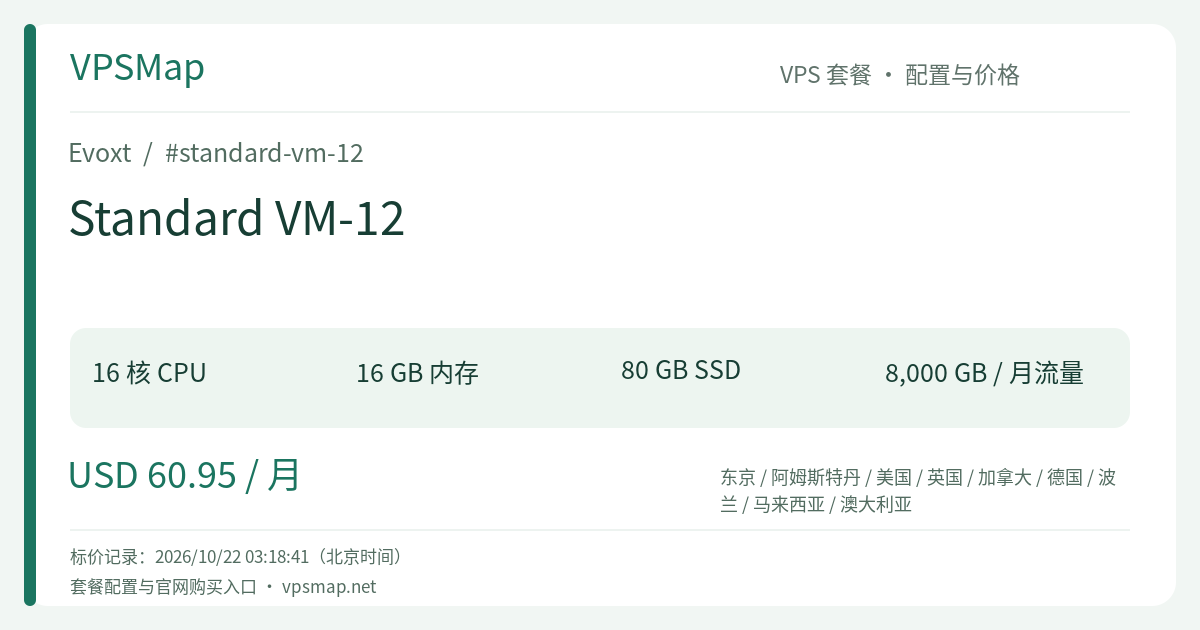
The Standard VM-12 from Evoxt addresses this exact challenge with razor-sharp economics. For $60.95/month, it packs 16 high-frequency vCPU cores (bursting up to 6.0 GHz) alongside 16 GB of RAM, 80 GB of SSD storage, and an expansive 8,000 GB monthly bandwidth quota. It is engineered for teams whose bottlenecks stem from CPU queue depth rather than monolithic memory footprints, letting you scale thread counts without paying enterprise premiums for unused RAM.
Hardware Profile & Technical Breakdown#
Below is a detailed examination of the hardware configuration powering the Standard VM-12:
| Metric | Specification | Engineering Benefit |
|---|---|---|
| Compute Capacity | 16 vCPUs (Up to 6.0 GHz Turbo Clock) | Massive core density ready to distribute dozens of concurrent application threads with minimal scheduling latency |
| System RAM | 16 GB RAM | Balanced 1:1 core-to-memory ratio ideal for concurrent worker pools in Go, Python, and Node.js |
| SSD Storage | 80 GB SSD | High-speed local SSD ensures low read/write latency for OS layers, build artifacts, and package dependencies |
| Network Quota | 8,000 GB / Month (1 Gbps Shared Port) | An immense 8 TB bandwidth ceiling to handle high-volume API payloads and bulk data transfers without overage anxiety |
| Backup Architecture | Automated Weekly Offsite Snapshots | Built-in weekly offsite data protection included at zero subscription charge |
| Monthly Investment | $60.95 / Month | Highly competitive price-per-core economics compared to traditional compute-optimized instances |
Powered by enterprise KVM hypervisors, the VM-12 leverages exceptional single-core clock speeds (up to 6.0 GHz turbo). Even under concurrent multi-core load, individual request threads are executed rapidly, preventing cascading backlog issues.
Best-Fit Production Scenarios for Standard VM-12#
1. High-Concurrency Asynchronous Task Workers & Scrapers#
Workloads that continuously ingest external data, run ETL pipelines, or process message queues (e.g., Celery, Sidekiq, BullMQ, or Go worker pools) scale almost linearly with available CPU cores:
- 16 cores can easily execute 30–50 concurrent lightweight worker threads simultaneously;
- The 8 TB monthly transfer allowance ensures that aggressive scraping, remote API polling, and payload ingestion never face bandwidth penalties;
- 16 GB of RAM provides ample breathing room for in-memory batch processing and local queue buffers.
2. Multi-Branch Parallel CI/CD Build Hubs#
Development teams frequently lose productive hours waiting on serial build queues. A dedicated self-hosted build runner on the VM-12 changes the equation:
- Spin up multiple concurrent Docker-based compilation jobs (e.g., Maven, Rust cargo, Webpack/Vite asset compilation) across parallel cores;
- Cut build and test pipeline runtimes significantly, enabling faster deployments and continuous delivery.
3. Distributed Microservice API Gateways#
In a microservices topology, the central reverse proxy and internal routing mesh must manage thousands of concurrent connections while performing on-the-fly TLS termination, JWT validation, and rate limiting:
- 16 cores ensure that API routing logic and worker processes never starve each other of scheduler time slices;
- Evoxt's platform-level Layer 3 firewall filters network-level noise before traffic even touches the host stack.
Architectural Insights & Sizing Trade-Offs#
To ensure the VM-12 aligns with your stack, keep these architectural realities in mind:
- Core-to-Memory Ratio (16 Cores / 16 GB RAM): The instance maintains an average allocation of 1 GB RAM per CPU core. For compiled binaries (Go, Rust), modern async engines (Node.js, Python FastAPI), or optimized worker processes, this ratio is virtually ideal. However, if your architecture revolves around memory-intensive Java/JVM enterprise applications allocating 4 GB+ heap sizes per service, 16 GB will be consumed before all 16 cores can be fully leveraged. In that scenario, the 32 GB configuration found in VM-16 is the more appropriate target.
- Storage Management: The 80 GB local SSD is fast and reliable, but high-concurrency environments generate substantial log files and build artifacts over time. Ensure proper log rotation (
logrotate), configure Docker layer pruning, and route heavy persistent datasets to external storage or attach supplemental disk space via the Evoxt portal.
Tier Evaluation: VM-8 vs. VM-12 vs. VM-16#
Here is how the VM-12 compares against its immediate pricing neighbors:
VM-8 (8 Cores / 16 GB RAM / 80 GB SSD / 6 TB Bandwidth) ── $47.99/mo
     │
     ├─ +$12.96/mo: Doubles CPU cores (8 ➔ 16 cores), +2 TB Bandwidth, RAM unchanged
     ▼
VM-12 (16 Cores / 16 GB RAM / 80 GB SSD / 8 TB Bandwidth) ── $60.95/mo (Featured Plan)
     │
     ├─ +$35.04/mo: Doubles RAM (16 GB ➔ 32 GB), +20 GB Storage, +2 TB Bandwidth
     ▼
VM-16 (16 Cores / 32 GB RAM / 100 GB SSD / 10 TB Bandwidth) ── $95.99/mo- Compared to Standard VM-8 ($47.99/mo): Upgrading from VM-8 to VM-12 costs an additional $12.96 per month—a modest ~27% price increase. In exchange, your vCPU core count doubles from 8 to 16, and your monthly bandwidth expands by 2,000 GB. If your application's primary bottleneck is CPU concurrency rather than RAM exhaustion, this is arguably the most cost-effective upgrade in the entire catalog.
- Compared to Standard VM-16 ($95.99/mo): Both VM-12 and VM-16 provide the same 16-core compute foundation, but VM-16 doubles system memory to 32 GB at an extra cost of $35.04/month. If your monitoring shows that memory consumption remains comfortably within the 16 GB boundary, staying with VM-12 keeps your monthly infrastructure expenses lean without sacrificing a single drop of compute throughput.
Platform Capabilities & Management Features#
Deploying on Evoxt pairs raw compute with robust developer-friendly tooling:
- Automated Offsite Protection: Weekly backups are performed automatically and stored offsite, giving you instant recovery points in the event of misconfigurations or data corruption.
- Granular Resource Scaling: Need an extra IPv4 address ($3/month) or additional disk and transfer capacity? Upgrade individual resource items on demand via the dashboard without redeploying the entire machine.
- Role-Based Sub-Accounts: Grant team-specific permissions for developers, sysadmins, and billing managers to streamline organizational operations.
- Full REST API Control: Script deployments, manage lifecycle states, and integrate VM operations into your custom orchestration pipelines.
Ordering & Setup Instructions#
Deploying a Standard VM-12 takes just a few clicks:
- Open the Portal: Navigate to the Evoxt Console and log in or create your user profile.
- Choose Your Datacenter: Under the Standard Regions tab, pick the facility nearest your primary user base (e.g., Frankfurt, Amsterdam, or London for Europe; Los Angeles or New York for the US; Tokyo, Sydney, or Kuala Lumpur for APAC).
- Select Your OS or Template: Pick your preferred OS (Ubuntu, Debian, AlmaLinux, Windows Server) or choose a pre-built application image (Docker, OpenLiteSpeed, CyberPanel).
- Confirm Standard VM-12: Verify specifications: 16 Cores, 16 GB RAM, 80 GB SSD, 8,000 GB Transfer.
- Review Billing & Checkout: Select your billing interval (monthly up to 3 years) and preferred payment method, including credit/debit cards, PayPal, and cryptocurrencies (Bitcoin, USDT-TRON).
- Provisioning Complete: Within approximately 2.5 minutes, your 16-core instance is provisioned with a public IP address and ready for immediate deployment via SSH or web-based VNC.