Evoxt Standard VM-2 Buying Guide: The 4GB RAM Sweet Spot for Production Stacks and Containerized Workloads
Updated
Why 4 GB RAM is the Golden Baseline for Modern Cloud Workloads#
When choosing a virtual private server, many developers instinctively begin with 1 GB or 2 GB entry-level plans. However, once an application transitions into genuine production, recurring operational pain points quickly emerge:
- Running
composer install,npm run build, or container image compilations routinely triggers the Linux Out-Of-Memory (OOM) Killer; - Relational databases (MySQL, MariaDB, PostgreSQL) lack adequate headroom for their buffer pools, bottlenecking performance on disk I/O;
- Introducing background queues, Redis caches, and log shipping agents rapidly exhausts available memory, leaving the server vulnerable to traffic surges.
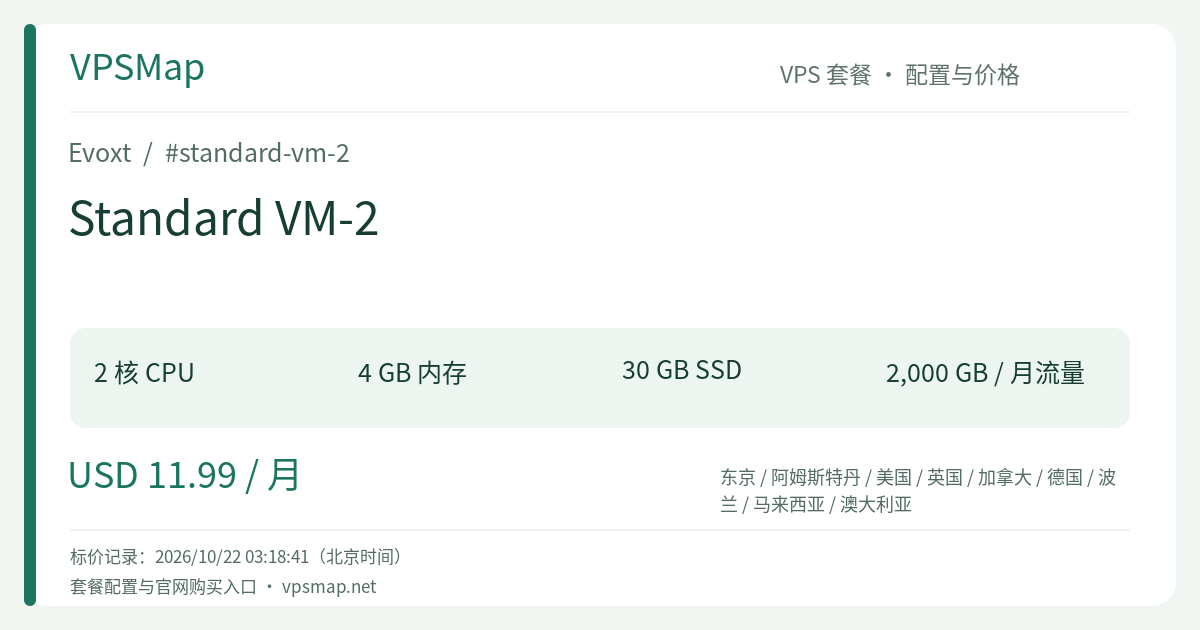
Evoxt Standard VM-2 (2 vCPU cores / 4 GB RAM / 30 GB Storage / 2,000 GB Monthly Transfer / 1 Gbps Port / Free Weekly Offsite Backups at $11.99/month) is engineered specifically to eliminate this memory anxiety.
It is not a bare-bones sandbox; it is a full-fledged, stable compute instance designed to handle self-contained production environments with comfortable resource buffers.
Hardware Specifications & Architecture Breakdown#
| Specification | Allocation | Architectural Advantage |
|---|---|---|
| CPU Cores | 2 vCPU (Up to 6.0 GHz Turbo Clock) | Combines rapid single-thread execution with multi-thread background scheduling |
| System Memory | 4,096 MB (4 GB) | Generous headroom for application runtimes, database caching, and OS buffers |
| Fast Storage | 30 GB Enterprise NVMe/SSD | High IOPS for operating system files, application source code, and transaction logs |
| Bandwidth & Port | 1 Gbps Port / 2,000 GB Monthly Quota | Generous allocation easily handling hundreds of thousands of dynamic page requests |
| Disaster Recovery | Automatic Weekly Offsite Backups (Free) | Critical system protection and fast rollback at zero recurring extra cost |
| Pricing | $11.99 / month | Available on monthly terms up to 3 years; modular upgrades supported in-panel |
1. High Single-Core Frequency Meets Dual-Core Concurrency#
One of Evoxt's signature technical features is high CPU operational frequency (reaching up to 6.0 GHz Turbo Clock, with legacy systems maintaining 3.5 GHz+ base clocks). Dynamic runtimes such as PHP-FPM, Node.js, Python WSGI, and Ruby execute significant synchronous logic where clock speed directly dictates page generation time. With 2 vCPUs on VM-2, complex dynamic queries complete in milliseconds while administrative background tasks or SSL handshakes run concurrently without starving the main web thread.
2. Architectural Freedom Granted by 4 GB RAM#
With 4 GB of physical memory, you no longer have to compromise service configurations:
- Allocate 1.0 GB to 1.5 GB directly to
innodb_buffer_pool_size, keeping hot relational indices fully cached in RAM; - Maintain an in-memory Redis 7.x instance (256 MB–512 MB) for sub-millisecond session handling and transient cache keys;
- Run lightweight monitoring agents like Prometheus Node Exporter or Vector alongside web services without fear of memory exhaustion.
Target Production Use Cases#
Scenario A: Production Docker Compose Stacks#
For developers deploying modern microservices or isolated stacks via Docker Compose, Standard VM-2 comfortably hosts:
- Reverse Proxy: Nginx or Caddy handling automated Let's Encrypt SSL/TLS certificates;
- API / Application: 2 to 3 isolated Go, Node.js, or FastAPI service containers;
- Relational Database: A dedicated PostgreSQL 15 or MariaDB 10 instance;
- Cache & Message Broker: Redis 7.x;
- Task Queue: Celery or BullMQ worker processes.
Under normal execution, this composition consumes approximately 2.2 GB to 2.8 GB of physical RAM, preserving ample headroom for sudden HTTP burst traffic and Linux OS page cache.
Scenario B: High-Performance WordPress / WooCommerce Stores#
As e-commerce stores scale with plugins, payment gateways, and inventory trackers, memory demands grow rapidly. Leveraging Evoxt's WordPress (OpenLiteSpeed) 1-click deployment on Standard VM-2 provides dramatic performance improvements:
- LSCache delivers pre-rendered static content directly from memory with negligible CPU overhead;
- Dynamic non-cacheable checkouts, cart interactions, and account queries are executed across 2 high-frequency cores;
- Complementary weekly offsite backups ensure peace of mind in the event of faulty plugin updates or database corruption.
Scenario C: Internal Team Developer Workstations & CI Runners#
Standard VM-2 serves as an ideal self-hosted developer hub running Gitea, an internal documentation portal (such as BookStack or Outline), lightweight CI execution workers, and automated scheduled crawlers. The 2,000 GB monthly bandwidth allowance accommodates continuous data transfers and container pulls effortlessly.
Practical Considerations & Trade-Offs#
To ensure an optimal deployment, keep the following architectural factors in mind:
- Shared Multi-Tenant vCPU Allocation: Evoxt leverages high-performance KVM hypervisors with shared high-clock cores. While ideal for dynamic traffic spikes, web requests, and background worker bursts, it is not engineered for uninterrupted 24/7 100% CPU crunching (such as perpetual cryptographic mining or nonstop video rendering).
- Storage Management: 30 GB of fast enterprise storage provides exceptional disk throughput for OS and databases. If your application accumulates massive user-generated media or large historical raw logs, integrate an external S3-compatible object storage provider (such as Cloudflare R2 or Backblaze B2) to conserve local disk space.
- Network Routing Options: Standard regions span Tier-1 connected datacenters including Los Angeles, New York, London, Frankfurt, Amsterdam, Warsaw, Tokyo, Malaysia, and Sydney. Note that Hong Kong and Osaka operate under Evoxt's Premium network routing with adjusted monthly quotas. Select the region aligned closest to your geographic user base.
Comparative Analysis: VM-2 vs. Adjacent Tiers#
| Plan | Price/Mo | Specifications | Strategic Recommendation |
|---|---|---|---|
| Standard VM-1.5 | $6.95 | 2 Cores / 2 GB RAM / 20 GB Disk / 1.5 TB BW | Suitable for lightweight staging. Upgrading to VM-2 for $5 more doubles your memory to 4 GB, mitigating OOM crashes. |
| Standard VM-2 | $11.99 | 2 Cores / 4 GB RAM / 30 GB Disk / 2.0 TB BW | The ultimate sweet spot for standalone web servers, Docker stacks, and commercial blogs. |
| Standard VM-3 | $14.99 | 4 Cores / 4 GB RAM / 30 GB Disk / 3.0 TB BW | Retains 4 GB RAM while adding 2 more CPU cores and 1 TB bandwidth for just $3 more; ideal for parallel workloads. |
| Standard VM-4 | $23.99 | 4 Cores / 8 GB RAM / 60 GB Disk / 4.0 TB BW | Doubles RAM to 8 GB and disk to 60 GB; chosen for enterprise CRMs, Java runtimes, or multi-tenant hosting. |
Step-by-Step Deployment Guide#
Evoxt automates server provisioning, with typical instance readiness delivered within 2.5 minutes:
- Enter the Portal: Navigate to the Evoxt Customer Console to register or log in.
- Select Datacenter Region: Under the Standard Regions section, choose the facility closest to your primary audience (e.g., Los Angeles or New York for North America; Frankfurt, Amsterdam, or London for Europe; Tokyo or Malaysia for Asia-Pacific).
- Choose the Plan: Highlight VM-2 (verifying specs: 2 vCPU, 4 GB RAM, 30 GB Storage, 2,000 GB Transfer).
- Pick OS or 1-Click Template: Select clean distributions (Ubuntu 22.04/24.04 LTS, Debian 12, AlmaLinux, Rocky Linux) or pre-configured software stacks (Docker, WordPress LiteSpeed, CyberPanel, cPanel, HestiaCP).
- Billing Terms & Checkout: Select your billing cadence from monthly up to 36 months. Payment options include major credit cards, debit cards, PayPal, Bitcoin, and USDT (TRC20).
- Access and Manage: Once provisioned, manage your static IPv4/IPv6 addresses, configure Layer 3 firewall policies directly in the control panel, or access emergency console controls via web-based VNC.