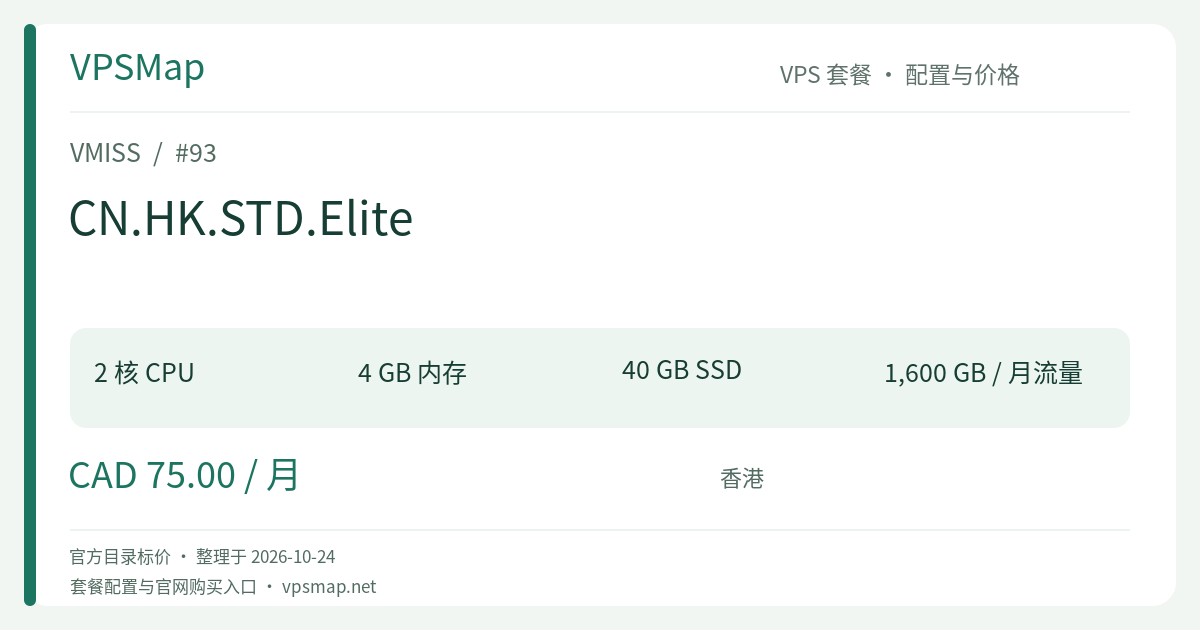
VMISS Hong Kong CN.HK.STD.Elite Deep Dive: Evaluating Multi-Task Workloads with 2 Cores, 4GB RAM, and 1.6TB Bandwidth
Updated
Breaking Free from Single-Core Limits: Dual Cores and 4GB RAM#
In cloud computing environments, single-core instances inevitably face scheduling delays under computational spikes, regardless of how much memory they possess. Background tasks such as database index rebuilds, code compilations, or large archive decompression can tie up the sole execution core, introducing latency to inbound user traffic.
VMISS CN.HK.STD.Elite (CAD 75/month) resolves this operational barrier by offering 2 vCPU cores alongside 4096MB (4GB) of physical memory. The dual-core layout allows Linux to cleanly segregate kernel I/O interrupts and background daemons from primary web process routines. Furthermore, 4GB of RAM enables the allocation of substantial database buffer pools and in-memory caches, transforming the instance into a dependable production server.
Real-World Deployments and Workload Matching#
- Production Backend & Colocated Database: Running modern services built on Java (Spring Boot), Python (Django/FastAPI with Celery), or Go alongside a tuned PostgreSQL or MariaDB relational database.
- Data Pipelines & Automation Hubs: Operating workflow orchestrators like n8n or lightweight data processing jobs. The 40GB disk and 4GB RAM easily handle temporary processing files and in-memory data parsing.
- Team CI/CD & Private Git Runspaces: Deploying a self-hosted Gitea instance paired with Gitea Actions Runner or Drone CI, handling continuous testing, unit builds, and container packaging on-site.
Database Tuning for 40GB Storage and 4GB RAM#
With 40GB of local SSD capacity, you have adequate space for persistent application data, database files, and system logs. For instances running PostgreSQL 16, tuning /etc/postgresql/16/main/postgresql.conf ensures optimal use of the 4GB memory envelope without triggering swap activity:
# Optimized configuration for PostgreSQL on a 4GB system
shared_buffers = 1024MB                  # Set shared buffers to 25% of system memory
work_mem = 16MB                         # Memory per sorting/hash operation
maintenance_work_mem = 256MB            # Maintenance operation allocation
effective_cache_size = 3072MB           # Estimated OS file cache limit
wal_buffers = 16MB
checkpoint_completion_target = 0.9
To maximize network socket reuse on dual-core systems handling high concurrency, adjust standard Linux network stack parameters:
# Apply via /etc/sysctl.d/99-network.conf and reload with sysctl -p
net.core.somaxconn = 4096
net.ipv4.tcp_max_syn_backlog = 4096
fs.file-max = 2097152
1600GB Bandwidth over a 100Mbps Interface#
A 1600GB (1.6TB) data transfer pool provides an average of over 53GB per day. Combined with the 100Mbps network port, this bandwidth allows regional web applications, customer portals, and internal enterprise tools to serve continuous API calls, media assets, and data syncs without hitting end-of-month data restrictions.
| Attribute | CN.HK.STD.Elite Specifications |
|---|---|
| Pricing | CAD 75 / month (billed monthly) |
| Compute | 2 vCPU Cores |
| Memory | 4096MB (4GB RAM) |
| Disk Space | 40GB Storage |
| Bandwidth Allowance | 1600GB / month (100Mbps Port) |
| Available Add-on | IP Replacement at CAD 5 per request via support ticket |
Competitive Comparison & Recommendation#
- Compared to Pro (CAD 38/mo): Pro provides 1 core, 2GB RAM, and 20GB disk. While suitable for lightweight or stateless applications, workloads with multi-threaded tasks, active background queues, or concurrent database queries will benefit significantly from Elite's dual-core architecture and doubled RAM.
- Compared to Ultra (CAD 150/mo): Ultra increases specs to 4 cores, 8GB RAM, and 3000GB of bandwidth. Unless your service demands heavy parallel computing or massive concurrent traffic, CN.HK.STD.Elite at CAD 75/month strikes the ideal balance between performance capability and infrastructure expenditure.
Check live stock and proceed with deployment through the official portal: Configure VMISS CN.HK.STD.Elite.