VMISS Japan Tokyo BGP Elite Breakdown: Dual-Core 4GB RAM and 2TB Traffic for Asia-Pacific Business Workloads
Updated
Production Scaling: The Real Need for Dual-Core, 4GB RAM, and 2TB Bandwidth#
When evaluating cloud hosting, lightweight instances serve simple proxies and hobby deployments well, but their architectural limits appear quickly under serious production stress. A single CPU core can become entirely monopolized by transient SSL handshakes, periodic log rotations, or background compilations, causing network packet queuing and timeouts. Meanwhile, 1GB to 2GB memory ceilings force administrators to strip critical application functionality or risk abrupt kernel out-of-memory terminations.
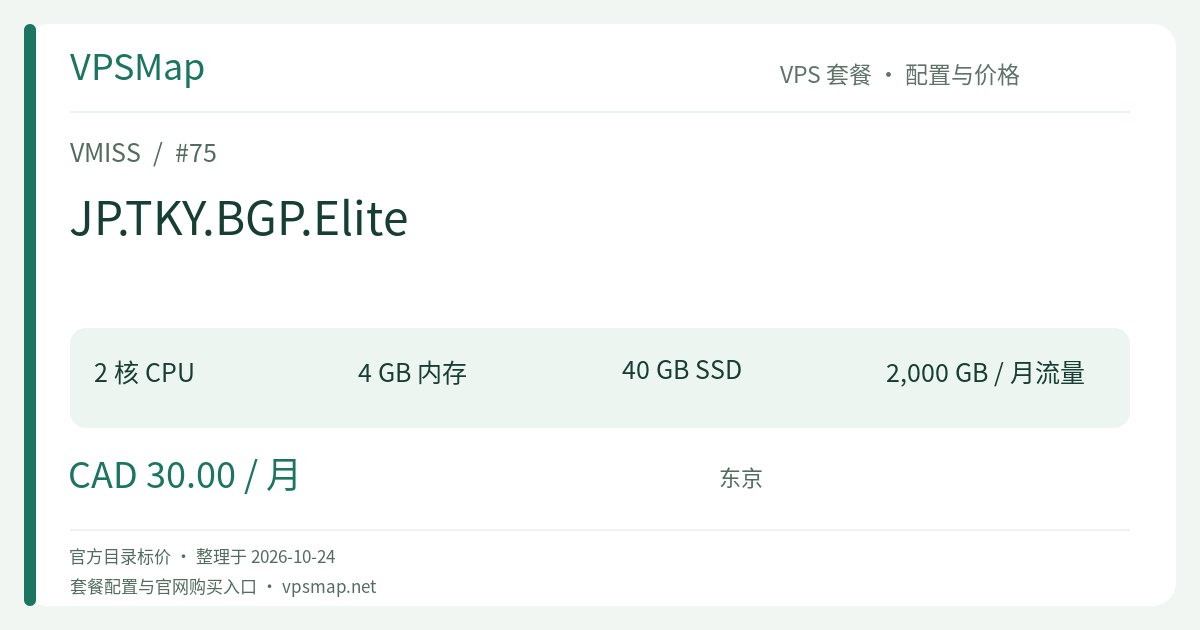
The JP.TKY.BGP.Elite plan by VMISS solves these computational and capacity bottlenecks. Priced at CAD 30 / month (billed in Canadian Dollars), this tier delivers 2 vCPUs, 4096MB (4GB) RAM, 40GB storage, and a substantial 2000GB (2TB) monthly bandwidth pool over a 750Mbps network port. It stands as a capable Tokyo-based operational hub for multi-threaded services, team platforms, and high-traffic web applications.
Technical Architecture and Core Specifications#
| Specification | Allocation | Production Implication |
|---|---|---|
| Processor | 2 vCPUs | Enables true concurrency between application logic and background system I/O |
| System Memory | 4096 MB (4GB) | Generous memory space for multi-container orchestration and heavier web stacks |
| Disk Storage | 40 GB | Ample capacity for container layers, persistent database volumes, and logs |
| Bandwidth | 2000 GB (2TB) | ~66GB daily transfer quota to sustain data-heavy network operations |
| Port Speed | 750 Mbps burst | Wide bandwidth channel minimizing connection queuing under surge demand |
| Billing | CAD 30 / month | Straightforward monthly billing in CAD with no forced annual lock-in |
1. Multitasking Resilience with 2 Cores and 4GB RAM#
The fundamental advantage of 2 vCPUs over single-core environments is fault-isolated operational resilience. On a single-core machine, sudden computational spikes—such as batch processing, database index rebuilding, or cryptographic tasks—can drive CPU utilization to 100%, causing SSH latency spikes and dropped network connections. With two cores, the Linux scheduler can isolate system maintenance and management threads, ensuring service availability.
Simultaneously, 4096MB of memory unlocks deployments that demand genuine headroom:
- Team Collaboration & CI/CD Gateways: Running dedicated Gitea platforms, GitLab Runners, internal knowledge portals, and automated deployment pipelines.
- Modern Low-Code & Automation Backends: Hosting self-hosted Supabase services, n8n workflow engines, or headless CMS platforms such as Strapi and Directus.
- High-Concurrency Content & Community Portals: Supporting high-traffic WordPress or Discourse installations integrated with Redis object caching, lightweight search engines (like Meilisearch), and persistent databases.
2. The Operational Scope of 2000GB (2TB) Bandwidth#
In many global cloud catalogs, multi-terabyte data transfer allowances are typically relegated to distant North American or European facilities. Positioning a 2000GB pool directly in Tokyo, Japan offers strategic value:
- An average of 66GB usable data transfer every day;
- The ability to serve tens of thousands of dynamic API payloads, media assets, or web views daily;
- In combination with the 750Mbps burst port, remote data synchronization, container image distribution, and automated offsite backups complete in narrow transfer windows.
Datacenter Profile and Operational Policies#
VMISS is a hosting provider based in Mississauga, Ontario, Canada. Operating on this Tokyo BGP plan involves several verified provider-specific conditions:
- Strictly IPv4 Connectivity: In accordance with an official announcement enacted on June 8, 2026, VMISS discontinued all IPv6 routing across both the JP.TKY.BGP and JP.TKY.IIJ series, including previously allocated free IPv6 addresses. Each virtual machine operates purely on a dedicated public IPv4 address.
- Standardized IP Replacement: Should your operational lifecycle necessitate changing the public IPv4 address, VMISS provides an IP Replacement add-on in the client portal for CAD 5. Upon payment, opening a support ticket specifying the virtual machine ID initiates the address update.
- Catalog Transparency: The "BGP" label reflects the vendor's routing pool categorization. All specifications and financial terms cited are verified from official catalog releases.
Tier Comparison: Pro, Elite, or Ultra?#
The mid-to-high tiering in the VMISS Tokyo BGP product line displays distinct resource gradations:
| Plan Name | CPU / RAM | Disk | Monthly Traffic | Port Speed | Base Price |
|---|---|---|---|---|---|
| JP.TKY.BGP.Pro | 1 Core / 2048 MB | 20 GB | 1200 GB | 750 Mbps | CAD 16 / mo |
| JP.TKY.BGP.Elite | 2 Cores / 4096 MB | 40 GB | 2000 GB | 750 Mbps | CAD 30 / mo |
| JP.TKY.BGP.Ultra | 4 Cores / 8192 MB | 80 GB | 3200 GB | 1000 Mbps | CAD 60 / mo |
- Upgrading from Pro to Elite (CAD 14/mo difference): CPU resources double from 1 to 2 cores, memory doubles from 2GB to 4GB, disk storage expands from 20GB to 40GB, and bandwidth increases by 800GB to reach a full 2TB. If an existing workload experiences occasional compute saturation or memory alerts, Elite provides a decisive resolution.
- Elite versus Ultra (CAD 30/mo difference): Ultra extends allocations to 4 cores, 8GB RAM, and 3.2TB traffic, but at CAD 60/month. For most growing digital operations, team tools, and active content hubs, the 2-Core / 4GB / 2TB specifications of Elite provide ample capability while preserving sensible monthly expenditure.
Implementation Guidelines & Ordering#
Tokyo BGP inventory is managed in real time based on active platform capacity. When available, instances are automatically provisioned upon payment confirmation.
- Direct Order Link: Order VMISS JP.TKY.BGP.Elite (CAD 30/month)
Upon OS installation, implementing proper non-root administrative controls, configuring Docker log rotation policies to manage the 40GB storage volume, and setting up service monitoring will ensure this Tokyo VPS operates as a dependable Asia-Pacific production bastion.