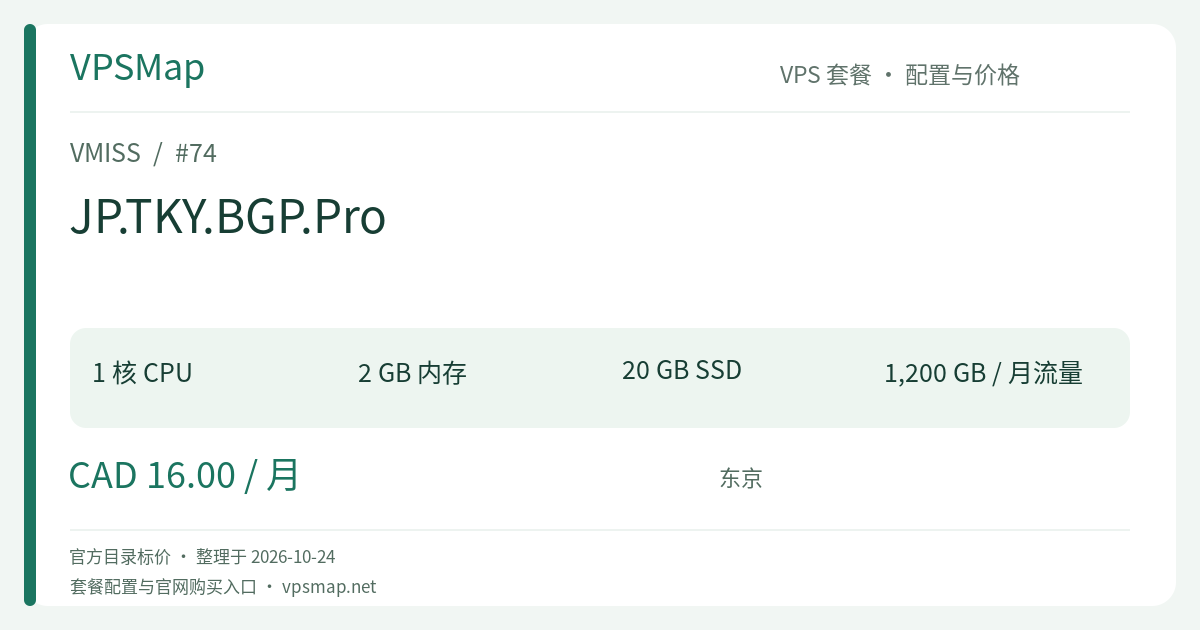
VMISS Japan Tokyo BGP Pro Overview: Stepping Up to 2GB RAM and 750Mbps Bursts at CAD 16/mo
Updated
The Core Value: Crossing the 2GB Memory Threshold#
In cloud infrastructure sizing, 1GB RAM often creates persistent operational friction. While accessible, deploying modern software stacks on 1GB mandates constant compromises. Between background OS processes, a container daemon, an embedded database, and an application framework, available memory quickly dwindles to tens of megabytes—leaving services vulnerable to sudden Linux kernel OOM (Out of Memory) terminations during traffic peaks.
The JP.TKY.BGP.Pro package from VMISS provides the natural bridge for projects advancing from sandbox experimentation to true production status. Priced at CAD 16 / month (billed in Canadian Dollars), it upgrades baseline resources to 1 vCPU, 2048MB (2GB) RAM, 20GB disk storage, 1200GB monthly traffic, and an expanded 750Mbps burst port. This configuration removes memory ceilings and enables reliable multi-tier service hosting in Tokyo.
Comprehensive Technical Specifications#
| Attribute | Provisioned Level | Production Reality |
|---|---|---|
| vCPU | 1 Core | Handles intensive I/O scheduling and regular synchronous processing |
| RAM | 2048 MB (2GB) | Comfortably runs containerized stacks, local databases, and application frameworks |
| Storage | 20 GB | Provides headroom for OS binaries, container layers, cache files, and logs |
| Bandwidth | 1200 GB / month | ~40GB daily allowance, well-suited for high-volume API relays and web apps |
| Port Speed | 750 Mbps burst | Substantially wider network pipe for faster asset transfers and spike absorption |
| Pricing | CAD 16 / month | Transparent monthly CAD billing with flexible termination terms |
1. Workloads Unlocked by 2GB RAM#
With 2048MB RAM available, administrative practices shift from tight memory rationing to standard Docker Compose deployments. Systems can comfortably run multi-component stacks without constant stability hazards:
- Production Web Platforms: Content systems such as Ghost, WordPress, or custom headless CMS solutions running alongside tuned MariaDB/PostgreSQL instances and Redis caches, with ample space remaining for OS page caching.
- Application Gateways: Microservices written in Python (FastAPI), Node.js (NestJS/Express), or Go running behind Nginx or Caddy SSL reverse proxies, smoothly absorbing deployment and cold-start memory spikes.
- Automation & Sync Daemons: Self-hosted developer utilities such as Gitea/Forgejo code repositories, lightweight object storage proxies, or workflow automation tools like n8n.
2. The Synergy of 750Mbps Port Speeds and 1200GB Bandwidth#
Stepping up from the 500Mbps port of lower tiers to a 750Mbps interface yields significant throughput benefits. During large package installations, container image pulls, or backup syncs, this 50% increase in burst capacity reduces transit latency and prevents queue backups.
Furthermore, the 1200GB monthly bandwidth quota translates to approximately 40GB of daily transfer. This volume accommodates busy business APIs, multi-user relay proxies, and active web properties without risk of end-of-month starvation.
Network Characteristics & Operational Policies#
Hosted in VMISS's Tokyo facility with routing classified under the vendor's Tokyo BGP profile, users should account for the following official technical parameters:
- IPv4-Only Networking: As officially notified on June 8, 2026, IPv6 connectivity was formally terminated across the JP.TKY.BGP and JP.TKY.IIJ product groups. Each virtual machine receives a dedicated public IPv4 address without native IPv6 routing.
- Standardized IP Replacement: If network reconfiguration demands a fresh public IPv4 address, VMISS provides an IP Replacement service under the "Others" store section for CAD 5. Upon payment, submitting a support ticket detailing the instance ID completes the reassignment.
- Corporate & Currency Context: VMISS operates out of Mississauga, Ontario, Canada, with all storefront invoices rendered in Canadian Dollars (CAD).
Comparative Tier Analysis: Why Pro Hits the Sweet Spot#
Examining the tier transitions highlights why Pro represents a standout value step:
[Core: CAD 10/mo]  --> 1C / 1GB RAM / 15GB Disk / 800GB Bandwidth / 500Mbps
       |
       +-- +CAD 6/mo (Upgrade to Pro)
       v
[Pro:  CAD 16/mo]  --> 1C / 2GB RAM / 20GB Disk / 1200GB Bandwidth / 750Mbps
       |
       +-- +CAD 14/mo (Upgrade to Elite)
       v
[Elite: CAD 30/mo] --> 2C / 4GB RAM / 40GB Disk / 2000GB Bandwidth / 750Mbps- Versus Core (CAD 10/mo): An additional CAD 6/month delivers double the memory (2GB vs 1GB), 50% more monthly transfer (1200GB vs 800GB), 5GB extra storage, and an upgraded 750Mbps port. This modest incremental fee provides the single largest reliability upgrade in the Tokyo line by mitigating memory starvation.
- Versus Elite (CAD 30/mo): While Elite adds a second CPU core and reaches 4GB RAM, it nearly doubles the price to CAD 30/month. Unless applications specifically require multi-threaded compute workloads, Pro remains the most cost-efficient choice for general dynamic services.
Procurement and Getting Started#
Storefront inventory updates in real time based on infrastructure availability. When in stock, instances are quickly configured upon invoice clearing.
- Direct Order Link: Order VMISS JP.TKY.BGP.Pro (CAD 16/month)
Following provisioning, enabling Linux BBR congestion control is recommended to optimize data throughput over the 750Mbps interface, establishing a responsive, dependable Tokyo deployment base.