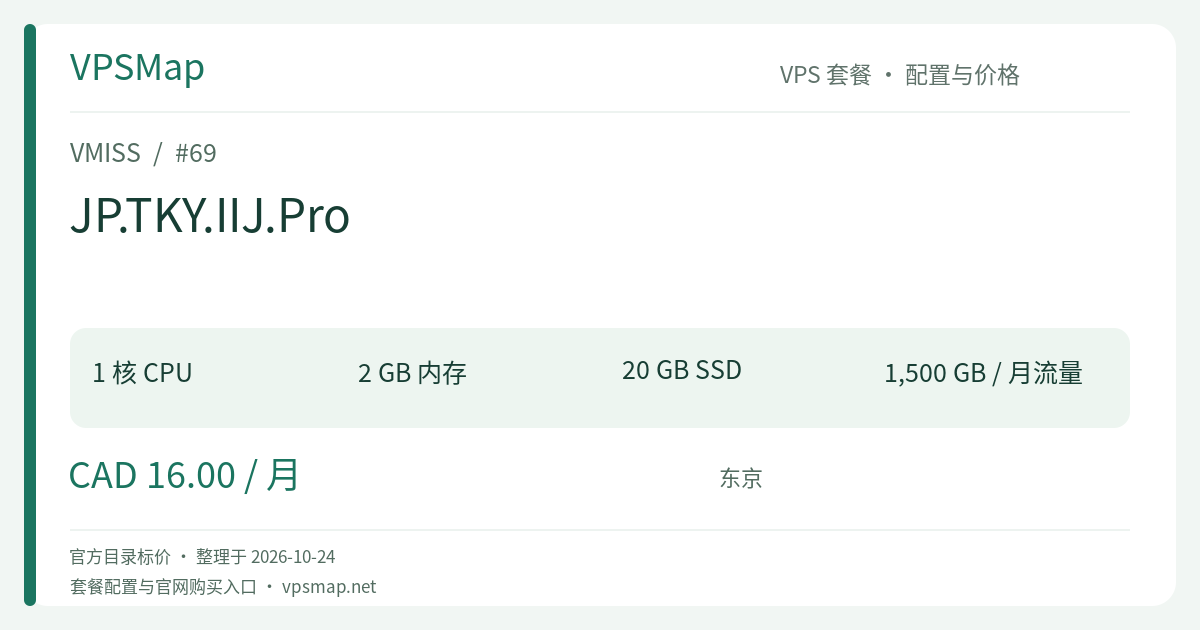
VMISS JP.TKY.IIJ.Pro Review & Buyer's Guide: The Balanced 2GB RAM Tokyo VPS with 750Mbps Uplink
Updated
Why Production Workloads Require at Least 2GB RAM#
When evaluating cloud hosting options in Tokyo, entry-level tiers with the lowest monthly price tags often catch the initial attention. However, in modern server environments, 1GB of RAM leaves very little room to breathe. Modern Linux distributions (such as Ubuntu 22.04/24.04 or Debian 12) routinely consume 150MB to 250MB out of the box. Once you run the Docker daemon, an Nginx reverse proxy, an application backend built on Node.js, Python, or Go, and a companion relational database or Redis cache, available memory quickly approaches critical limits. A single heavy background job or system update can trigger the Linux OOM Killer, terminating vital business processes without warning.
VMISS JP.TKY.IIJ.Pro addresses this challenge directly with its 2048 MB (2 GB) RAM allocation. That extra gigabyte of headroom provides a safe cushion for system buffers, application caches, and restart spikes, allowing developers to run a complete, self-contained software stack on a single server without constant anxiety over memory saturation.
Hardware & Network Specification Breakdown#
This tier strikes a deliberate balance between computing power, storage efficiency, and network throughput:
| Specification | Details |
|---|---|
| vCPU Cores | 1 vCPU |
| System Memory | 2048 MB (2 GB) |
| Local Storage | 20 GB |
| Monthly Bandwidth | 1500 GB |
| Port Speed | 750 Mbps |
| Datacenter / Network Tag | Tokyo, Japan / JP.TKY.IIJ |
| Official Price | CAD 16 / month (Billed in Canadian Dollars) |
| Purchase Link | Order VMISS JP.TKY.IIJ.Pro |
Beyond doubling RAM over entry tiers, the Pro plan upgrades port throughput from 500 Mbps to 750 Mbps, expanding peak transmission bursts by 50%. The 1500 GB monthly transfer quota averages roughly 50 GB per day—more than generous for transactional APIs, SaaS utilities, and regular web traffic.
Ideal Practical Use Cases#
- Production-Ready Content Platforms & Web Applications Capable of hosting full dynamic stacks like WordPress (with Redis caching and OPcache), Ghost, Strapi, or SSR frameworks like Next.js, maintaining reliable response times without database restarts.
- Containerized Utility Stacks Easily supports multiple utility containers via Docker Compose, such as Uptime Kuma for status checks, Vaultwarden for password management, and Nginx Proxy Manager for automated SSL certificate renewals.
- Low-Latency East Asian Gateway Services Operating in Tokyo, this plan acts as an efficient bridge for interacting with local public cloud regions (e.g., AWS Tokyo, GCP Tokyo) or regional client endpoints across East Asia.
Important Trade-offs and Official Policy Considerations#
To ensure your workloads align smoothly with this service, keep the following official terms and characteristics in mind:
- IPv4-Only Networking (No IPv6): According to the official VMISS announcement on June 8, 2026, IPv6 service on the JP.TKY.IIJ and JP.TKY.BGP lines has been permanently discontinued, and existing complimentary addresses were phased out. This instance operates strictly with a single dedicated IPv4 address.
- Vendor Network Labeling: The "IIJ" tag in the product name is the vendor's internal network identifier. Official documentation does not guarantee custom routing rules per individual ISP.
- 20 GB Storage Discipline: With 20 GB of local storage, the instance is intended for core system files, runtime packages, and operational caches. Media-heavy sites or historical archives should offload binary objects to dedicated cloud storage (such as Cloudflare R2 or Backblaze B2).
- IP Replacement Protocol: If your IP needs to be rotated due to external constraints, VMISS provides an IP Replacement add-on for CAD 5. Once purchased, submit a support ticket specifying the affected service to complete the reassignment.
- Dynamic Availability and Currency: All billing is processed in Canadian Dollars (CAD). Catalog availability varies dynamically; check live inventory directly on the order page.
Comparing Within the Series: Basic, Core, Pro, and Elite#
VMISS structures its Tokyo IIJ catalog in straightforward functional tiers:
| Plan Name | vCPU / RAM | Storage | Bandwidth | Port Speed | Price |
|---|---|---|---|---|---|
| JP.TKY.IIJ.Basic | 1C / 1024 MB | 10 GB | 500 GB | 500 Mbps | CAD 5 / mo |
| JP.TKY.IIJ.Core | 1C / 1024 MB | 15 GB | 800 GB | 500 Mbps | CAD 10 / mo |
| JP.TKY.IIJ.Pro | 1C / 2048 MB | 20 GB | 1500 GB | 750 Mbps | CAD 16 / mo |
| JP.TKY.IIJ.Elite | 2C / 4096 MB | 40 GB | 2500 GB | 750 Mbps | CAD 30 / mo |
- Compared to Basic / Core: At CAD 5 or CAD 10 per month, the lower tiers work well for basic diagnostic probes or raw static pages. However, for continuous business services, upgrading to Pro for CAD 16/month eliminates the fatal 1GB RAM bottleneck and delivers a wider 750 Mbps pipe.
- Compared to Elite: Elite at CAD 30/month offers 2 cores and 4GB RAM. If your application logic does not demand intensive parallel processing, Pro allows you to run smoothly while saving CAD 14 each month.
Initial Deployment Recommendations#
To maximize the operational resilience of your 2GB instance, consider applying these setup adjustments upon initial boot:
- Configure a 2GB Swap File: Even with 2GB of physical memory, a small swap partition protects the server against unexpected consumption spikes:
fallocate -l 2G /swapfile chmod 600 /swapfile mkswap /swapfile swapon /swapfile echo '/swapfile none swap sw 0 0' >> /etc/fstab - Set Container Memory Limits: When creating services via Docker Compose, apply explicit memory caps (e.g.,
mem_limit: 512m) to prevent rogue containers from exhausting system resources. - Maintain Disk Hygiene: Run regular image prune jobs (
docker image prune -af) to ensure unused layers do not accumulate inside the 20GB local disk.