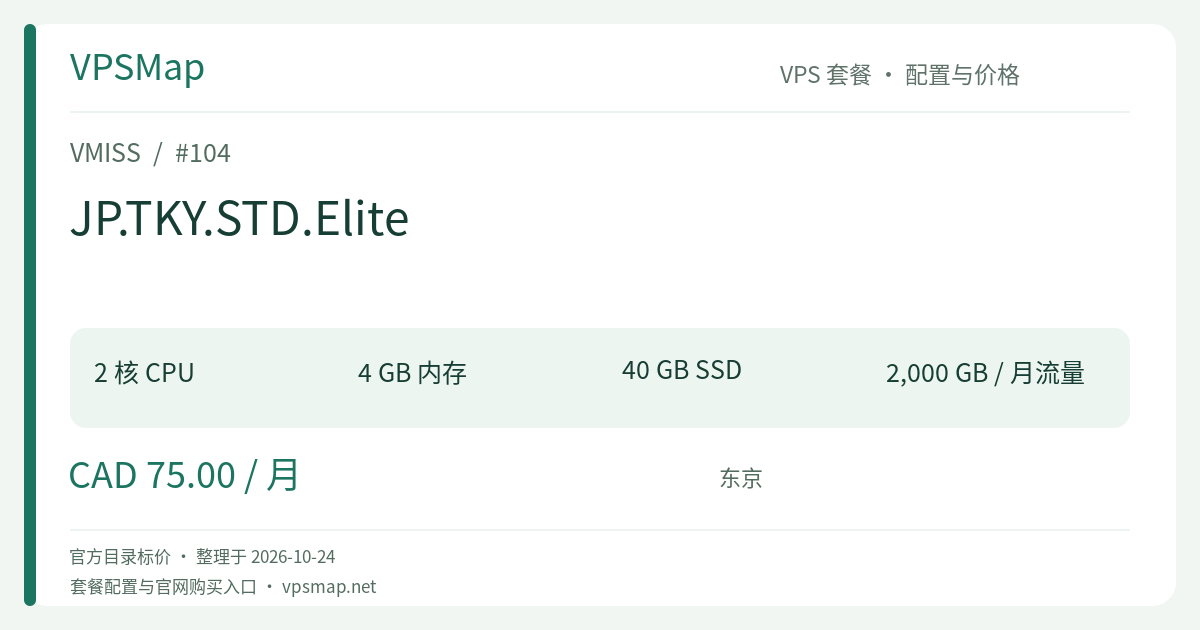
VMISS Tokyo JP.TKY.STD.Elite Guide: The 2-Core, 4GB RAM & 2TB Bandwidth Balance in Japan
Updated
Why 2 Cores and 4GB RAM Mark the Turning Point for Production#
When deploying cloud infrastructure in Tokyo, many lightweight deployments start out on entry-level 1-core, 1GB or 2GB RAM instances. However, as soon as a project introduces standalone relational databases, system observability daemons, or memory-hungry runtimes (such as Java-based services, multi-process Node.js clusters, or multi-container Docker Compose stacks), 1GB to 2GB quickly becomes a tight bottleneck. The system begins swapping aggressively, application performance degrades, and unexpected Out-Of-Memory (OOM) crashes become a constant risk.
VMISS's JP.TKY.STD.Elite plan was created precisely to solve this challenge. It moves beyond the limitations of experimental instances, providing a true production-grade tier in Tokyo with 2 vCPUs, 4096MB of RAM, and 40GB of storage. Combined with a generous 2000GB monthly bandwidth allowance over a 200Mbps port, this instance gives engineering teams and digital businesses the resource headroom required to operate without fear of memory exhaustion.
Hardware Profile and Core Specifications#
Listed at CAD 75/month, the JP.TKY.STD.Elite package occupies a dedicated position for medium-to-high application demands:
- Compute: 2 vCPUs provide sufficient concurrency to handle multithreaded jobs, parallel request parsing, and background routines simultaneously without stalling the main application loop.
- System Memory: 4096MB (4GB) allows hosting a standard web stack alongside a local MySQL, PostgreSQL, or Redis cache, while leaving adequate space for the Linux OS page cache to keep disk I/O latency low.
- Storage Capacity: 40GB disk space, doubling the allowance of the lower tiers, offering adequate room for Docker layers, application logs, and database tables.
- Network Transfer: 2000GB/month (approx. 2TB) on a 200Mbps port, delivering reliable throughput for daily traffic peaks and data exchanges across regional endpoints.
Realistic Deployment Use Cases#
1. Mid-Sized Web Applications and Containerized Stacks#
If your setup involves a reverse proxy (e.g., Nginx, Caddy), a backend API service, and a database instance running together on a single server, 4GB RAM is the recommended baseline. JP.TKY.STD.Elite consolidates these tiers onto one box, eliminating the latency of multi-server interconnections while giving each daemon enough breathing room.
2. East Asia Regional API Gateway and Sync Node#
Tokyo acts as a major network exchange center in the Asia-Pacific region, providing short geographic reach to nearby countries. With a 200Mbps port and 2TB of monthly traffic, this instance is well suited to serve as a regional API proxy, webhook ingestion node, or synchronization endpoint.
3. Self-Hosted CI/CD Runners and Build Environments#
Code compilation and test suites demand burstable CPU and solid memory reserves. A 1-core machine often times out during complex asset builds or Docker image packaging. The 2-core, 4GB RAM profile of the Elite plan handles these workflows reliably without crashing background processes.
Important Considerations and Trade-Offs#
Before ordering JP.TKY.STD.Elite, evaluate these practical considerations against your architectural requirements:
- Budget Commitment: At CAD 75/month, this plan represents a significant monthly infrastructure investment compared to the CAD 12 or CAD 24 tiers. If you are merely hosting a personal blog or low-traffic landing page, the Basic or Core options remain far more economical.
- Network Characteristics: This plan belongs to the Tokyo Standard series (catalog tag
jp-tokyo-std). It operates over standard Japanese local and international transit. It should not be mistaken for premium carrier-specific routing, and connectivity should be evaluated based on standard transit benchmarks. - Throughput Bounds: The 200Mbps network port is more than adequate for dynamic REST APIs and web traffic, but if your core requirement involves massive sustained transfers or raw media streaming, ensure that a 200Mbps ceiling aligns with your SLA.
Tokyo Standard Series Comparison#
To help you determine which tier best matches your application scale, here is the full lineup of the Tokyo Standard family:
| Plan Name | vCPU | RAM | Storage | Bandwidth | Port Speed | Price (CAD) | Order Link |
|---|---|---|---|---|---|---|---|
| JP.TKY.STD.Basic | 1 Core | 1024 MB | 10 GB | 400 GB | 100 Mbps | CAD 12/mo | View & Order |
| JP.TKY.STD.Core | 1 Core | 2048 MB | 15 GB | 800 GB | 100 Mbps | CAD 24/mo | View & Order |
| JP.TKY.STD.Pro | 1 Core | 3072 MB | 20 GB | 1200 GB | 200 Mbps | CAD 38/mo | View & Order |
| JP.TKY.STD.Elite | 2 Cores | 4096 MB | 40 GB | 2000 GB | 200 Mbps | CAD 75/mo | Select Elite Plan |
| JP.TKY.STD.Ultra | 4 Cores | 8192 MB | 80 GB | 3200 GB | 300 Mbps | CAD 150/mo | View & Order |
Summary#
When your project outgrows basic development VPS tiers and demands dependable memory headroom and multi-core execution in Tokyo, JP.TKY.STD.Elite (CAD 75/month) provides a balanced, production-ready foundation with 4GB RAM and 2TB monthly bandwidth.