VMISS US.LA.TRI.Pro Review: Overcoming Entry-Level Memory Bottlenecks with 3084MB RAM in Los Angeles
Updated
The Dilemma: Why 3084MB RAM Marks the Budget VPS Sweet Spot#
When shopping for an entry-level VPS priced around the mid-teens in Canadian or US dollars, developers rarely run out of CPU power first. The primary constraint is almost always system memory exhaustion.
A typical 1GB or 2GB virtual machine running a contemporary Linux distribution (like Ubuntu 22.04 or Debian 12) with the Docker engine leaves mere hundreds of megabytes of spare RAM. Launching a Node.js runtime, a Python web application, a lightweight Java microservice, or an active MySQL database buffer quickly pushes memory saturation into the danger zone, often triggering the Linux kernel's Out-Of-Memory (OOM) Killer.
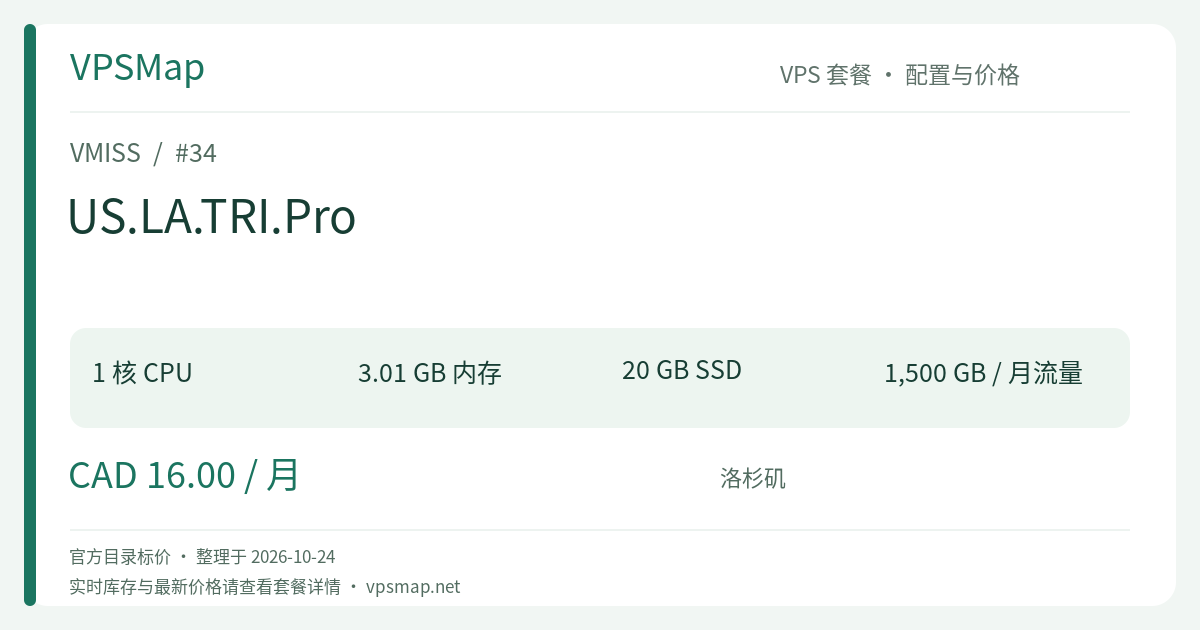
VMISS's Los Angeles facility offers the US.LA.TRI.Pro plan, officially engineered with a distinctive 3084 MB memory profile for CAD 16 / month. Delivering an extra gigabyte of headroom beyond conventional entry machines, this configuration provides the necessary margin to host real-world backend applications alongside their supporting services without forcing reliance on slow disk-based Swap partitions.
Detailed Technical and Network Specs#
Official technical metrics for US.LA.TRI.Pro are:
- CPU: 1 vCPU
- System Memory: 3084 MB (official vendor specification)
- Disk Storage: 20 GB
- Monthly Bandwidth: 1500 GB (bidirectional)
- Port Throughput: 300 Mbps
- Location: Los Angeles, United States (us-los-angeles-tri)
- List Price: CAD 16 / month (monthly billing cycle)
The Operational Role of a 300Mbps Port and 1500GB Bandwidth#
Los Angeles acts as a principal telecommunications nexus for Western North America and trans-Pacific connectivity:
- 300 Mbps Uplink / Downlink: Yielding maximum theoretical throughput of approximately 37.5 MB/s, this bandwidth comfortably accelerates dependency resolution (
npm install,docker pull), asset delivery, and remote administrative workflows without throttling. - 1500 GB Data Allocation: Equivalent to an average daily budget of roughly 50 GB, this transfer volume easily covers standard personal portfolios, automated monitoring collectors, lightweight web services, and internal tooling without running the risk of monthly overages.
Comparing the Los Angeles TRI Series#
The US.LA.TRI product family features three clear capacity tiers:
| Plan Name | CPU | RAM | Storage | Bandwidth | Port Speed | Price | Order Link |
|---|---|---|---|---|---|---|---|
| US.LA.TRI.Pro | 1 Core | 3084 MB | 20 GB | 1500 GB | 300 Mbps | CAD 16 / mo | Order Now |
| US.LA.TRI.Elite | 2 Cores | 4096 MB | 40 GB | 2500 GB | 300 Mbps | CAD 30 / mo | Order Now |
| US.LA.TRI.Ultra | 4 Cores | 8192 MB | 80 GB | 4000 GB | 500 Mbps | CAD 60 / mo | Order Now |
Why the Pro Tier Stands Out#
Stepping up from the CAD 16/mo Pro plan to the CAD 30/mo Elite plan nearly doubles your expenditure. While Elite introduces a second CPU core, 40GB storage, and a modest jump in memory to 4096MB, workloads that are memory-sensitive rather than compute-heavy—such as long-running worker processes, API daemons, and standalone caching layers—run smoothly within Pro's 3084MB boundary at practically half the ongoing recurring cost.
Practical Disk Optimization Guidelines#
With 20 GB of local storage, sensible hygiene preserves adequate headroom for OS patches and software updates:
1. Pruning Container Cache#
Docker environments can accumulate untagged layers and dangling volumes over successive CI/CD cycles. Running a cleanup routine maintains free disk space:
# Check filesystem consumption
df -h

# Remove unused container layers, networks, and build caches
docker system prune -f
2. Restricting System Log Footprint#
By default, Linux systemd journals can consume considerable disk space. Limit log sizes by setting SystemMaxUse in /etc/systemd/journald.conf:
[Journal]
SystemMaxUse=200M
Apply the changes using systemctl restart systemd-journald. This configuration guarantees that system logs will never encroach on application storage.
Final Buying Recommendation: Who Should Pick US.LA.TRI.Pro?#
- Developers and Engineers: Seeking an affordable, stable US West sandbox with enough RAM to run Docker without tripping memory alarms.
- Low-to-Medium Traffic Web Deployments: Hosting modern stacks (NestJS, Django, FastAPI, lightweight Spring Boot) that require baseline memory allocations to stay responsive.
- Global and North American Facing Endpoints: Benefiting from robust network transit out of Los Angeles for distributed clients.
If you want to escape the restrictive limits of typical 1GB and 2GB entry instances while keeping your server budget at CAD 16 / month, US.LA.TRI.Pro delivers an exceptionally balanced, memory-conscious starting point.