V.PS Tokyo NRT EPYC Formula Gen 2 Review: 8-Core 32GB Flagship with 2.5 Gbps Port for High-Load APAC Workloads
Updated
Flagship Positioning: When Mission-Critical Workloads Demand Raw Power and Wide Bandwidth#
In the world of cloud servers, instances often fall into two opposite extremes: cheap entry-level boxes suited only for toy scripts or personal blogs, and overpriced hyperscaler instances that meter network bandwidth by the single megabit. However, practical engineering deployments frequently encounter a demanding sweet spot: businesses serving massive, active user bases across the Asia-Pacific region that require robust multi-core processing, generous memory for containerized microservices, and high-throughput, low-jitter network connectivity.
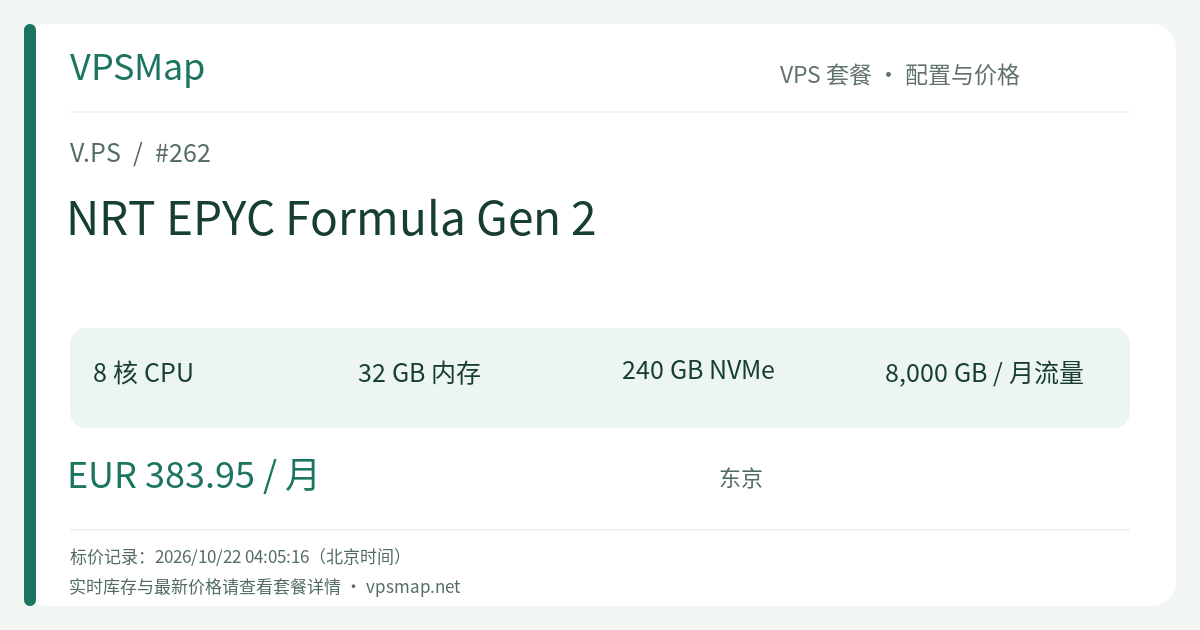
The Performance KVM VPS family from V.PS is specifically engineered for this production-grade tier. Deployed in Tokyo, Japan, the NRT EPYC Formula Gen 2 stands at the pinnacle of the Tokyo lineup. Combining 8 AMD EPYC cores, 32 GB of RAM, 240 GB NVMe SSD storage, and a massive 2.5 Gbps network uplink, it delivers 8 TB of monthly data transfer and includes 2 automated backup slots by default. For engineering teams seeking a formidable deployment node in Tokyo, this is an enterprise-ready workstation ready to deploy out of the box.
Hardware and Network Architecture#
Evaluating a high-tier instance begins with reviewing its hardware specifications and upstream network profile. Below are the official specifications for NRT EPYC Formula Gen 2:
| Specification | Official Details |
|---|---|
| Model Name | NRT EPYC Formula Gen 2 |
| Data Center Location | Tokyo, Japan (NRT) |
| CPU Cores | 8 Cores (AMD EPYC shared vCPU) |
| System Memory | 32 GB RAM |
| Storage Disk | 240 GB Enterprise NVMe SSD |
| Monthly Bandwidth | 8 TB High-Speed Transfer |
| Physical Uplink | 2.5 Gbps Port |
| IP Allocation | 1 Dedicated IPv4 + 1 Native IPv6 |
| Disaster Recovery | 2 Automated Backup Slots Included |
| Base Pricing | €383.95 / month (Billed in EUR) |
Compute & Storage Capabilities#
- 8-Core AMD EPYC: AMD EPYC processors are renowned for high IPC, extensive memory bandwidth, and reliable multi-threaded compute. While operated in a shared virtualization environment (not bare-metal dedicated cores), an 8-core allocation easily accommodates intensive thread pools, JVM instances, Go microservices, and asynchronous background worker queues.
- 32 GB RAM: Memory is the backbone of production stability. Having 32 GB allows engineering teams to comfortably run Redis clusters, Elasticsearch nodes, PostgreSQL database instances, and reverse proxies side by side without fearing the operating system's OOM-killer.
- 240 GB NVMe Storage: High concurrency demands high I/O throughput. The NVMe storage backend ensures ultra-low access latency and elevated IOPS, keeping database commits, WAL writes, and deployment builds swift and responsive.
Network Advantage: 2.5 Gbps Uplink in Tokyo#
Tokyo is the preeminent Internet exchange gateway in East Asia, housing dense submarine cable landings and primary Tier-1 global transit networks. Backed by xTom's established network infrastructure, V.PS integrates premium Tier-1 carrier upstreams and maintains direct peering at global Internet Exchange Points (such as AMS-IX and DE-CIX). With an expanded 2.5 Gbps physical port, the instance easily absorbs sudden inbound bursts and effortlessly pumps massive outbound streams with minimal packet queuing.
What Problems Does It Solve?#
An investment of €383.95 per month must directly deliver tangible architectural and business benefits:
1. Primary APAC Regional Hub#
For businesses catering to clients across Japan, Korea, Hong Kong, Southeast Asia, and the US West Coast, Tokyo consistently offers the most balanced routing topology with minimal regional latency. Combined with a 2.5 Gbps pipe, it functions brilliantly as a primary API gateway and application backend.
2. Multi-Container Microservice Clusters (Docker / K3s)#
Running Kubernetes or extensive Docker Compose stacks on 2GB or 4GB virtual servers inevitably leads to resource contention. Formula Gen 2 provides the compute and memory ceiling required to host a self-contained microservice cluster—complete with Traefik, Prometheus, Loki, message brokers, and dozens of discrete application containers—all within a single clean instance.
3. High-Throughput Media and Data Processing#
With an 8 TB transfer quota and a 2.5 Gbps pipe, the server easily handles heavy data ingestion pipelines, automated media transcoding workloads (leveraging the 8 EPYC cores), and cross-cloud synchronization relays.
4. Built-In 2 Backup Slots for Zero-Risk Operations#
Backup neglect remains one of the costliest oversights in server management. V.PS includes two independent backup slots with the Performance tier. Developers can snapshot the complete system image prior to critical migrations or framework upgrades, enabling rapid rollbacks if unexpected failures arise.
Tier Comparison & Purchase Trade-offs#
Before finalizing your deployment, consider the sibling models in the Tokyo Performance family to determine the ideal budget-to-resource match:
| Plan Name | CPU Cores | RAM | NVMe SSD | Monthly Bandwidth | Port Speed | Backups | Price / Month |
|---|---|---|---|---|---|---|---|
| Flash Gen 2 | 2 EPYC | 4 GB | 30 GB | 1 TB | 1.00 Gbps | 2 | €49.95 |
| Flow Gen 2 | 2 EPYC | 8 GB | 60 GB | 2 TB | 1.25 Gbps | 2 | €95.95 |
| Fleet Gen 2 | 4 EPYC | 16 GB | 120 GB | 4 TB | 2.00 Gbps | 2 | €191.95 |
| Formula Gen 2 | 8 EPYC | 32 GB | 240 GB | 8 TB | 2.50 Gbps | 2 | €383.95 |
Important Trade-Off Considerations:#
- Budget Realism: Formula Gen 2 represents the absolute flagship tier. If your workload is in an initial testing phase and stays comfortably within 16GB RAM, Fleet Gen 2 (€191.95/mo) offers higher entry efficiency. Formula is designed for revenue-generating workloads that cannot afford performance degradation under peak load.
- Storage Type vs. Capacity: The 240GB NVMe storage is built for low-latency random I/O and rapid transactional workloads. If your requirement is archiving dozens of terabytes of cold data, opt for a dedicated Storage HDD line instead of consuming premium NVMe blocks.
- Shared Virtualization: While CPU allocations are generous and powered by high-end AMD EPYC processors, cores are shared vCPUs. Sustained 100% mining or abusive continuous stress tests violate standard Terms of Service.
Terms of Service, Anti-Fraud, and Refund Policy#
V.PS maintains strict compliance policies and transparent refund procedures that all buyers should understand:
- Accurate Billing Information Required: Users must provide their genuine legal name and residential address during checkout. Orders are screened by automated anti-fraud filters and review staff; suspicious or fraudulent submissions will be rejected and refunded.
- 14-Day Money-Back Guarantee (Conditions Apply):
- VPS refunds can be requested within 14 calendar days of order placement via a support ticket.
- Limited to one refund per account across its lifetime.
- Data transfer consumed must be strictly under 10 GB.
- No active BGP sessions or Internet Exchange (IX) services may be associated with the server.
- The instance must not have been transferred to or received from another customer account.
- The server IP must not be listed on any abuse blacklists (such as Spamhaus, blocklist.de, or regional filtering lists) at the time of the refund request.
- No IP replacement requests have been submitted.
- Payments made via Cryptocurrency or Bank Transfer are strictly non-refundable.
- Renewals and promotional flash-sale orders are strictly non-refundable.
Step-by-Step Purchase & Deployment Guide#
Public catalog listings do not guarantee static stock availability. To check inventory and provision your server:
- Access the Portal: Navigate through the official gateway via V.PS Official Portal to establish an authentic session on the homepage.
- Browse Products: Click Deploy a Server or inspect the navigation menu to locate Performance KVM VPS.
- Select Region & Plan: Navigate to the Asia Pacific - Tokyo (NRT) tab, locate NRT EPYC Formula Gen 2, and click Order.
- Configure Operating System: Select your preferred Linux distribution (Debian Stable, Ubuntu LTS, CentOS Stream, Rocky Linux, AlmaLinux) or prepare for a custom netboot.xyz ISO installation.
- Complete Checkout: Enter accurate personal and billing address details. Select your preferred payment method (PayPal, Credit Card, Alipay where supported, or regional payment rails) and complete payment.
- Instant Provisioning: Once cleared through automated anti-fraud checks, your instance will be provisioned in seconds. Access your client dashboard to retrieve your assigned IPv4/IPv6 credentials and begin deploying your production stack.