BandwagonHost 480G KVM PROMO VPS Review: 24GB Monster RAM, 7 Cores, 480GB Storage for Heavy Workloads
Updated
The Heavy Artillery: Why You Need a 24GB RAM Heavyweight VPS#
In conventional cloud deployment, virtual private servers are often associated with small static blogs or lightweight scripts, where 1GB or 2GB of RAM is more than sufficient. However, for engineering teams, independent software developers, and data infrastructure engineers, entry-level servers quickly hit painful brick walls:
- Running a modern, self-hosted GitLab CE stack with integrated container registries and continuous integration runners frequently crashes if provisioned with less than 4GB of RAM.
- Launching in-memory data backends—such as Elasticsearch, Redis caching instances, ClickHouse, and Kafka message brokers—instantly consumes 8GB of memory, pushing the operating system into heavy swap thrashing and halting disk I/O.
- Handling multi-gigabyte raw datasets or performing complex offline analytics becomes impossible when constrained by tiny disks and limited RAM.
Ordering an equivalent 7-Core vCPU, 24 GB RAM, 480 GB SSD cloud server on mainstream public clouds like AWS EC2, Azure, or Google Cloud regularly yields recurring invoices between $150 and $250+ each month, excluding metering fees for egress bandwidth.
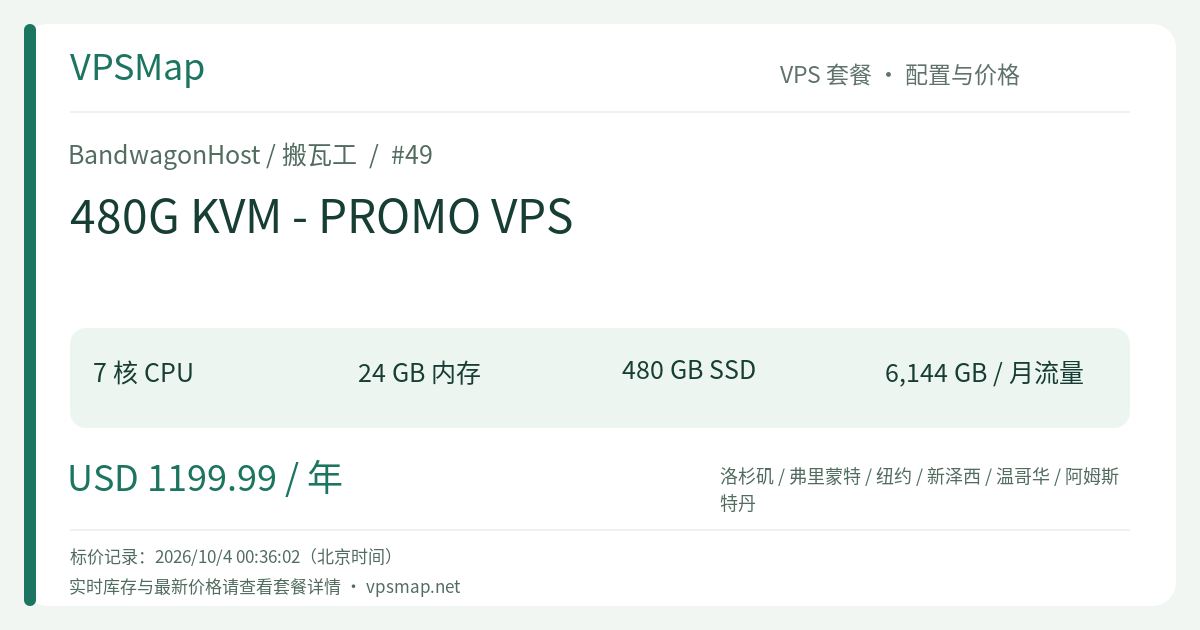
BandwagonHost's 480G KVM - PROMO VPS [Buy direct ↗] (PID 49) is engineered specifically for heavy workloads. By pivoting away from ultra-expensive pure Asian CN2 GIA routing premiums, it channels its resource budget directly into abundant physical compute capacity, massive enterprise SSD storage, and a colossal 6 TB monthly bandwidth quota—all for $1199.99/year (approximately $100/month equivalent).
Specification Profile: 480G KVM PROMO (PID 49) at a Glance#
The sheer scale of this server provides remarkable operational headroom:
| Specification | Details |
|---|---|
| vCPU Cores | 7 Cores (KVM Full Virtualization on enterprise host nodes) |
| System Memory | 24576 MB (24 GB guaranteed physical RAM) |
| Disk Storage | 480 GB SSD (Enterprise RAID redundant array) |
| Monthly Bandwidth | 6144 GB / month (A massive 6 TB global transfer pool) |
| Network Uplink | 1000 Mbps (1 Gbps full duplex port) |
| Routing Profile | Standard KVM optimized routing (Including CN2 GT, LA, and European backbones) |
| Datacenter Options | Seamless KiwiVM migration across 6 premier US, Canadian, and European datacenters |
| Annual Price | $1199.99 / year (Dynamic stock module verification applies) |
Comparison across the High-Capacity PROMO Lineup:
- 80G KVM PROMO (PID 46): 4 Cores / 4GB RAM / 80GB SSD / 3072GB Traffic ($199.99/yr)
- 160G KVM PROMO (PID 47): 5 Cores / 8GB RAM / 160GB SSD / 4096GB Traffic ($399.99/yr)
- 320G KVM PROMO (PID 48): 6 Cores / 16GB RAM / 320GB SSD / 5120GB Traffic ($799.99/yr)
- 480G KVM PROMO (PID 49): 7 Cores / 24GB RAM / 480GB SSD / 6144GB Traffic ($1199.99/yr)
Within this family, PID 49 delivers the top-tier resource combination, offering outstanding memory and storage capacity per dollar.
Roaming Across Six Premier Datacenters: KiwiVM Mobility#
A standout capability included with this plan is BandwagonHost's proprietary KiwiVM automated datacenter migration technology. Subscribers can dynamically shift the entire running system across six strategic Western hubs:
- Los Angeles, USA: Features CN2 GT optimization, providing solid baseline transit across the Pacific rim.
- Fremont, USA: Positioned in the heart of Silicon Valley, ideal for high-speed West Coast tech interconnections.
- New York, USA: The premier East Coast hub for commerce and financial connectivity.
- New Jersey, USA: Excellent connectivity across the Greater New York metropolitan area.
- Vancouver, Canada: Prime Western Canadian network exchange facility.
- Amsterdam, Netherlands: One of Europe's largest internet exchange crossroads (AMS-IX), providing continent-wide low latency.
Triggering a migration within the KiwiVM control panel initiates an automated background disk copy and IP re-allocation. Operating systems, databases, installed packages, and custom configurations remain intact. This multi-datacenter agility provides exceptional flexibility for disaster recovery and cross-continental testing.
Core Engineering Workloads: Concrete Problem Solving#
1. Private Team DevOps, CI/CD, and Build Clusters#
Modern software delivery requires reliable continuous integration pipelines. Backed by 7 vCPU cores and 24GB of RAM, you can comfortably run a private GitLab CE instance alongside automated Jenkins agents or self-hosted GitHub Actions runners. When compiling multi-module Java/Spring Boot applications, heavy Rust projects, or complex Webpack/Vite bundles, ample RAM prevents out-of-memory lockups and slashes build turnaround times.
2. Comprehensive Docker and Microservice Staging Sandboxes#
Free your local laptop from running heavy staging stacks. Deploy full-scale integration environments—spanning dozens of containerized microservices, distributed caching layers, and message brokers like RabbitMQ or Kafka—directly to this 24GB cloud server. Engineering teams can collaborate remotely via VS Code Remote-SSH, validating features against realistic staging environments.
3. Data Extraction, Scraping, and Analytical Ingestion#
A 480GB SSD paired with 24GB of RAM provides an outstanding compute foundation for data pipelines. You can load multi-million-row Pandas DataFrames or DuckDB analytical stores straight into volatile memory, executing aggregation, deduplication, and transformation routines without hitting disk I/O bottlenecks. A 6TB monthly transfer allowance provides ample pipe capacity for high-volume data harvesting.
4. Cross-Continental Disaster Recovery and Media Archiving#
Keeping all organizational assets within a single cloud provider creates single-point-of-failure risks. With 480GB of storage and 6TB of bandwidth, PID 49 serves as an affordable secondary disaster recovery destination. Automated rsync, BorgBackup, or Restic scripts can securely mirror database snapshots and code archives to reliable North American or European facilities.
Pragmatic Trade-Offs: Is This Plan Right for You, or Is CN2 GIA Better?#
Before finalizing your deployment, clarify how this PROMO plan differs from BandwagonHost's CN2 GIA family (such as PID 95, 108, and 167):
                  ┌────────────────────────────────────────┐
                  │       Core Requirement Assessment      │
                  └──────────────────┬─────────────────────┘
                                     │
             ┌───────────────────────┴───────────────────────┐
             ▼                                               ▼
   【Sub-50ms Ping & Zero Peak Packet Loss to China】 【Heavy Compute, 24GB Monster RAM & Storage】
   Need absolute fastest Mainland response           Need DevOps, Docker fleets, big data hubs
             │                                               │
             ▼                                               ▼
   Choose: CN2 GIA Series (PID 95/108/167)          Choose: 480G KVM PROMO (PID 49)
Focus: Scarce, ultra-premium transit Focus: Maximum compute/RAM density- Its Core Advantage: For the same budget ($1199.99/year), a CN2 GIA plan provides 2GB to 8GB of RAM. Here, you secure 24 GB of RAM, 480 GB of SSD storage, and a massive 6TB data transfer pool.
- The Trade-Off: This plan operates over standard optimized routing (CN2 GT and standard transatlantic/transpacific backbones). It excels for Western audiences, internal enterprise infrastructure, and global endpoints. However, for Mainland China visitors during peak evening hours (20:00 - 23:00 CST), transit stability and packet loss resistance cannot match high-cost CN2 GIA/CTGNet connections.
- Fair Share CPU Boundaries: According to BandwagonHost's Terms of Service, the sustained 1-hour average CPU load limit for the 480G tier is 100% of 3 cores (with short-term bursts up to 100% across all 7 cores). This accommodates demanding compilation and batch jobs, while preventing 24/7 unconstrained cryptocurrency mining.
Summary and Purchase Recommendation#
If you need a reliable workhorse capable of running entire CI/CD pipelines, hosting complex containerized microservice fleets, or serving as a robust data processing engine, the 480G KVM - PROMO VPS (PID 49) delivers tremendous value. With 24GB RAM, 480GB SSD, 6TB bandwidth, and 6-datacenter flexibility, it provides an outstanding engineering platform.