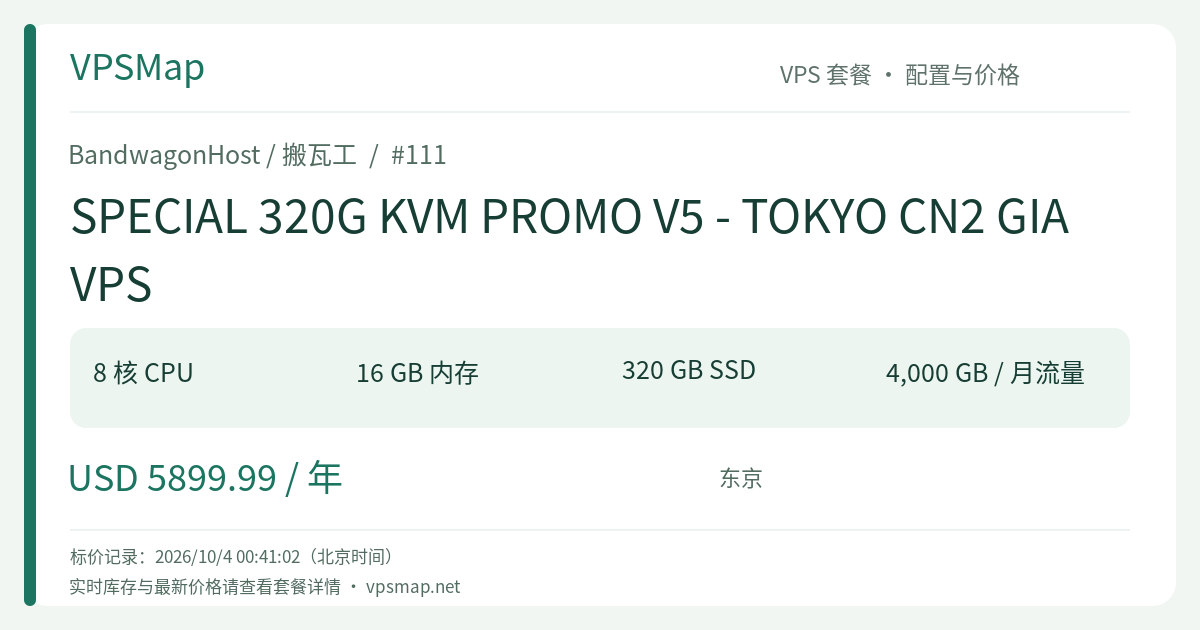
BandwagonHost Tokyo CN2 GIA Flagship (320G/16G): 1.2 Gbps Enterprise Japanese Node Optimized for Mainland China
Updated
The Strategic Value of Tokyo in East Asian Networking#
While Hong Kong provides optimal proximity to southern China, Tokyo offers distinctive routing advantages when serving central and northern China alongside the broader Asia-Pacific region:
- Direct Low-Latency Corridors into Eastern & Northern China: Subsea cable systems (such as NCP and APG) connect Tokyo directly into major Internet transit hubs in Shanghai, Qingdao, and Beijing. Round-trip latency consistently measures between 35ms and 55ms, often outperforming routes from Hong Kong into northern regions.
- World-Class Internet Exchange Connectivity: Tokyo hosts tier-one Internet exchanges (JPIX, BBIX, JPNAP) and major cloud points of presence, providing efficient interconnection across Japan and global backbones.
BandwagonHost's SPECIAL 320G KVM PROMO V5 - TOKYO CN2 GIA VPS (#111 [Buy direct ↗]) utilizes China Telecom's premier AS4809 CN2 GIA network. This eliminates the peak-hour congestion typical of standard 163 public transit (where packet loss often exceeds 30%), delivering a dependable deployment for cross-border production systems.
1.2 Gbps Uplink & Robust Hardware Configuration#
This deployment features a dedicated 1,200 Mbps (1.2 Gbps) physical uplink, providing a 20% throughput advantage over standard 1,000 Mbps ports:
| Spec Dimension | Configuration | Operational Value |
|---|---|---|
| Processing Power | 8 vCPUs | Multithreaded compute capacity for complex workloads |
| Memory | 16,384 MB (16 GB) | Substantial memory space for containers, Redis instances, and application frameworks |
| Disk Storage | 320 GB Pure SSD (RAID-10) | Enterprise storage array delivering consistent I/O performance for production databases |
| Monthly Bandwidth | 4,000 GB (4 TB) | Ample CN2 GIA transfer volume for high-traffic data flows |
| Port Speed | 1,200 Mbps (1.2 Gbps) | Headroom above standard 1 Gbps to absorb traffic spikes |
| Network Route | Dedicated CN2 GIA / CTGNet | Low-latency China transit with minimal evening jitter |
| Management | Proprietary KiwiVM Panel (KVM) | Full administrative suite including snapshots, OS reloads, rDNS, and API access |
Targeted Production Workloads#
- Enterprise Applications Serving Eastern & Northern China: For platforms with significant user bases in the Yangtze River Delta or Beijing-Tianjin-Hebei regions, Tokyo CN2 GIA delivers responsive 35ms–50ms transit without cross-Pacific latency.
- Real-Time Gaming Backends & WebRTC Relays: Combining robust Japanese domestic connectivity with low-latency China transit, this node suits multiplayer game servers, real-time audio/video relays, and signaling platforms.
- Continuous Integration & Cross-Border Hubs: Development environments requiring rapid synchronization between GitHub, AWS/GCP Tokyo, and development teams in mainland China.
- E-Commerce & Digital Asset Delivery: Leveraging a 1.2 Gbps port and 16GB RAM to support concurrent catalog searches, dynamic caching, and asset handling.
Official Terms of Service & Technical Boundaries#
System architects must design around BandwagonHost's documented service boundaries:
- CPU Fair Share Limitations:
- Under ToS rules for the
V5 HONG KONG/TOKYO 320G plan, instances may burst to 100% across all 8 cores during short-term workload surges. - Sustained CPU consumption is evaluated on a one-hour average, with this tier permitted a sustained limit of 100% of 4 cores.
- If the hourly average exceeds this threshold, KiwiVM throttles clock cycles without suspending or powering down the instance. Full performance resumes once compute demands decrease.
- Under ToS rules for the
- Storage I/O Usage Guidelines:
- Avoid continuous disk write operations exceeding 100 MiB/s for 4+ consecutive hours to maintain storage pool performance.
- Self-Managed Service Boundary:
- BandwagonHost maintains physical host nodes, power redundancy, and core transit links. Customers manage internal operating system configuration, software maintenance, and security hardening.
- DDoS Handling & IP Nullrouting:
- CN2 GIA transit is high-cost and capacity-constrained, making it vulnerable to volumetric attacks. In the event of a significant DDoS attack, traffic is nullrouted to protect overall network integrity. Origin IPs should be properly shielded behind reverse proxies.
- 30-Day Refund Policy:
- Available on new orders within 30 days, provided the account is in good standing, the IP address is clean, and total cumulative data usage remains strictly under 10% of the monthly quota.
Sizing & Ordering Guide#
For enterprise projects requiring 16GB RAM, 320GB SSD storage, and a capable 1.2 Gbps uplink, the #111 Tokyo Flagship Plan (8 Cores / 16GB / 320GB / 4TB @ 1.2Gbps) delivers a high-performance foundation in Japan.
For projects with smaller footprints on the same network backbone, consider these alternatives:
- #110 Mid-to-Large Tier: 6 vCPUs / 8GB RAM / 160GB SSD / 2,000GB Bandwidth / 1.2 Gbps Port at $2,999.99/year—ideal for standalone production APIs.
- #109 Standard Enterprise Tier: 4 vCPUs / 4GB RAM / 80GB SSD / 1,000GB Bandwidth / 1.2 Gbps Port at $1,559.99/year—great for production websites and critical data interfaces.
- #108 Agile Entry Tier: 2 vCPUs / 2GB RAM / 40GB SSD / 500GB Bandwidth / 1.2 Gbps Port at $899.99/year—an accessible entry point for testing low-latency Tokyo CN2 GIA connectivity.