BandwagonHost SPECIAL 80G CN2 GIA eCommerce VPS Review & Buyer's Guide: 4GB RAM and 3TB Bandwidth for Mission-Critical Cross-Border Production
Updated
Why Production Workloads Demand the 80G Tier#
Most developers and cross-border businesses start their VPS journey with entry-level or limited-edition plans: 1 to 2 vCPUs, 1GB to 2GB of RAM, and 500GB to 1000GB of monthly data transfer. While suitable for simple personal sites or test proxies, these smaller instances quickly run into serious bottlenecks once real production traffic hits. Running modern Dockerized services, Redis caching layers, Elasticsearch instances, or handling high-volume eCommerce marketing campaigns often triggers out-of-memory (OOM) crashes, CPU throttling, and bandwidth depletion.
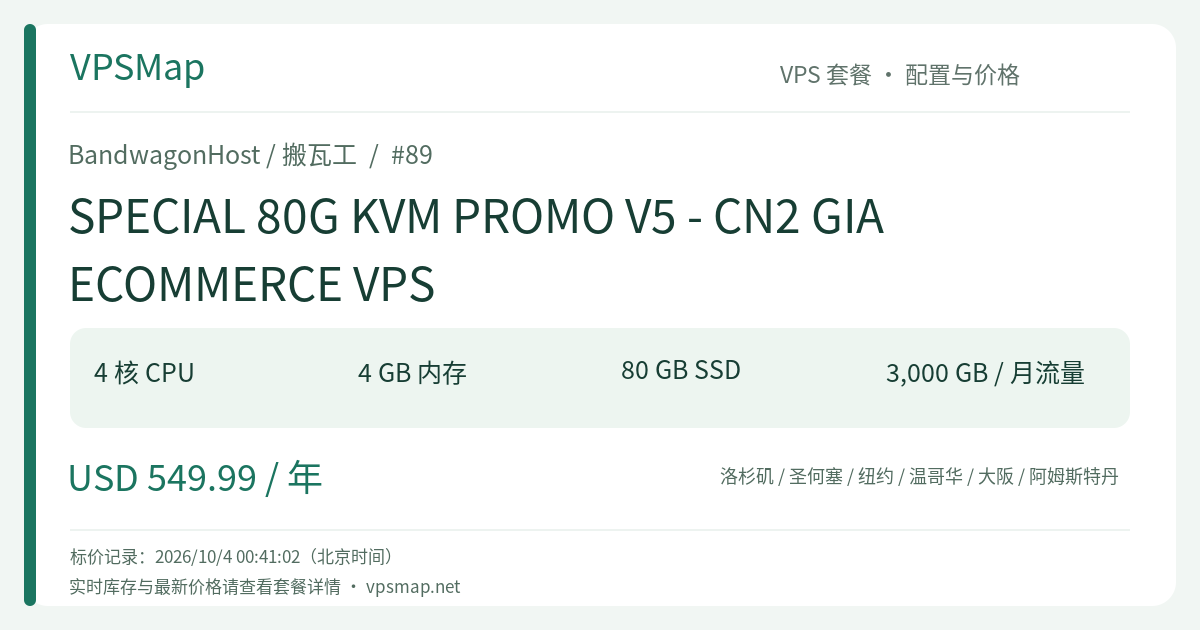
BandwagonHost's SPECIAL 80G KVM PROMO V5 - CN2 GIA ECOMMERCE VPS (PID 89) is designed specifically to eliminate these operational constraints. Delivering 4 vCPUs, 4096 MB (4GB) of RAM, 80GB enterprise SSD storage, and 3000GB of monthly bandwidth over a 2.5Gbps port, this plan transitions your infrastructure from experimental staging to reliable enterprise-grade production.
Hardware Specifications & Real-World Capacity#
When evaluating a premium VPS tier at $549.99 annually, infrastructure engineers look directly at compute headroom and sustained throughput:
| Specification | Allocation | Production Impact |
|---|---|---|
| Compute | 4 vCPUs (KVM virtualization) | Efficiently processes high-concurrency Web workers, background jobs, and API threads |
| Memory | 4096 MB (4GB RAM) | Ample headroom to run a complete LNMP stack, Redis caching, and Docker containers without OOM |
| Storage | 80GB Enterprise SSD RAID | Generous space for media assets, eCommerce catalogs, database logs, and local snapshots |
| Bandwidth | 3000 GB / month (3 TB) | Easily accommodates sustained daily traffic and unpredictable promotion traffic spikes |
| Port Speed | 2500 Mbps (2.5 Gbps) | Low-latency line-rate processing for large concurrent downloads and page bursts |
| Datacenters | Los Angeles, San Jose, Osaka, Amsterdam, etc. | Seamless zero-downtime migration across multiple locations via the KiwiVM control panel |
The 4GB RAM Threshold in Modern Stacks#
Contemporary eCommerce platforms (WooCommerce, Magento 2, PrestaShop) and modern API microservices (Spring Boot, Node.js clusters, Go/Python backends) require substantial runtime memory. On 2GB instances, executing a database re-indexing job or experiencing sudden traffic concurrency frequently causes the Linux kernel to terminate the MySQL daemon.
With 4GB of physical RAM, you can comfortably allocate 1.5GB to the MySQL InnoDB Buffer Pool, dedicate 512MB to 1GB to Redis for in-memory object caching, and retain ample capacity for PHP-FPM or backend runtime workers. This setup eliminates dependency on disk swap, resulting in significantly lower Time To First Byte (TTFB).
Unmatched Connectivity: 8×10GbE Backbone and Tri-Carrier Routing#
Network performance issues between North America and mainland China are rarely caused by raw distance; they are caused by transit congestion. During evening peak hours (20:00 to 23:00 Beijing Time), standard public routes (such as 163 ChinaNet AS4134) experience packet loss rates frequently exceeding 30%, resulting in broken connections, dropped sessions, and sluggish rendering.
BandwagonHost addresses this in its Los Angeles facilities with 8 × 10 GbE (80Gbps) CN2 GIA/CTGNet connectivity combined with direct local peering with tier-1 providers like Google:
- China Telecom Premium Transit: Bidirectional AS4809 CN2 GIA and AS23764 CTGNet routes provide top-tier routing priority, maintaining minimal packet loss and jitter even during peak transit windows.
- Tri-Carrier Optimization (USCA_9 / USCA_6): All inbound and outbound traffic to mainland China is actively optimized across the big three carriers—China Telecom via CN2 GIA, China Unicom via Premium AS10099/9929, and China Mobile via CMIN2 (AS58807). Visitors across all major domestic networks receive stable, low-latency delivery.
- 2.5Gbps Port Headroom: Unlike standard 1Gbps uplinks, a 2.5Gbps port handles burst spikes smoothly, ensuring that heavy concurrent image, stylesheet, and data downloads do not queue up on the physical interface.
Global Mobility via KiwiVM Datacenter Migration#
Deploying the CN2 GIA eCommerce VPS does not permanently lock your data to one server location. Using BandwagonHost's in-house KiwiVM management panel, you can leverage the Datacenter Migration tool at any time without extra fees:
- Los Angeles DC6 / DC9 (USCA_6 / USCA_9): The premier tri-carrier gateway providing balanced global and China-bound performance.
- Osaka, Japan (JPOS_1): Premium Softbank transit providing ultra-low ping for East Asia and coastal China users.
- Vancouver (Canada), Amsterdam (Netherlands), San Jose, and New York: Flexible deployment options to align with evolving regional compliance or international expansion.
Migration runs automatically in the background, preserves all disk files and configurations, and assigns a clean target-location IP upon completion. This architectural flexibility protects your long-term hosting investment against unexpected route changes or regional strategy shifts.
Terms of Service (TOS) & Resource Governance#
To ensure fair multi-tenant reliability across enterprise hardware nodes, BandwagonHost enforces transparent resource usage limits:
- CPU Fair Share Allocation: As designated under the
V5 CN2GIA 80G Promo planin the official TOS, your VPS may burst to 100% of all 4 vCPU cores for short intervals. However, the sustained one-hour average CPU load must not exceed 2 cores (200%). If this ceiling is reached, KiwiVM automatically limits available CPU cycles to protect node stability. Normal cycles resume automatically once the workload cools down, without account suspensions. - Disk I/O Safeguards: Continuous storage I/O throughput must not exceed 100 MiB/s for prolonged periods (4+ consecutive hours) to prevent disk subsystem degradation.
- Self-Managed Responsibility: BandwagonHost guarantees host node hardware availability, virtualization integrity, and network routing. Operating system administration, software configuration, patch management, and application backups are strictly the customer's responsibility. Regular offsite backups should be maintained despite redundant host storage.
- 30-Day Refund Eligibility: Refunds can be requested within 30 days of initial order, provided that the assigned IP is clean, total data transfer is under 10% of the monthly quota, and the account has no payment disputes.
Comparison: Selecting the Right Tier#
| Plan Identifier | vCPU / RAM | Storage / Bandwidth / Port | Pricing (Annual) | Target Workload |
|---|---|---|---|---|
| #105 [Buy direct ↗] Limited Edition | 1 Core / 1024 MB | 20GB / 500GB / 1Gbps | $89.99 | Lightweight personal testing, highly constrained inventory |
| #132 [Buy direct ↗] Limited Edition | 2 Cores / 2048 MB | 40GB / 1000GB / 2.5Gbps | $89.90 | Entry-level value choice, quickly exhausted by commercial traffic |
| #88 [Buy direct ↗] eCommerce | 3 Cores / 2048 MB | 40GB / 2000GB / 2.5Gbps | $299.99 | Solid for growing SMB storefronts, but 2GB RAM limits complex stacks |
| #89 [Buy direct ↗] eCommerce (This Plan) | 4 Cores / 4096 MB | 80GB / 3000GB / 2.5Gbps | $549.99 | The production benchmark for high-concurrency stores, container clusters, and core workloads |
For commercial ventures generating regular revenue, choosing an under-provisioned 2GB server to save initial costs frequently leads to expensive downtime and lost customer conversions during high-traffic events. The SPECIAL 80G tier (PID 89) delivers the computing and transit cushion required for dependable business operations.
Summary & Direct Order Access#
- Ideal Use Cases: High-volume WooCommerce/Magento stores, mission-critical API gateways, cross-border development staging environments, and content delivery platforms requiring rock-solid mainland China responsiveness.
- Deployment Tip: Start by selecting USCA_9 (Los Angeles DC9) or USCA_6 (Los Angeles DC6) during checkout for optimal tri-carrier backbone performance, and re-allocate via KiwiVM as your geographical focus evolves.