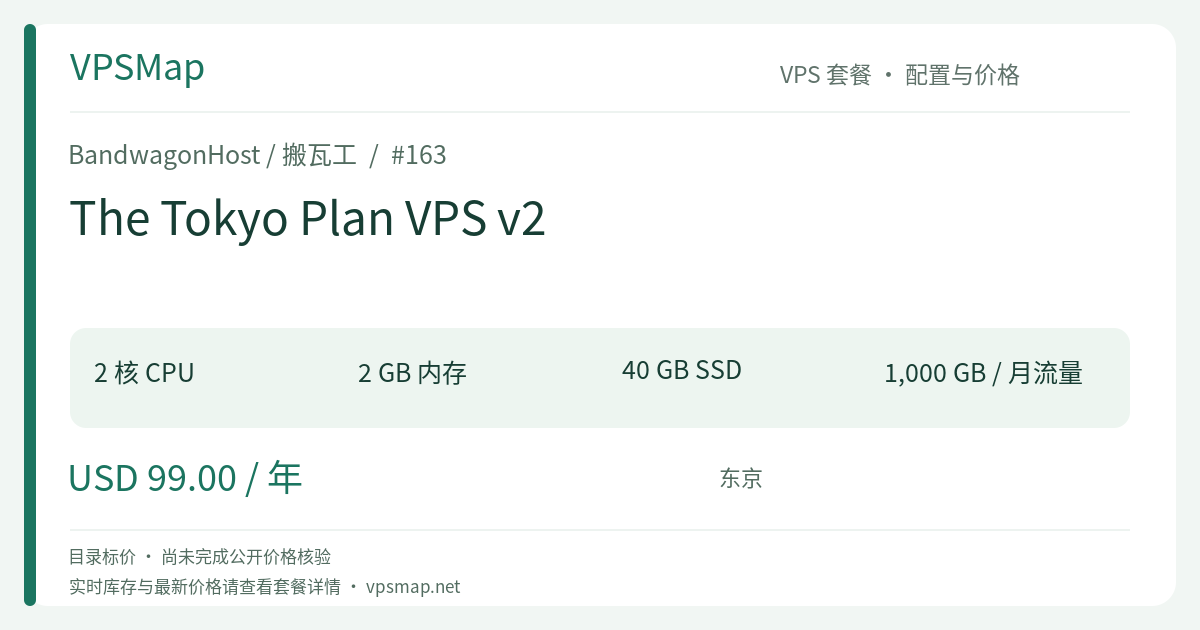
BandwagonHost The Tokyo Plan v2 (PID 163) In-Depth Guide: 5 Gbps Uplink and Doubled Specs at $99/Year
Updated
Moving from Light Exploration to True Production: The Evolution of Tokyo Plan v2#
Developers seeking high-performance virtual servers in Tokyo often encounter a frustrating trade-off:
- Affordable entry-level offerings typically cap resources at 1 vCPU and 512MB or 1GB RAM. Under modern deployment standards, launching an Nginx reverse proxy, a Node.js or Go backend, and an essential database engine quickly exhausts 1GB of memory, causing frequent Out-Of-Memory (OOM) process terminations;
- Conversely, enterprise-grade cloud instances in Tokyo with 2GB+ memory often demand steep monthly fees of $50 to $100+, creating heavy recurring overhead for independent developers, content creators, and small startups.
BandwagonHost's The Tokyo Plan v2 [Buy direct ↗] (PID 163) was engineered to solve this dilemma. By adding only $20/year to the price of the original Tokyo Plan ($99/year vs $79/year), it comprehensively doubles the CPU cores, RAM, SSD capacity, bandwidth quota, and uplink port speed—turning an entry-level test node into a legitimate, production-capable powerhouse in Tokyo.
Comprehensive Spec Analysis: The "All-Around Doubled" Architecture#
A close examination of The Tokyo Plan v2 (PID 163) highlights why it has earned a stellar reputation among developers:
| Dimension | Specification | Upgrade vs. v1 (PID 162) | Practical Operational Advantage |
|---|---|---|---|
| vCPU Allocation | 2 vCPU Cores | Doubled (1 Core ➔ 2 Cores) | Multi-threaded task handling and efficient concurrent request processing |
| CPU Fair-Share Limit | 1-Hour Average 45% of 1 core | +50% Higher (30% ➔ 45%) | Generous compute headroom under official ToS guidelines |
| RAM Capacity | 2048 MB (2 GB) | Doubled (1024 MB ➔ 2048 MB) | Comfortably runs containerized microservices and databases without OOM panics |
| SSD Storage | 40 GB Enterprise SSD | Doubled (20 GB ➔ 40 GB) | Ample capacity for Docker images, application volumes, and system logs |
| Monthly Traffic | 1000 GB (~1 TB) | Doubled (500 GB ➔ 1000 GB) | Supports active production web apps, API traffic, and periodic data sync |
| Port Speed | 5000 Mbps (5 Gbps) | Doubled (2.5 Gbps ➔ 5 Gbps) | Massive tier-1 backbone throughput; eliminates local upstream queuing |
| Annual Price | $99.00 USD / Year | +$20/year difference | ~$0.27/day—an extraordinary price-to-performance ratio in Tokyo |
Securing 2GB of RAM, 40GB SSD, and a genuine 5 Gbps port in central Tokyo for under $100/year represents exceptional industry value.
5 Gbps Bandwidth and 2GB RAM: Practical Capabilities#
What operational hurdles does upgrading to this configuration solve?
1. Robust Multi-Container Deployments with Docker Compose#
2 GB of RAM represents the dividing line between brittle single-app setups and reliable microservice stacks. On The Tokyo Plan v2, you can deploy Docker Compose configurations encompassing an Nginx/Caddy edge router, a PostgreSQL or MySQL database, and containerized backend services (written in Python, Go, or Node.js) simultaneously. The 40 GB SSD allows ample room for base images and persistent database volumes.
2. High-Throughput, Low-Latency East Asian API Gateways#
Leveraging Tokyo's physical proximity to East Asian users combined with the 5 Gbps uplink pipe, this VPS functions as a rapid dispatch gateway. Whether consuming financial market feeds, relaying real-time webhooks, or running continuous automated integration tests, it processes large JSON payloads and high-concurrency requests without interface throttling.
3. Self-Hosted Team Infrastructure and Fast Asset Caching#
With 1000 GB of monthly bandwidth and a 5 Gbps connection, this server shines as a private Git mirror, self-hosted file sync point (such as Nextcloud), or asset caching proxy. File uploads and repository cloning take full advantage of fast client pipes without hitting server bandwidth bottlenecks.
Operational Boundaries & Terms of Service (ToS) Compliance#
To maintain predictable multi-tenant performance across the cluster, BandwagonHost applies straightforward Fair Share policies:
- CPU Load Balancing: The official ToS designates a 1-hour average load limit of 45% of 1 core for The Tokyo Plan v2 (notably higher than the 30% baseline assigned to most limited plans). Brief bursts up to 100% are permitted. If sustained usage crosses 45%, KiwiVM dynamically throttles CPU cycles to the baseline without suspending the instance; once load subsides, normal processing resumes automatically.
- Sustained Disk I/O Limits: Tenants must avoid prolonged disk I/O rates exceeding 100 MiB/s for 4 or more consecutive hours. Proper logging rotation and memory caching should be used to minimize unnecessary disk churn.
- Refund Policy Criteria: BandwagonHost offers a 30-day money-back guarantee for new orders, subject to clear prerequisites: monthly bandwidth usage must remain below 10%, the allocated IP address must not appear on any blacklist, and the account must be in good standing with zero chargebacks. Note that blacklisted IPs cannot utilize KiwiVM's datacenter migration feature until delisted for at least 7 consecutive days.
Purchasing and Restock Strategy#
Both versions of The Tokyo Plan are produced in controlled batches due to Tokyo datacenter supply constraints, resulting in intermittent out-of-stock periods.
When replenishment opens, The Tokyo Plan v2 (PID 163) is strongly recommended:
The modest $20/year price premium over v1 yields double the memory, storage, bandwidth quota, and port speed, alongside higher CPU operational limits;
It provides lasting infrastructure headroom, ensuring you won't outgrow the server as workloads expand.
Direct Order Link: Order The Tokyo Plan v2 (PID 163)
Alternate Entry Link: View The Tokyo Plan v1 (PID 162)