DigitalOcean c-48-intel Review: 48 Dedicated vCPUs for High-Throughput Compute Workloads
Updated
Why Choose a 48 Dedicated Core Droplet?#
When your continuous integration pipeline faces dozens of simultaneous build jobs, or your video transcoding pipeline stutters during peak ingest hours due to CPU contention, standard shared-core VMs hit an unavoidable barrier: noisy-neighbor interference. c-48-intel is built specifically to address this pain point. As a flagship in DigitalOcean’s CPU-Optimized Premium Intel lineup, its purpose is crystal clear: provide 100% dedicated physical hyper-threads to compute-heavy workloads, eliminating virtualization throttling once and for all.
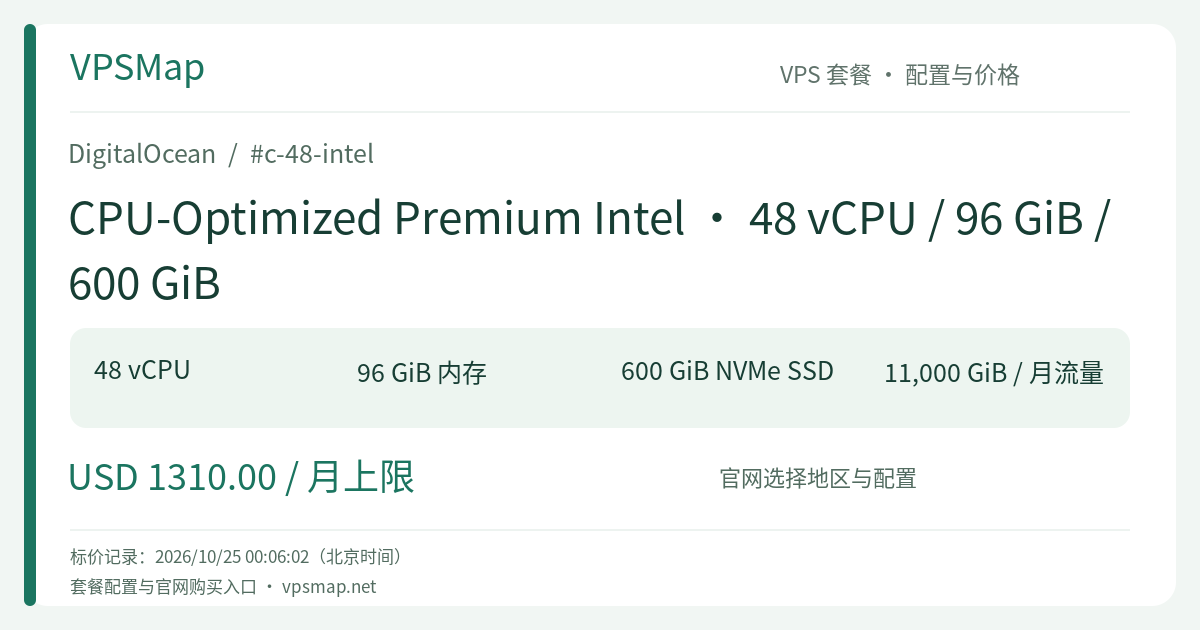
Configured with 48 dedicated vCPUs, 96 GiB of RAM, and 600 GiB of local NVMe SSD storage, this instance adheres strictly to the classic 1:2 memory-to-vCPU ratio. For teams running compute-bound operations that don't need to pay for surplus RAM, it directs every dollar directly into raw execution throughput.
Architectural & Hardware Highlights#
1. Dedicated Hyper-Threads on Intel Ice Lake#
Unlike Basic Droplets that share time slices across multiple virtual machines, c-48-intel reserves every single core. The hypervisor permanently pins 48 hyper-threads strictly for your virtual machine. Powered by 3rd Gen Intel Xeon Scalable processors (Ice Lake) running at base frequencies above 2.6 GHz with full AVX-512 support, you can sustain 100% CPU utilization around the clock without artificial thermal throttling or hypervisor throttling.
2. High-Speed 10 Gbps Networking#
As part of the Premium Intel family, this Droplet features up to 10 Gbps of outbound network throughput—a 5x improvement over standard 2 Gbps configurations. Whether orchestrating a fleet of containerized runners, streaming converted video chunks to edge caches, or handling multi-gigabit ingress, the network adapter never becomes the system bottleneck.
3. Hypervisor-Direct NVMe Disk Storage#
The 600 GiB storage is not high-latency network block storage; it is directly attached to the physical hypervisor over NVMe. This yields microsecond-level latency and superior random IOPS, ensuring that unzipping massive asset bundles, writing build artifacts, or processing multi-stream logs does not stall your 48 execution threads.
Ideal Use Cases#
- Enterprise CI/CD Build Runners: Powering distributed Jenkins, GitHub Actions, or GitLab CI pipelines. Run parallel builds across C++, Rust, Android, or iOS multi-target toolchains without thread starvation.
- Video & Media Processing: Executing CPU-intensive H.264/H.265/AV1 software encoding, video slicing, and packaging for real-time delivery with predictable latency.
- Stateless High-Throughput Gateways: Handling hundreds of thousands of concurrent requests across microservices, running intensive regex URL rewrites, and load balancing traffic.
- Batch Mathematical Simulation & Scientific Workloads: Monte Carlo simulations, algorithmic financial modeling, and 3D rendering jobs that scale linearly with dedicated CPU cores.
Cost Efficiency and Billing Mechanics#
Managing cloud spend requires predictability. DigitalOcean structures c-48-intel billing with transparent rules:
- Per-Second Billing with a 672-Hour Monthly Cap: Droplets are billed per second with a 60-second minimum charge. Monthly usage is capped at 672 hours (28 days). Once reached in any billing month, you are not charged additional hours, providing financial certainty for 24/7 production services.
- 11,000 GiB Team-Pooled Outbound Bandwidth: This plan includes 11,000 GiB of outbound bandwidth allowance, while all inbound traffic is entirely free. Transfer allowances pool at the team account level, allowing low-bandwidth Droplets to offset high-bandwidth workloads. Additional transfer is charged at a competitive $0.01 per GiB.
- Power-Off Billing Rule: Because your 48 dedicated cores and 96 GiB RAM remain reserved on the physical hardware, simply powering off the machine keeps billing active. For ephemeral batch jobs, automate instance destruction upon job completion, backed by automated Snapshots if rapid reconstruction is required.
Architectural Considerations#
- Memory Sizing: 96 GiB is optimal for parallel compiler threads and media transcoding. However, if your system runs in-memory data structures (like giant Redis instances or memory-heavy enterprise JVMs), consider General Purpose (1:4) or Memory-Optimized (1:8) tiers.
- Storage Tiering: Treat the 600 GiB local NVMe disk as an ultra-fast scratchpad and OS volume. For persistent long-term data, attach network-based Volumes or connect to DigitalOcean Spaces via private VPC networking, where internal transfer incurs no bandwidth quota usage.
- Regional Capacity: Large high-spec instances are subject to datacenter capacity limits. Always verify current availability in your chosen region inside the cloud console.
To spin up this dedicated compute powerhouse, navigate to the DigitalOcean Cloud Console.