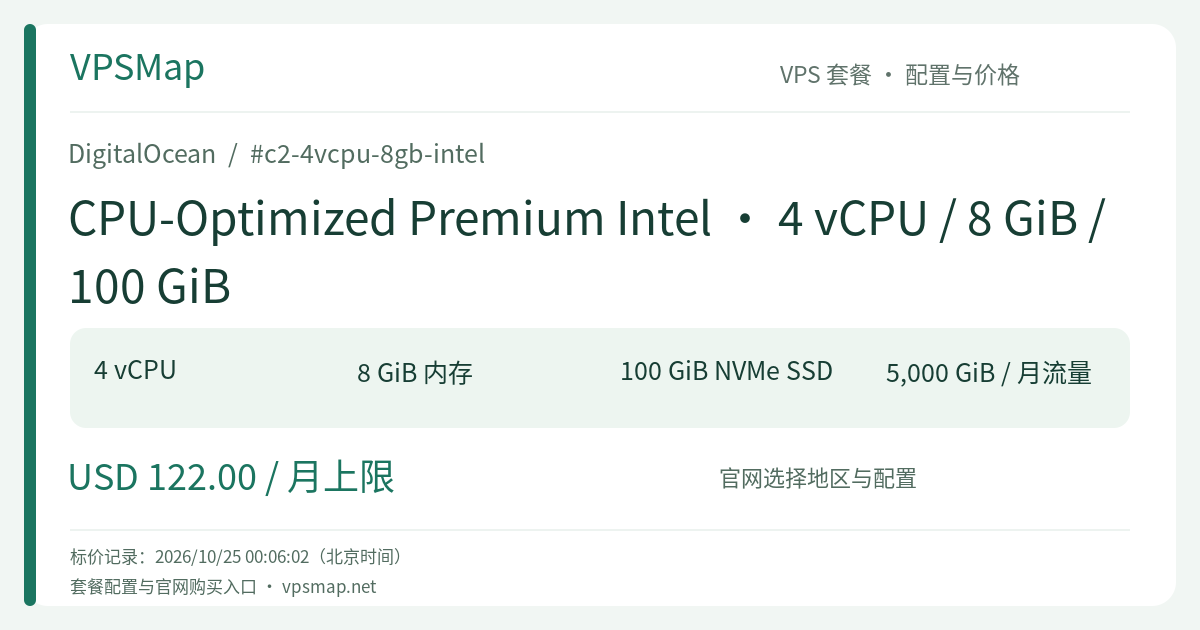
DigitalOcean c2-4vcpu-8gb-intel Buyer's Guide: 100 GiB Local NVMe as the Sweet Spot for 4-Core Workloads
Updated
Why 100 GiB Local NVMe is the "Sweet Spot" for 4-Core Workloads#
For many mid-tier production workloads, 4 dedicated CPU cores paired with 8 GiB of RAM hits the ideal balance between processing muscle and cost. However, in day-to-day operations, development teams running on baseline compute models frequently encounter a common bottleneck: 50 GiB of disk space disappears faster than anticipated.
In modern container-driven architectures, an operating system like Ubuntu combined with the Docker engine, several microservice images with their dependencies, build caches (npm, pip, Go build artifacts), and rolling system logs can easily push a 50 GiB disk past the 80% threshold within days. Engineers find themselves having to script aggressive disk cleanups or worry that an oversized build image will cause an out-of-disk failure on the host.
The c2-4vcpu-8gb-intel Droplet targets this exact operational pain point. Retaining the 4 dedicated Intel Ice Lake cores and 8 GiB of memory, it expands the local direct-attached NVMe storage to a comfortable 100 GiB. That additional 50 GiB gives your operations team breathing room, operational stability, and far greater tolerance for transient build files.
Direct NVMe vs. Block Storage Volumes: Latency and Throughput Divergence#
A sensible question often arises: "If 50 GiB isn't enough, why not deploy the base instance and attach a cheap Block Storage Volume?"
Understanding the architectural difference between storage tiers is crucial:
- Block Storage Volumes are network-attached, distributed block storage. While highly flexible and independently snapshot-capable, all reads and writes traverse a virtualized storage network. This introduces microsecond-to-millisecond network hops and caps raw IOPS compared to local silicon.
- The 100 GiB disk on c2-4vcpu-8gb-intel is physically attached to the host hypervisor via high-speed PCIe lanes (NVMe). Random reads and writes during compilation, as well as copy-on-write operations across container layers (OverlayFS), hit the hardware directly with zero network overhead.
If the purpose of expanding storage is to support active compiler caches, Docker image layers, or high-throughput temporary directories, opting for the native 100 GiB NVMe on the c2 tier provides far superior performance and simplicity.
Sustained 4-Core Ice Lake Muscle and 10 Gbps Pipe#
Beyond its well-balanced disk capacity, c2-4vcpu-8gb-intel delivers uncompromised foundation performance:
- Dedicated Hardware Threads: Built on 3rd Generation Intel Xeon Scalable (Ice Lake) processors with base clock speeds exceeding 2.6 GHz. All 4 vCPUs are strictly reserved for your instance, eliminating noisy neighbors and ensuring consistent runtime latencies.
- 10 Gbps High-Speed Networking: Premium Intel instances enjoy up to 10 Gbps of bidirectional network capacity. Pulling multi-gigabyte container images from private registries takes seconds, and high-frequency internal RPC traffic across private VPCs operates without congestion.
- 5,000 GiB Team Pooled Transfer: Comes with 5,000 GiB of included monthly outbound transfer. Transfer accrues by the second into your team-level pool. Inbound transfer is entirely free, and private VPC traffic never deducts from your quota.
Prime Use Cases#
- Self-Hosted CI/CD Runners (GitHub Actions / GitLab CI): One of the best deployment environments for this Droplet. Multi-threaded compilation consumes all 4 dedicated cores, while 100 GiB of NVMe comfortably retains multi-branch build caches, container runtime layers, and intermediate artifacts without disk-full interruptions.
- Multi-Container Microservice Stacks (Docker Compose / K3s): Hosting a stack like Nginx, a Go/Node.js backend, Redis caching, and monitoring agents on a single server. The 100 GiB volume prevents container image updates from prematurely filling root storage.
- Mid-Sized High-Load Web Applications: Serving dynamic web backends with substantial local file operations, document parsing, or media preprocessing where dedicated CPU guarantees predictable response times and local NVMe prevents I/O stalling.
Operations, Billing, and Disaster Recovery#
- Automated Incremental Backups: Enabling automated backups is highly recommended. DigitalOcean employs incremental snapshotting (initial full backup followed by incremental deltas). Weekly backups cost just 20% of the Droplet's monthly fee and maintain 4 weeks of recovery points.
- Billing Precision: Billed per second with a monthly cap at 672 hours (28 days). Because compute and NVMe resources are reserved on the physical hardware, powering off the server still incurs charges. Destroy the instance when decommissioning temporary runners.
Conclusion & Recommendation#
If a 50 GiB drive leaves your operational stack feeling cramped, but your applications demand the low latency of host-attached NVMe combined with dedicated CPU threads, the c2-4vcpu-8gb-intel Droplet is the definitive workhorse for the job.
Regional inventory is confirmed inside the management console during droplet deployment. Launch your server via the link below: