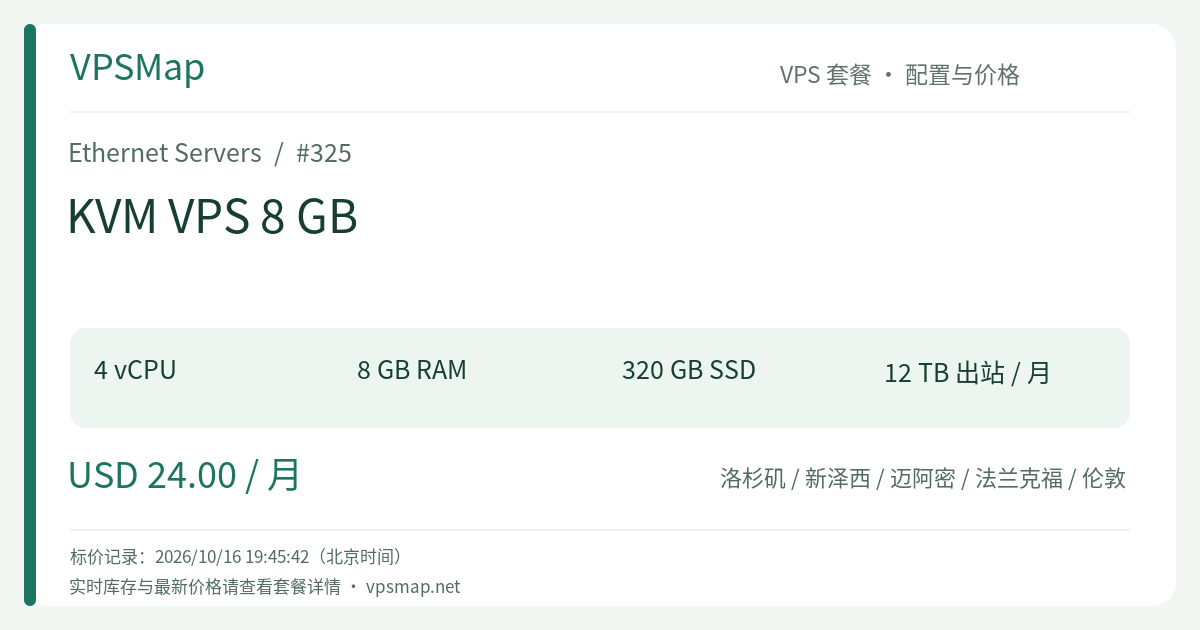
Ethernet Servers 8 GB RAM VPS Review: 4-Core Concurrency and High-Capacity Workload Anchor
Updated
At $24 per month, this 8 GB RAM plan delivers serious computing muscle with 4 vCPUs, 320 GB SSD storage, and 12 TB outbound bandwidth. Engineered to handle high-concurrency container clusters, multi-database stacks, and medium-scale backend workloads, it offers a robust balance of computational power and predictable operating costs.
Compute Matrix: Multi-Core Concurrency with 4 vCPUs#
Stepping up to 4 vCPUs and 8 GB RAMtransforms this VPS from a basic hosting utility into a high-throughput computational hub. Four virtual cores grant the kernel outstanding thread-scheduling efficiency when executing concurrent requests, background cron jobs, or complex SQL queries. Even if an intensive data pipeline monopolizes an entire core, the remaining three cores ensure incoming web traffic is served promptly without latency hiccups.
Expansive Storage and Big Pipelines: 320 GB SSD and 12 TB Bandwidth#
This package delivers an 320 GB SSD , this package grants expansive local disk headroom for accumulating production databases, operational logs, and multi-tenant test directories. Monthly outbound transfer scales to a colossal 12 TBalongside unmetered inbound bandwidth. Coupled with a 10 Gbps shared host connection and 5 Gbps DDoS mitigation, it reliably sustains heavy data pulls and cross-region synchronization without constant storage anxiety.
OS Images and VirtFusion Panel Flexibility#
Governed by the VirtFusion management panel, this machine allows rapid reinstalls across Debian, Ubuntu, and AlmaLinux, alongside quick deployment of Windows Server 180-day evaluation images (strictly an evaluation build, not a perpetual commercial license). Advanced engineers with specialized kernels or custom operating systems can freely mount external ISOs and configure rDNS directly; note that outbound port 25 remains closed by default and requires ticketed manual verification.
Complex Topologies and Microservices Deployment#
An 8 GB memory capacity comfortably supports a self-contained microservices topology. You can simultaneously host standalone PostgreSQL databases, Redis caching clusters, RabbitMQ message queues, and several client-facing backend services. It also serves as an outstanding host for private enterprise collaboration platforms like GitLab CE or Nextcloud, where four virtual cores reliably crunch concurrent file syncs and code indexing.
Tier Evaluation: 4 GB vs. 8 GB vs. 16 GB Flagship#
Compared to the $12 4 GB plan, this 8 GB tier doubles your core count, RAM, and SSD storage at twice the cost, making it the perfect upgrade path for maturing architectures transitioning past initial staging. Looking upward to the top-tier $48 16 GB plan, this tier delivers ample headroom for mainstream non-extreme workloads at half the operational expense, hitting peak cost-performance without leaving expensive computing resources idle.
Data Safety, Downgrade Restrictions, and Ordering Notes#
Automated daily offsite backups retain up to 7 daily restore points for disaster recovery, though official terms disclaim absolute data recovery guarantees, making automated external backups mandatory. Take note that Ethernet Servers supports upward scaling but strictly bars plan downgrades, and the 60-day refund window covers only a customer's first purchase once. You can pay via PayPal, Alipay, or credit cards, using SAVETEN for 10% off the first invoice; monthly validation is recommended before long-term commitments.