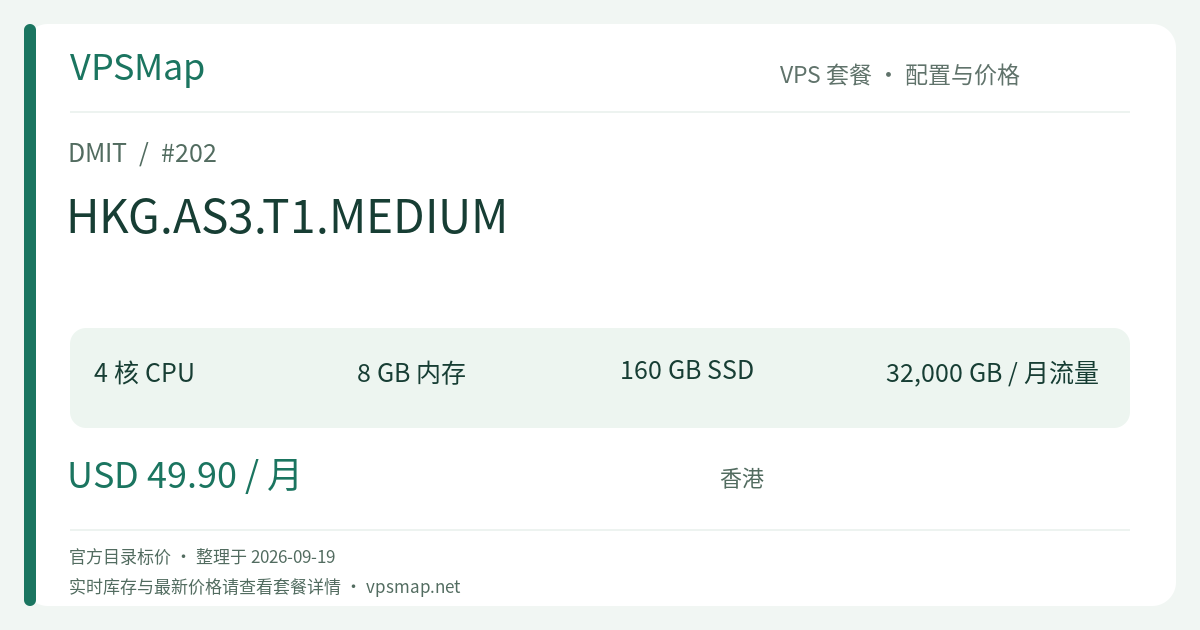
DMIT HKG.AS3.T1.MEDIUM Review: Unleashing 32TB on a 10Gbps Port for High-Bandwidth APAC Hubs
Updated
When deploying workloads in Hong Kong data centers, developers and businesses often hit an inescapable barrier: prohibitive bandwidth pricing and painfully limited traffic quotas. Most direct lines optimized for mainland China offer only a few hundred gigabytes to 1TB of monthly allowance. Once a project requires large-scale international data synchronization, global CDN edge origins, or high-throughput API gateways, bandwidth fees skyrocket.
DMIT HKG.AS3.T1.MEDIUM [Buy direct ↗] was specifically created to break this bandwidth bottleneck. Located in a premier Hong Kong data center and powered by high-capacity Tier 1 international transit, it provides an enormous 32,000GB (32TB) of monthly traffic on a massive 10Gbps uplink port. Combined with 4 AMD EPYC vCPUs and 8GB of RAM, it serves as a formidable computational and networking engine for APAC and global operations.
1. Core Positioning: Conquering the Hong Kong Bandwidth Bottleneck#
To appreciate the true value of this plan, one must understand its strategic position within DMIT's catalog:
- Gigantic Traffic Pool: Delivering 32TB of monthly transfer in Hong Kong for $49.90/month translates to roughly $1.50 per TB—an exceptionally rare rate in this premium metropolitan location.
- 10Gbps Burst Uplink: When coping with sudden traffic spikes or bulk multi-gigabyte transfers, a 10Gbps physical interface eliminates single-host network card saturation (note: datacenter backbone capacity does not equal guaranteed single-instance bandwidth, but it grants ample burst headroom).
- Generous Compute Balance: 4 vCPUs on the AMD EPYC 7003 (Zen 3) platform, 8GB of memory, and 160GB of NVMe SSD provide ample headroom to host Docker microservice stacks, high-performance reverse proxies, caching layers, and database workloads.
If your architecture demands an APAC-based server capable of handling sustained, high-volume international traffic without incurring runaway per-gigabyte costs, this specification is unmatched at this price point.
2. Network Routing Profile: Understanding Tier 1 Transit#
Before ordering, it is essential to understand the network routing dynamics to ensure it aligns with your architectural goals.
What is Tier 1 (T1) Transit?#
DMIT segments its routing into Premium (VIP direct China transit), Eyeball (carrier-optimized direct routes), and Tier 1 (global international transit):
- Engineered for Global & Regional APAC Interconnection: HKG T1 is connected directly to top-tier global Tier 1 carriers and the Hong Kong Internet Exchange (HKIX). Routing to Singapore, Tokyo, Seoul, Taipei, Europe, and North America exhibits minimal latency, zero detours, and superb throughput.
- No Dedicated Mainland China Optimizations: T1 routing does not include dedicated VIP return paths such as China Telecom CN2 GIA, China Unicom AS9929, or China Mobile CMIN2. When accessed directly from mainland China, packets traverse generic public transit, which may experience packet loss or routing detours during evening peak hours.
[!NOTE] DMIT's official documentation notes that the advertised 15ms latency is a reference benchmark between Hong Kong and Shenzhen, not a nationwide guarantee. Furthermore, Tier 1 plans do not guarantee first-connect clean IP availability for sensitive regions like mainland China.
Recommended Architecture for Mainland Connectivity#
If your setup requires mainland China interaction, the recommended pattern is a decoupled hybrid architecture:
- Edge Ingress: Deploy a lightweight, latency-optimized node (such as DMIT's Pro series or domestic points of presence) as the front-facing entry point.
- Backend Processing: Use HKG.AS3.T1.MEDIUM as the central compute hub, storage origin, and international communication node, connected via secure tunnels. This delivers optimal latency to domestic visitors while unlocking 32TB of international transfer.
3. Hardware Architecture and Platform Capabilities#
HKG.AS3.T1.MEDIUM runs on the field-proven AMD EPYC 7003 (Zen 3 / Milan) enterprise server line:
| Specification | Configuration | Practical Benefit |
|---|---|---|
| vCPU | 4 Cores | High multi-threaded capacity for concurrent API processing, compression, and builds |
| RAM | 8192 MB (8GB) | Easily runs PostgreSQL/MySQL, Redis caching, and containerized microservices |
| Storage | 160 GB NVMe | Enterprise-grade read/write IOPS, ample room for system disks, logs, and staging |
| Bandwidth Quota | 32,000 GB (32TB) | Total freedom from bandwidth anxiety during massive data migrations |
| Port Speed | 10,000 Mbps (10Gbps) | Eliminates bandwidth throttling during burst events |
| IPv6 Allocation | Default /64 Prefix | Enterprise-ready dual-stack support with an extensive address block |
DMIT also provides a modern proprietary control panel with native SSH Key management and Two-Factor Authentication (2FA) for top-tier security.
4. Key Deployment Scenarios#
Where does HKG.AS3.T1.MEDIUM deliver maximum return on investment?
Scenario A: APAC Regional API Gateway & SaaS Backend#
For cross-border platforms, mobile games, and SaaS providers catering to Southeast Asia, East Asia, and overseas markets, this instance acts as an ultra-fast regional traffic exchange. 4 cores and 8GB RAM provide the exact capacity required for Kong, Envoy, or Caddy setups processing millions of requests daily.
Scenario B: High-Volume Media Distribution and Asset Cache#
For media streaming relays, application package downloads, or self-hosted package registries, a 10Gbps port paired with 32TB monthly data lets you push heavy bandwidth without fear of surprise overage bills.
Scenario C: Cross-Cloud Database Replication and Storage Sync#
When moving database backups, object storage replicas, or container images across multiple global cloud providers, having a central transit hub in Hong Kong with a 32TB allowance is an invaluable cost-optimization strategy.
5. Tier 1 Portfolio Comparison: Choosing Your Tier#
Here is how HKG.AS3.T1.MEDIUM compares against its siblings in the Hong Kong T1 lineup:
| Plan Name | vCPU / RAM | NVMe SSD | Monthly Data | Port Speed | Monthly Price | Best For |
|---|---|---|---|---|---|---|
| HKG.AS3.T1.STARTER | 1 Core / 2GB | 40GB | 4,000GB | 10Gbps | $12.90 / mo | Light edge probes, simple scripts |
| HKG.AS3.T1.MINI | 2 Cores / 2GB | 60GB | 8,000GB | 10Gbps | $21.90 / mo | Small web scrapers, lightweight proxies |
| HKG.AS3.T1.MICRO | 4 Cores / 4GB | 80GB | 16,000GB | 10Gbps | $32.90 / mo | Intermediate microservices |
| HKG.AS3.T1.MEDIUM | 4 Cores / 8GB | 160GB | 32,000GB | 10Gbps | $49.90 / mo | High-throughput production hub (Top Recommendation) |
Upgrading from MICRO ($32.90) to MEDIUM ($49.90) costs just $17 more per month, but doubles your RAM (4GB to 8GB), doubles your SSD storage (80GB to 160GB), and doubles your monthly transfer from 16TB to 32TB. For genuine production duties, MEDIUM is the definitive sweet spot.
6. Official Policies: Refund and IP Replacement Guidelines#
Before ordering, review the official DMIT service terms:
- Refund Policy:
- 3-Day Full Refund: Eligible within 3 days of purchase if cumulative data transfer does not exceed 30GB (payment provider transaction fees deducted, except Alipay or account balance refunds which incur no fee).
- 30-Day Pro-Rated Refund: Eligible within 30 days of purchase; calculated based on remaining service time or remaining data quota, whichever deduction is higher.
- Exclusions: Services targeted by DDoS attacks, flagged for abuse, or cancelled due to network subjective complaints are non-refundable.
- T1 IP Replacement Policy:
- Instances must be active for at least 24 hours.
- Paid IP replacement is available for $5 USD per request, with a minimum 3-day cooldown and at least 3 days of remaining service.
- T1 does not guarantee initial IP accessibility in restricted regions.
7. Verdict and Order Link#
If you need a reliable Hong Kong server equipped with 4 EPYC cores, 8GB memory, and the power to effortlessly push 32TB of international traffic on a 10Gbps port, DMIT HKG.AS3.T1.MEDIUM delivers unparalleled performance and bandwidth economics.