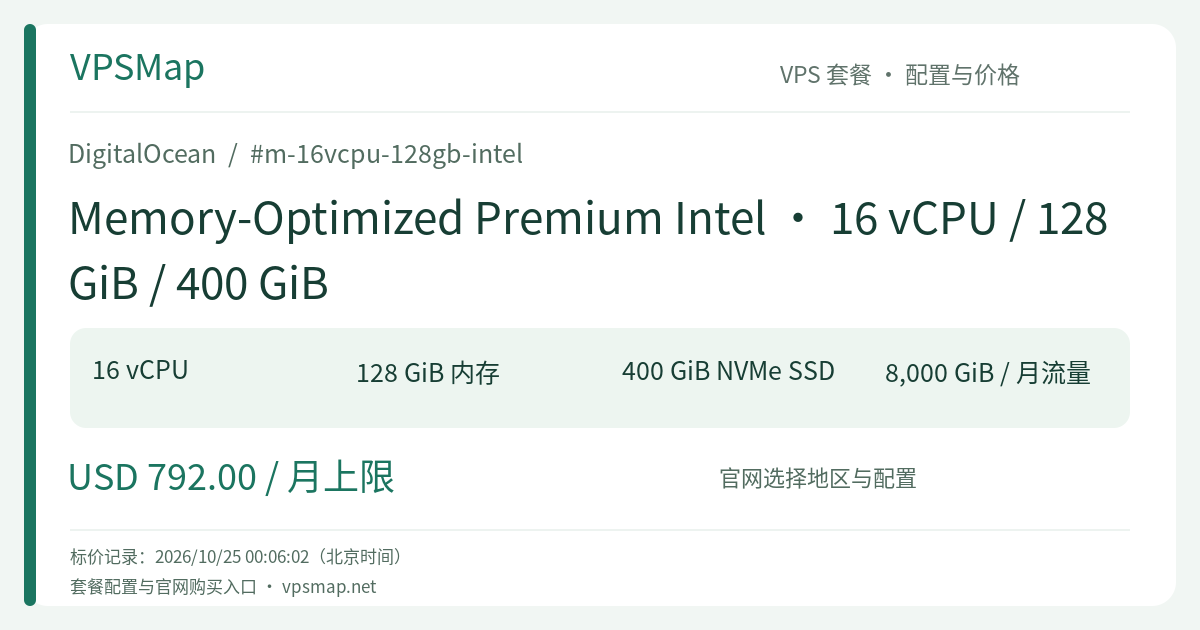
DigitalOcean 16 vCPU / 128 GiB Memory-Optimized Droplet Review: The Production Powerhouse for Databases and In-Memory Caching
Updated
Why the 1:8 Core-to-Memory Ratio Redefines Heavy Production Workloads#
During architectural scaling, development teams often hit a frustrating operational wall: CPU usage remains comfortably around 40% to 50%, yet the Linux kernel's OOM-Killer unpredictably terminates database processes, or relentless swapping drives API latency from tens of milliseconds into multi-second timeouts. With conventional General Purpose (1:4 ratio) or CPU-Optimized (1:2 ratio) instances, teams are frequently forced to overprovision redundant compute cores just to acquire the raw memory their workloads starve for.
DigitalOcean's m-16vcpu-128gb-intel plan directly resolves this architectural mismatch. Built with 16 dedicated vCPUs and 128 GiB of high-frequency RAM (running over 2,933 MHz memory buses), it delivers the industry-standard 1:8 compute-to-memory sweet spot. Every dedicated hardware execution thread is backed by a full 8 GiB of dedicated physical memory.
This balance fundamentally unlocks core infrastructure capabilities:
- PostgreSQL & MySQL Transaction Acceleration: You can comfortably allocate 32 GiB or more to
shared_buffers, pinning active indexes and working datasets directly in memory to bypass physical disk latency entirely. - In-Memory Caching at Scale: Host substantial Redis or KeyDB deployments capable of tracking millions of active user sessions, shopping carts, and dynamic leaderboards without triggering page eviction or kernel thrashing.
- Stabilized Enterprise JVM Environments: Allocate a spacious 32 GiB to 64 GiB heap for complex Java or Spring Boot microservices while preserving abundant physical RAM for off-heap buffers and Linux Page Cache, dramatically slashing garbage collection pauses.
Dedicated Hardware Threads and 10 Gbps Line-Rate Throughput#
In multi-tenant cloud environments, shared CPU tiers introduce "noisy neighbor" risks. When adjacent virtual machines burst, shared CPU allocations are dynamically throttled, causing unpredictable latency spikes in latency-sensitive applications.
The 16 vCPUs on this Premium Intel Droplet represent guaranteed, dedicated hyper-threads on 3rd Generation Intel Xeon Scalable processors:
- Deterministic Processing Power: Dedicated threads ensure constant clock performance without neighbor contention. Heavy tasks—such as complex SQL hash joins, real-time JSON parsing, and cryptographic TLS handshakes—execute on consistent, predictable timelines.
- 10 Gbps Network Interface: Premium Intel droplets deliver up to 10 Gbps of network bandwidth—a fivefold increase over standard regular-CPU tiers. This broad pipe guarantees that inter-service RPC calls, database replica synchronization, and large-scale asset streaming never hit a network saturation wall.
- 400 GiB Local NVMe Storage: Directly attached to the hypervisor, the NVMe SSD utilizes advanced parallelism to service transactional logging, WAL flushes, and temporary database files with low single-digit millisecond latency.
Ideal Workload Scenarios and Architectural Fit#
1. Primary Relational Databases (OLTP)#
When database tables scale into tens of millions of rows, query performance hinges on cache hit ratios. Running your primary database on a 128 GiB memory profile ensures that the active working set remains resident in memory, converting unpredictable random reads into lightning-fast memory hits and sequential log writes.
2. Search and Event Streaming Clusters (Elasticsearch / Kafka)#
The standard operational best practice for Elasticsearch recommends capping the JVM heap at approximately 31 GiB (to retain compressed object pointers) while granting all remaining system memory to the OS filesystem cache. 128 GiB of RAM is the textbook capacity for this strategy, providing roughly 97 GiB for Lucene segment caching.
3. Decoupled Cloud Microservices#
If your architecture decouples compute from primary storage—such as leveraging managed storage backends or attaching scalable DigitalOcean Volumes Block Storage—the local 400 GiB NVMe boot disk provides the exact capacity required for operating system overhead, deployment binaries, and scratch spaces without paying for unneeded local disk sprawl.
Transparent Billing and Operational Best Practices#
DigitalOcean supports this high-tier compute instance with developer-friendly billing policies:
- 672-Hour Monthly Cap: Droplets are billed per second up to a monthly maximum ceiling of 672 hours (28 days). For any standard 30- or 31-day month, your operational costs are capped, providing predictable budget ceilings while retaining per-second operational elasticity.
- Team Bandwidth Pooling: The included 8,000 GiB of outbound transfer is added directly into your team's cumulative bandwidth pool. Outbound egress from busy web tiers is offset by the unused allocation of this compute node, while internal VPC communication remains completely free.
- Power-Off vs. Destroy Semantics: Shutting down the Droplet from inside the operating system or via the control panel does not pause billing. Because the hypervisor guarantees 16 dedicated physical cores and 128 GiB of hardware RAM exclusively for your VM, compute capacity remains reserved until you explicitly choose to destroy the Droplet.
To safeguard mission-critical data, enable DigitalOcean Backups during creation. Backups operate incrementally at the hypervisor level (costing just 20% of the Droplet baseline for weekly protection, or 30% for daily retention), giving you effortless disaster recovery.
Capacity Note: Inventory for dedicated high-memory profiles is dynamically allocated across global datacenters. Catalog pricing reflects standard rates; active provisioning status should always be verified directly within your cloud console.
👉 Deploy the 16 vCPU / 128 GiB Memory-Optimized Droplet on DigitalOcean