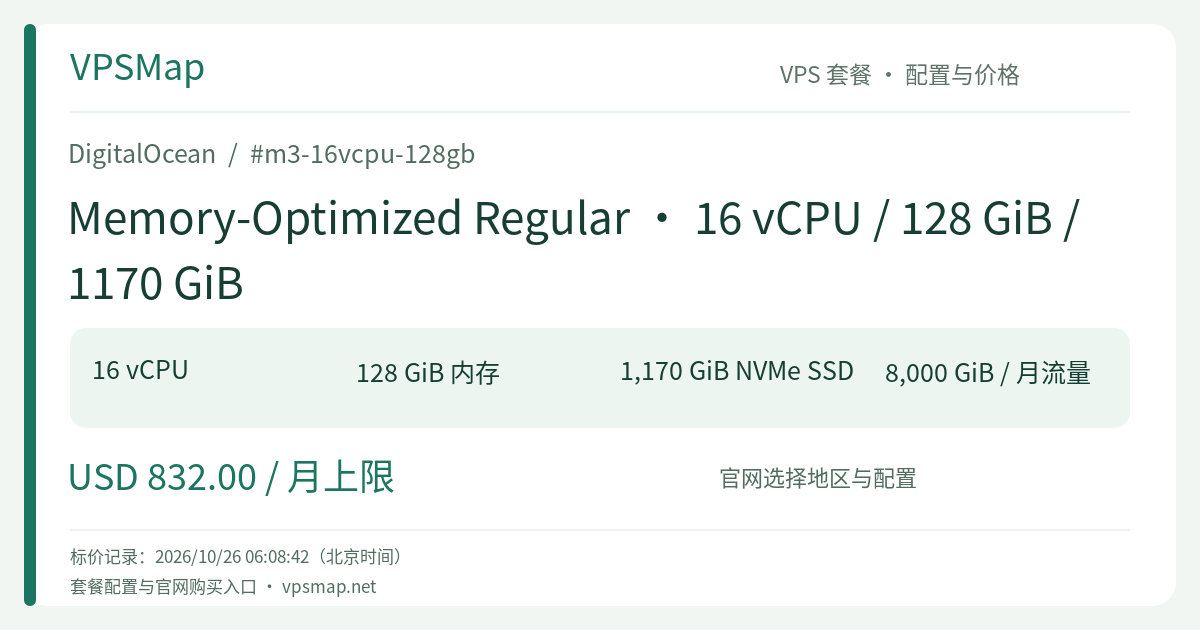
DigitalOcean m3-16vcpu-128gb Comprehensive Review: 16 Dedicated vCPUs, 128 GiB RAM, and 1,170 GiB Local NVMe for Heavy Data Backbones
Updated
The Strategic Value of 16 Cores, 128 GiB RAM, and 1.17 TB Local NVMe#
In large-scale production architectures, system capacity often confronts the "weakest link" constraint: 16 dedicated vCPUs provide robust concurrency, and 128 GiB of RAM offers expansive caching capacity. However, if local disk space is limited to a baseline 400 GiB, rapid business expansion quickly fills the volume with growing transaction tables, index bloat, sort files, and audit logs.
Attaching external network block storage (Volumes) introduces recurring multi-millisecond network latency overhead, degrading Transactions Per Second (TPS) during continuous write-ahead log flushes and row-locking updates.
The DigitalOcean m3-16vcpu-128gb was designed specifically to eliminate this bottleneck. Retaining 16 dedicated vCPUs and 128 GiB of high-speed system memory, it expands hypervisor-direct NVMe SSD storage to 1,170 GiB (nearly 1.2 TB), creating a balanced equilibrium of processing throughput, memory buffering, and ultra-low-latency disk I/O.
Hardware Capabilities & Performance Profile#
1. 1.17 TB PCIe-Direct NVMe Storage#
Unlike network-attached volumes, local NVMe drives are wired directly into the host hypervisor's PCIe bus. When handling intensive PostgreSQL WAL writes, MySQL doublewrite buffer operations, or Elasticsearch shard merges, microsecond-tier access latencies prevent I/O queue buildup and eliminate thread pool exhaustion.
2. 16 Fully Dedicated Processor Cores#
Powered by enterprise Intel Xeon Scalable processors, all 16 vCPUs represent dedicated physical hyper-threads. Under concurrent heavy SQL executions, intensive regex pattern matching, or cryptographic hashing, compute output remains stable with zero CPU steal from neighboring tenants.
3. 8,000 GiB Bandwidth Pool & 2 Gbps Port#
Featuring a 2,000 Mbps (2 Gbps) physical interface, the instance includes an 8,000 GiB (8 TB) monthly outbound bandwidth allowance. Bandwidth pools automatically across all Droplets in your team account, minimizing the cost of cross-region database streaming and public asset distribution.
High-Impact Workload Scenarios#
1. High-Concurrency E-Commerce & Financial Transaction Databases#
During flash sales or high-frequency transaction processing, database engines must coordinate thousands of concurrent queries against hot table rows. With 128 GiB of RAM, you can comfortably allocate 64 GiB or more to buffer pools. The 1.17 TB local NVMe easily accommodates hundreds of millions of historical order records and absorbs write-ahead logging spikes without storage contention.
2. Core Elasticsearch & OpenSearch Data Nodes#
Production search clusters thrive on balanced resource ratios: 31 GiB allocated to the JVM heap for inverted index querying, approximately 90 GiB left to the Linux kernel for file system caching, and 1.17 TB of direct NVMe storing 800 GiB to 1 TB of active search shards. This balance delivers exceptional full-text search and analytical aggregation response times.
3. High-Throughput Time-Series & Analytical Backbones (ClickHouse / InfluxDB)#
In IoT telemetry or central APM log pipelines where ingestion rates reach tens of thousands of metric points per second, the 16 dedicated cores execute parallel data compression while 1.17 TB of NVMe retains months of un-downsampled raw metrics, removing the operational hassle of frequent data archiving.
Financial ROI & Architecture Comparison#
- Pricing Structure: The plan meters per second at an hourly rate of $1.2381, with a predictable monthly cap of $832.00/month (calculated at 672 hours). Compared to the base
m-16vcpu-128gb($672/mo), an additional $160/month triples local physical NVMe storage from 400 GiB to 1,170 GiB. - Local NVMe vs. Network Volume Cost: Adding 770 GiB of external block storage to a baseline instance costs approximately the same, yet incurs the multi-millisecond latency penalties of network-attached disks. The
m3package delivers native bus-level speed with zero external volume attachment overhead. - Consolidated Monolith vs. Distributed Footprint: Rather than managing a fragmented fleet of smaller VMs burdened by inter-node network latency and distributed coordination overhead, a single
m3-16vcpu-128gbdelivers a resilient, high-density core that cuts administrative overhead significantly.
Production Operational Guidelines#
- Power-Off Billing Rule: When shut down, the Droplet's 16 dedicated cores, 128 GiB RAM, and 1.17 TB disk remain reserved on the physical host; billing continues unaffected. To permanently end charges, export your data and Destroy the instance.
- Managed Incremental Backups: For critical systems, automated backups provide robust disaster recovery. Weekly backups (4 cycles retained) cost 20% of the base price (+$166.40/mo); daily backups (7 cycles retained) cost 30% (+$249.60/mo). Backups take block-level snapshots without taking services offline.
- High-Availability Topologies: For mission-critical primary databases, set up a replica in the same datacenter over the internal VPC. Streaming replication across private networking is completely free and supports automated failover.
Summary: If your applications require 16 dedicated cores, 128 GiB of memory, and between 500 GiB and 1 TB of ultra-fast local storage, the
m3-16vcpu-128gbrepresents an exceptional production investment. Confirm live regional availability in the DigitalOcean console.