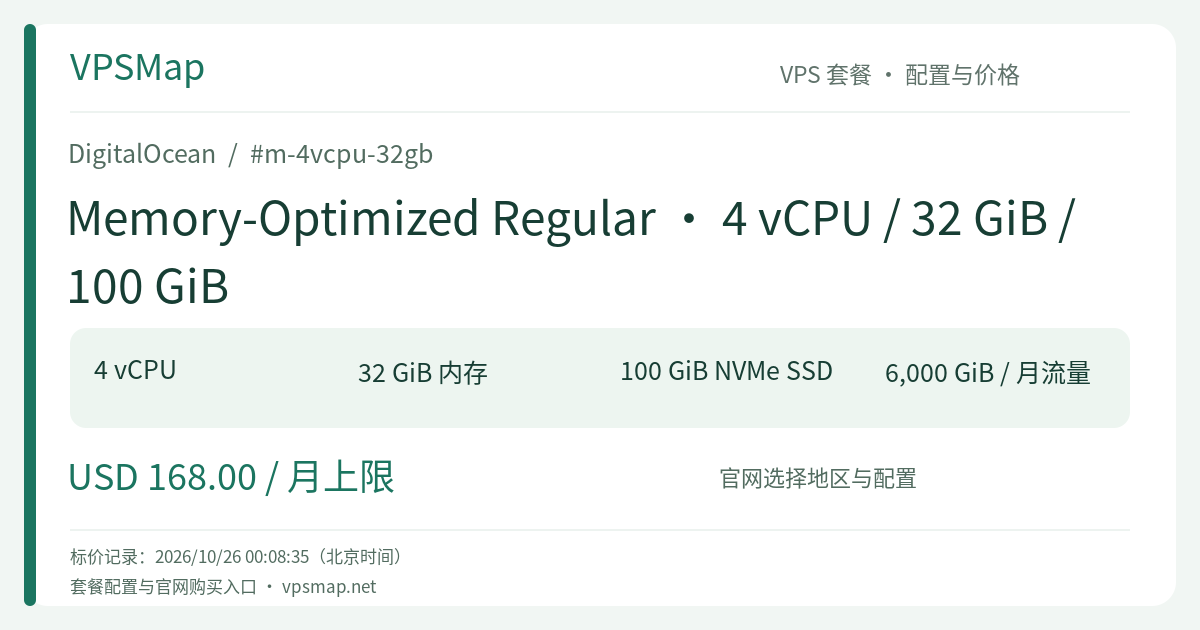
DigitalOcean m-4vcpu-32gb In-Depth Review: 4 Dedicated Cores and 32 GiB RAM for High-Concurrency Production Workloads
Updated
Overcoming the Concurrency and Memory Wall in Production#
As applications scale beyond initial growth milestones, infrastructure architectures frequently hit dual resource bottlenecks simultaneously:
- Connection Flooding: High concurrent client counts require dedicated per-connection memory allocations (
work_mem, connection thread pools), leading to rapid RAM exhaustion under sudden traffic spikes; - Enterprise Framework Demands: Modern multi-threaded enterprise services (Java/Spring Boot, Scala, Node.js clusters) demand wide memory corridors to prevent continuous garbage collection cycles;
- Buffer Pool Eviction: Limited cache capacity forces databases to evict active working sets, triggering catastrophic cascade effects when cold queries saturate physical storage I/O.
The DigitalOcean Memory-Optimized Regular · 4 vCPU / 32 GiB / 100 GiB plan (m-4vcpu-32gb) delivers a robust, highly reliable foundation designed to anchor demanding production services with deterministic performance.
Core Technical Architecture#
1. 4 Dedicated Hardware Hyper-Threads#
Stepping up to 4 dedicated vCPUs provides the parallel capacity necessary to isolate transactional query execution from background system overhead. Database maintenance routines—including WAL flushing, vacuuming, and checkpointing—frequently saturate single cores during peak usage. Having 4 dedicated hyper-threads guarantees that user-facing queries maintain responsive, non-blocking execution pathways with virtually zero scheduling delay.
2. 32 GiB Dedicated Memory for In-Memory Working Sets#
A massive 32 GiB memory allowance transforms database performance profiles:
- PostgreSQL / MySQL Tuning: Provision up to 24 GiB directly to the InnoDB Buffer Pool or leverage generous
shared_bufferscombined with large OS Page Cache margins. High-frequency queries operate entirely in memory, eliminating disk read latency. - Complex Analytical Joins: Allocate substantial working memory per query to process multi-table hash joins, distinct operations, and window functions in RAM, completely bypassing slow disk-based sorting.
- Resilient JVM Runtimes: Confidently assign 16–20 GiB heaps to Java microservices while retaining ample room for native memory allocations and OS operations, effectively curbing disruptive Stop-The-World GC latency.
3. High-Speed 100 GiB Local NVMe SSD#
Backed by a 100 GiB local NVMe SSD connected directly to the physical bus, the instance delivers dependable, high-IOPS write operations. Essential logs, active binaries, and operating system packages operate with rapid responsiveness.
Recommended Production Deployments#
- Primary Relational Databases: Anchor high-throughput PostgreSQL or MySQL databases managing high-transaction e-commerce platforms, SaaS platforms, or financial backends.
- Enterprise Caching Hubs: Power large-scale Redis, KeyDB, or Memcached clusters holding tens of millions of keys, extensive session states, and real-time counters.
- Consolidated Microservice Hosts: Deploy production Docker Compose or Kubernetes worker nodes running full backend stacks—combining API gateways, message queues, and application runtimes with comfortable headroom.
Sizing and Storage Strategies#
- Storage Density Upgrades: If your relational database or document store exceeds 60–80 GiB, evaluate the
m3-4vcpu-32gb(300 GiB NVMe) orm6-4vcpu-32gb(600 GiB NVMe) variants. These plans retain the 4 vCPU / 32 GiB computing profile while providing substantially larger bus-attached NVMe storage without relying on external network volumes. - Disaster Recovery: Activate DigitalOcean's automated backup service to capture incremental system images with zero administrative complexity.
Network Throughput and Fleet Integration#
Equipped with a 2 Gbps network interface, this Droplet contributes 6,000 GiB of outbound transfer to your team's collective bandwidth pool, with all incoming transfer free of charge. Private networking over DigitalOcean VPC guarantees unmetered, low-latency inter-service communication across your application fleet.
To provision a dependable 32 GiB production workhorse with dedicated compute isolation, you can deploy this instance on DigitalOcean.