DigitalOcean m3-2vcpu-16gb In-Depth Review: Triple Local NVMe Capacity for Low-Latency Transactional Workloads
Updated
The Latency Paradox of Network Storage for Databases#
Architecting a high-performance database tier requires balancing capacity, throughput, and I/O latency. While an entry-level memory-optimized instance with a 50 GiB boot disk provides ample RAM for buffer pools, transactional applications quickly exhaust baseline storage once indexes, transaction logs (WAL/binlog), and temporary tables accumulate.
A common workaround is attaching a network block storage volume. However, even high-speed network volumes introduce virtual network transport layers. For OLTP databases executing thousands of random transactions per second, network transport overhead inflates disk wait states and P99 query latencies. Sub-millisecond direct bus access remains irreplaceable for predictable transaction execution.
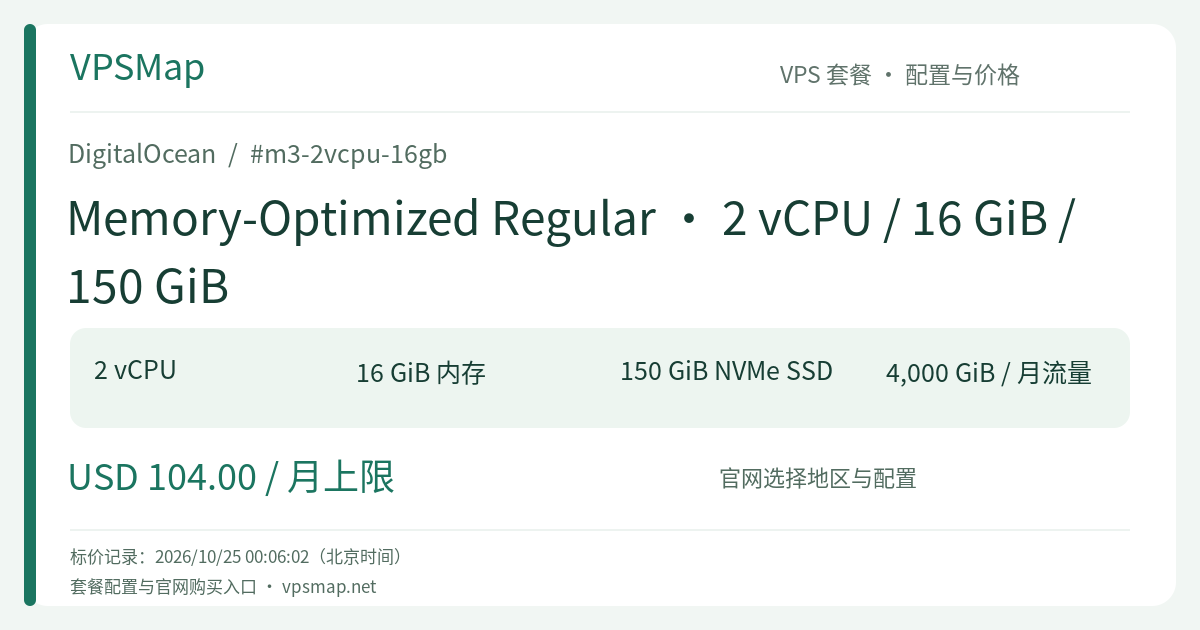
The DigitalOcean Memory-Optimized Regular · 2 vCPU / 16 GiB / 150 GiB plan (m3-2vcpu-16gb) solves this challenge by tripling onboard NVMe storage to 150 GiB, providing high-capacity, bus-attached performance without external volume latency.
Technical Foundations and Advantages#
1. Triple Bus-Attached NVMe Capacity#
Stepping up from the standard 50 GiB to 150 GiB of local NVMe storage eliminates immediate storage ceilings:
- Full Table and Index Retention: Manage databases with 50 to 100 GiB of raw data while maintaining multi-column indexes and full-text indexes on fast local storage.
- Unconstrained Write-Ahead Logging: Retain comprehensive write-ahead and replication binlogs across extended maintenance windows without risking disk exhaustion.
- Fast Spilling for Sorting: When complex queries involving extensive
GROUP BYorJOINoperations exceed work memory thresholds, temporary data spills to local NVMe SSDs with minimal latency penalties.
2. Dedicated Compute with an 8:1 RAM Ratio#
Pairing 2 dedicated vCPUs with 16 GiB of dedicated RAM maintains optimal resource allocation for relational engines. In a MySQL or PostgreSQL setup, you can allocate the majority of RAM to query caching and page buffers, leaving the operating system ample room to buffer writes while the 2 dedicated hardware threads handle connection threads with zero interference from neighboring VMs.
3. Avoiding Network Volume Overhead#
Because the 150 GiB NVMe drive connects directly to the hypervisor host, read and write operations bypass the software-defined network stack. This direct hardware pipeline delivers consistent sub-millisecond IOPS essential for relational database durability routines.
Targeted Production Workloads#
- Primary Relational Databases: Highly suited for PostgreSQL or MySQL instances supporting medium-sized production applications, e-commerce stores, or SaaS backends with fast-growing datasets.
- Persistent Redis Infrastructure: Serve high-volume caching tiers while having 150 GiB of fast local storage to safely maintain frequent RDB snapshots and write-heavy AOF files.
- Embedded Search Engines: Run standalone Elasticsearch, Typesense, or Meilisearch nodes where indexes fit into memory and document source data resides on responsive local NVMe.
Architectural Considerations#
- Horizontal Read Scaling: If CPU utilization consistently exceeds 80% due to connection volume rather than memory saturation, consider pairing this primary node with dedicated read replicas, or scaling upward to the 4-core
m3-4vcpu-32gb. - Backup Hygiene: Because local NVMe storage resides on the physical hypervisor, maintain active backup policies—such as DigitalOcean's automated snapshot mechanism—to ensure disaster recovery preparedness.
Connectivity and Fleet Efficiency#
The Droplet features a 2 Gbps network link and contributes 4,000 GiB of outbound transfer to your team's cumulative bandwidth pool. All incoming traffic is unmetered. For setups communicating with backend application tiers over DigitalOcean's private VPC, this instance delivers rock-solid performance with predictable costs.
To configure your database with low-latency direct-attached storage, you can deploy this instance on DigitalOcean.