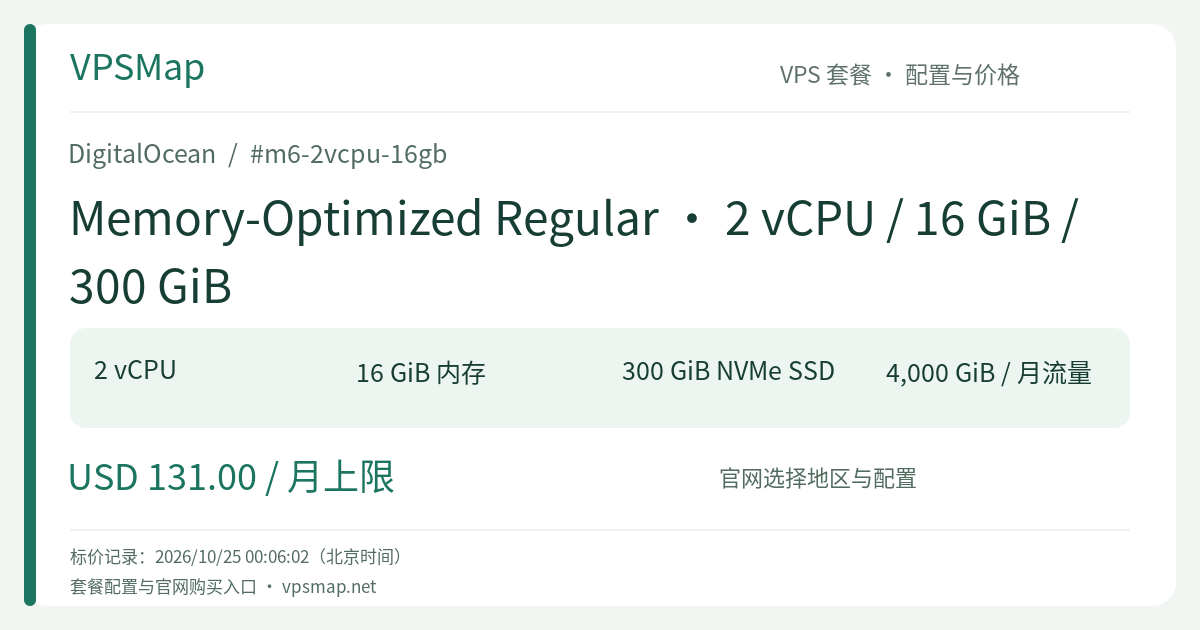
DigitalOcean m6-2vcpu-16gb In-Depth Review: 6x Direct NVMe Capacity for Storage-Heavy, In-Memory Workloads
Updated
The Case for Dense Local Storage on Memory-First Instances#
Certain production workloads exhibit an unconventional resource profile: compute demands remain modest (two dedicated cores handle ingestion and query routing comfortably), memory must be generous (16 GiB to serve active caches and JVM heaps), but the appetite for low-latency physical disk space is substantial.
Consider systems such as:
- Time-series monitoring engines (Prometheus, VictoriaMetrics, InfluxDB) storing weeks of operational telemetry;
- Event log streaming brokers (Kafka, Redpanda) maintaining multi-day message retention without throttling;
- Dedicated search engines (Elasticsearch, Meilisearch) managing large inverted indexes and document stores.
Running these services on a conventional 50 GiB boot disk causes constant disk exhaustion, while routing storage through external network volumes degrades read throughput during index lookups. The DigitalOcean Memory-Optimized Regular · 2 vCPU / 16 GiB / 300 GiB Droplet (m6-2vcpu-16gb) solves this architectural challenge by mounting a dense 300 GiB local NVMe drive directly onto the hypervisor.
Architectural Highlights#
1. 6x Local NVMe Expansion: High-Throughput Autonomy#
Expanding local NVMe storage to 300 GiB delivers structural flexibility for data-heavy single-node architectures:
- Elimination of Network Storage Bottlenecks: High-frequency metric ingestion and sequential disk writes operate directly over the host PCIe bus, avoiding the latency and throughput caps of virtual network volumes.
- Sub-Millisecond Random Reads: Document search and metric retrieval routines benefit from hardware-level NVMe parallelism, drastically reducing slow query counts during peak reporting hours.
2. Dedicated Dual Cores with 16 GiB Memory Allocation#
A lean 2 vCPU footprint combined with 300 GiB storage may look asymmetric, but for data ingestion engines, it represents an optimal cost curve:
- Aggressive OS Page Caching: With 16 GiB of RAM, you can allocate 8–10 GiB to the core daemon and allow the remaining 6–8 GiB to serve as kernel page cache, repeatedly satisfying read requests straight out of memory.
- Deterministic CPU Scheduling: Because the 2 vCPUs are dedicated hyper-threads rather than burstable slices, intensive background compaction jobs (such as LSM-tree merges) will not stall client query threads.
Primary Production Deployments#
- Self-Hosted Metrics and Observability: Deploy a central Prometheus or Thanos node to store weeks of high-resolution telemetry on high-speed NVMe, avoiding multi-tiered cloud storage complexity.
- Persistent Message Buffering: Run Kafka, RabbitMQ, or NATS brokers with extended retention periods. The 300 GiB local SSD absorbs heavy backlogs effortlessly during downstream consumer outages.
- Specialized Search Clusters: Power standalone search backends where index segments and documents demand responsive random access across hundreds of gigabytes of text.
Practical Recommendations#
- Monitoring Compute Saturation: If analytical queries frequently evaluate unbounded regular expressions or massive aggregate joins, monitor CPU usage. If utilization hovers above 80%, consider upgrading to the 4-core
m6-4vcpu-32gb. - Disaster Recovery Strategy: Protect your local NVMe data using DigitalOcean's automated snapshot policies or offload long-term historical archives to DigitalOcean Spaces via S3-compatible endpoints.
Fleet Networking and Value#
This Droplet includes a 2 Gbps network interface and contributes 4,000 GiB of outbound transfer to your team's collective bandwidth pool, with zero cost for incoming traffic. For private VPC architectures, communications between your application fleet and this storage node generate no egress fees, preserving cost predictability.
To establish an autonomous, storage-dense telemetry or caching node, you can deploy this instance on DigitalOcean.