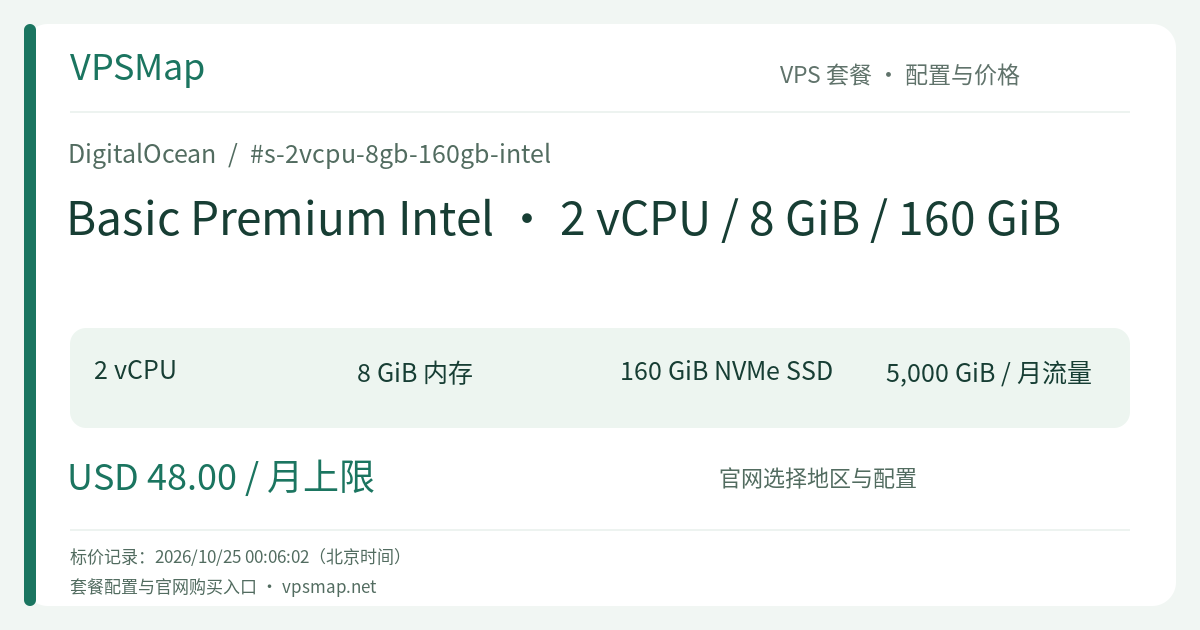
DigitalOcean Basic Premium Intel 2 vCPU / 8 GiB / 160 GiB Guide: The High-Memory Sweet Spot for Growing Workloads
Updated
Breaking the Memory Bottleneck Without Overpaying#
Developers frequently face a common architectural hurdle when picking virtual servers: entry-level 1-vCPU or 2-vCPU instances typically offer only 1 GiB to 4 GiB of RAM. Running modern software—such as Spring Boot, Django with asynchronous Celery workers, or multi-tenant Node.js applications—can easily exhaust available memory and trigger fatal Out-Of-Memory (OOM) errors. Moving straight to dedicated-CPU instances provides plenty of RAM, but at a significantly higher budget commitment.
The DigitalOcean s-2vcpu-8gb-160gb-intel Droplet addresses this imbalance directly. By combining 2 shared vCPUs with 8 GiB of system RAM (a comfortable 4:1 RAM-to-core ratio) and 160 GiB of local NVMe storage, it hits the ideal middle ground for workloads that need substantial memory room and fast disk transactions without requiring dozens of dedicated compute cores.
The Premium Intel Hardware Advantage: 2,933 MHz RAM & NVMe#
Belonging to DigitalOcean's Basic Premium Intel lineup, this Droplet is built on high-spec hardware compared to standard regular-CPU tiers:
- High-Frequency Memory Bus: Powered by 2nd or 3rd Generation Intel Xeon Scalable processors, memory operates at a 2,933 MHz bus speed. For memory-sensitive caching engines like Redis or database engines utilizing large memory buffers (such as PostgreSQL's
shared_buffers), high memory bandwidth directly lowers query access latency. - Hypervisor-Attached NVMe Storage: The 160 GiB SSD is directly attached to the physical hypervisor rather than mounted over the local datacenter network. NVMe's native parallel command processing and ultra-low seek times ensure that Write-Ahead Logs (WAL) and temporary table writes execute with minimal I/O friction.
- Dynamic CPU Time-Slicing: While the 2 vCPUs are shared threads, DigitalOcean's hypervisors dynamically allocate full processor clock cycles during traffic bursts, ensuring steady baseline responsiveness during peak traffic spikes.
Target Real-World Workloads#
This specific resource configuration fits multiple common production environments:
- Standalone Small-to-Medium Databases: Hosting production PostgreSQL or MySQL setups. The 8 GiB of memory allows allocating 4 GiB to 6 GiB directly to buffer pools, keeping active indexes and frequently queried working sets entirely in RAM, while 160 GiB NVMe accommodates transaction logs and consistent data growth.
- Multi-Container Staging & Staging Stacks: Running API servers, light message queues (e.g., RabbitMQ), Redis caches, and background workers together under Docker Compose. 8 GiB provides sufficient memory headroom to prevent container thrashing.
- Content Management Systems & E-commerce: Handling busy WordPress sites powered by WooCommerce or headless CMS platforms. The memory allows running robust PHP-FPM worker pools, while the 2 Gbps network interface ensures burst traffic doesn't bottleneck outbound delivery.
5,000 GiB Pooled Transfer & VPC Network Economics#
Bandwidth pricing on DigitalOcean is structured around team predictability and multi-service efficiency:
- Team-Level Transfer Pooling: The 5,000 GiB allowance is not siloed to this single machine. Bandwidth accrues second-by-second (at approximately 1/2,419,200 of the monthly total per second) into your organization's global transfer pool. If one Droplet exceeds its individual allocation, it draws from unused bandwidth accrued by other Droplets across the team.
- Free Inbound Bandwidth: All ingress traffic to the Droplet is completely free, making it ideal for webhook receivers, file intake, and data collection pipelines.
- Free VPC Communication: Internal traffic over your private Virtual Private Cloud (VPC) between Droplets or Managed Databases travels on private interfaces and never counts against your public transfer allowance.
- Internal Spaces Routing: When using the VPC-local DNS resolver, traffic between the Droplet and same-region Spaces object storage buckets is routed internally, bypassing public outbound transfer metering.
Operational Best Practices & Billing Mechanics#
Keep the following operational considerations in mind when managing your Droplet:
- Capped Monthly Billing: Bundled Droplets bill per second with a minimum charge of 60 seconds ($0.01), capped at 672 hours (28 days) per billing cycle. Running the instance continuously all month long never exceeds the flat monthly cap.
- Power-Off Billing Rule: Powering off a Droplet in the control panel does not stop billing, as physical hypervisor CPU, RAM, and NVMe allocations remain strictly reserved for your instance. To completely halt charges, take a snapshot and destroy the Droplet.
- Incremental Backup Architecture: DigitalOcean Backups can be activated in the control panel. Weekly backups cost 20% of the Droplet's monthly price (retaining 4 backups over 4 weeks), while daily backups cost 30% (retaining 7 backups over 7 days). Following the initial full backup, all subsequent backups are fast, incremental snapshots.
- Seamless Resizing: You can easily scale compute and memory upwards within the same family as your application's user base expands.
Verdict & Deployment Recommendation#
For engineering workloads that demand solid 8 GiB memory capacity, rapid NVMe transactional throughput, and generous 5 TB pooled bandwidth without the high cost of enterprise-tier dedicated cores, the s-2vcpu-8gb-160gb-intel plan delivers an exceptionally well-balanced return on investment.
Regional availability is confirmed live inside the console. Check real-time provisioning options for your preferred region via the DigitalOcean Control Panel.