DigitalOcean 2 vCPU / 16 GiB Storage-Optimized Droplet Review: Why 300 GiB Direct NVMe Is the Gold Standard for Low-Latency Databases
Updated
When operating relational databases, search clusters, or telemetry pipelines in the cloud, teams rarely hit compute bottlenecks first. Instead, the most common performance ceiling is I/O latency jitter. Standard cloud virtual machines typically rely on network-attached block storage. Regardless of advertised throughput numbers, traversing the data center network fabric introduces unavoidable round-trip latency. During peak concurrent transactions or intensive index rebuilds, high I/O wait times and query queue build-ups quickly degrade application responsiveness.
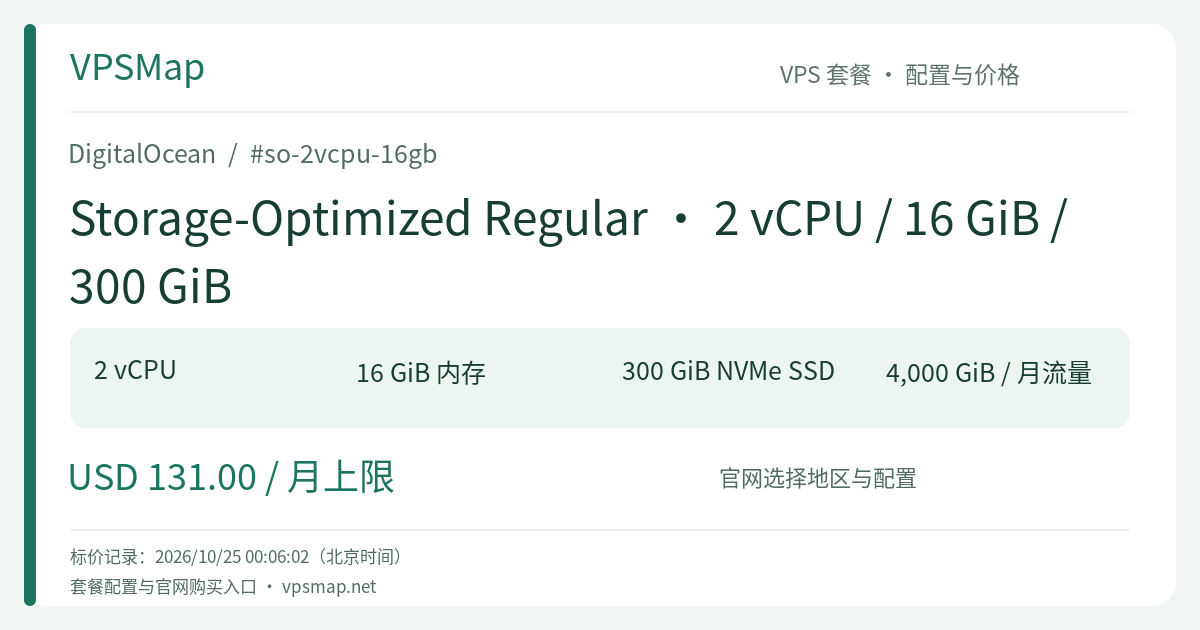
The DigitalOcean Storage-Optimized Regular · 2 vCPU / 16 GiB / 300 GiB plan (slug so-2vcpu-16gb) is architected specifically to dismantle this bottleneck. By mounting 300 GiB of enterprise NVMe SSD directly on the physical hypervisor bus and pairing it with 100% dedicated compute threads and an abundant 8:1 memory-to-core ratio, it delivers an ultra-responsive, cost-effective baseline for latency-critical workloads.
Why Host-Direct NVMe Matters#
To appreciate the value of this Droplet, it is crucial to recognize the engineering distinction between direct-attached NVMe and network block volumes (Volumes):
- PCIe Bus vs. Network Encapsulation: Network-attached volumes must route reads and writes across switches and storage controllers. Direct-attached NVMe lives directly on the hypervisor's PCIe bus. Leveraging NVMe's native parallel queue architecture, storage latency drops from several milliseconds down to sub-millisecond microsecond ranges.
- Predictable fsync Performance: High-throughput transactional systems (such as PostgreSQL write-ahead logs or MySQL redo logs) frequently invoke
fsyncto flush writes to non-volatile media. Direct host NVMe absorbs these synchronization calls near-instantaneously, eliminating write-lock stalls. - Local Parallel IOPS: As documented by DigitalOcean, direct NVMe hardware parallelism delivers disk throughput that can be an order of magnitude faster than conventional SSD storage, without the need to pay for provisioned IOPS tiers.
Dedicated 2 vCPU + 8:1 RAM-to-Core Ratio#
Beyond raw storage media, the so-2vcpu-16gb instance configuration is balanced specifically for data-intensive server roles:
1. Dedicated Compute Without Noisy Neighbors#
Unlike Basic Droplets where underlying CPU hyper-threads are dynamically contested among neighboring virtual machines, Storage-Optimized instances feature Dedicated vCPUs. Your 2 cores have uninterrupted access to physical hyper-threads at all times. Heavy background operations, such as database vacuuming or data compaction, run with consistent clock cycles and deterministic latency.
2. Generous 8:1 Memory Ratio for Massive Page Caching#
Pairing 16 GiB of RAM with 2 vCPUs provides an ideal architecture for database engines. In modern Linux distributions, unallocated memory functions as high-speed Page Cache:
- Database Working Sets: A database engine like PostgreSQL or MySQL can allocate 8 to 10 GiB to internal memory structures (Buffer Pool / Shared Buffers), pinning active tables and index trees directly in RAM.
- Read Acceleration: Queries that miss internal memory pools are served rapidly from the direct NVMe storage, creating a robust synergy of fast memory access and high-speed local disk persistence.
Primary Production Workloads#
- Core Relational Databases (PostgreSQL / MySQL): Single-instance master databases managing 50 to 200 GB datasets with high transaction rates requiring strict SLA compliance.
- Search and Logging Nodes (Elasticsearch / OpenSearch): 8 GiB JVM heap configuration paired with 8 GiB operating system file cache, allowing 300 GiB of local NVMe to ingest high-frequency log streams without disk queue saturation.
- Metrics and Time-Series Hubs (Prometheus / VictoriaMetrics): Dedicated TSDB instances gathering metrics from microservices, compressing samples in RAM, and committing segments smoothly to disk.
- Persistent Message Queues (Kafka / Redpanda / RabbitMQ): Brokers that demand rapid message persistence to disk with minimal acknowledgment latencies.
Specifications and Cost Structure#
| Specification | Details | Production Significance |
|---|---|---|
| Compute Cores | 2 Dedicated vCPUs | Guaranteed CPU cycles; zero neighbor contention |
| Memory | 16 GiB RAM (8 GiB per vCPU) | Generous memory space for database buffers and OS page cache |
| Storage | 300 GiB Direct NVMe SSD | Host-attached bus connection; microsecond I/O response times |
| Network Throughput | 2000 Mbps (2 Gbps) | High-speed intra-VPC communication and client connectivity |
| Bandwidth Allowance | 4,000 GiB / month (Team Pool) | Free inbound traffic; pooled team-level outbound quota |
| Billing Model | Capped at 672 hours / month | Billed per second with a 60-second minimum; predictable cloud budgeting |
Bandwidth Flexibility: DigitalOcean pools outbound bandwidth at the team level across all active Droplets. Inbound transfer is entirely free, and unused outbound allowance from this 4,000 GiB tier naturally covers overages from smaller front-end instances within your team account.
Operational Considerations & Best Practices#
To make the most of local NVMe storage, architectures must account for its physical realities:
- Hypervisor Locality: Direct-attached NVMe storage is bound to the physical hypervisor. Unlike network volumes, the storage cannot be detached and reattached instantly to another machine in the event of hardware maintenance.
- Architecting for Resilience:
- Enable DigitalOcean Backups: Automated Droplet backups (20% add-on for weekly, 30% for daily) provide point-in-time incremental system restore capabilities.
- Replication and Object Storage Offloading: Maintain a secondary read replica for mission-critical databases, and export periodic database dumps to DigitalOcean Spaces via private VPC networking (free of bandwidth charges within the same region group).
- Billing Lifecycle: Because compute hyper-threads and host NVMe storage remain permanently reserved on the physical hardware, stopped/powered-off Droplets continue to accrue charges. To terminate billing completely, destroy the Droplet via the Control Panel or CLI.
Verdict#
If your application suffers from erratic query response times and your server metrics show elevated I/O wait percentages under load, moving to the DigitalOcean Storage-Optimized 2 vCPU / 16 GiB Droplet is an immediate architectural upgrade. By combining dedicated compute cores, 16 GiB of system memory, and 300 GiB of direct-attached NVMe, it provides the low-latency stability your production databases require.
Note: Hardware availability for Storage-Optimized plans varies by datacenter region and is confirmed in the cloud console during provisioning.
Deploy the 2 vCPU / 16 GiB Storage-Optimized Droplet on DigitalOcean