DigitalOcean 4 vCPU / 32 GiB Storage-Optimized Droplet Review: The Resilient Core for Heavy Production Databases and Ingestion
Updated
As applications transition from early-stage traffic to enterprise-scale production, system demands increase exponentially: concurrent database connections surge into the hundreds or thousands, background maintenance routines (such as PostgreSQL Autovacuum or MongoDB compaction) compete directly with user-facing transactions, and standard cloud storage queues experience elevated wait times during traffic peaks.
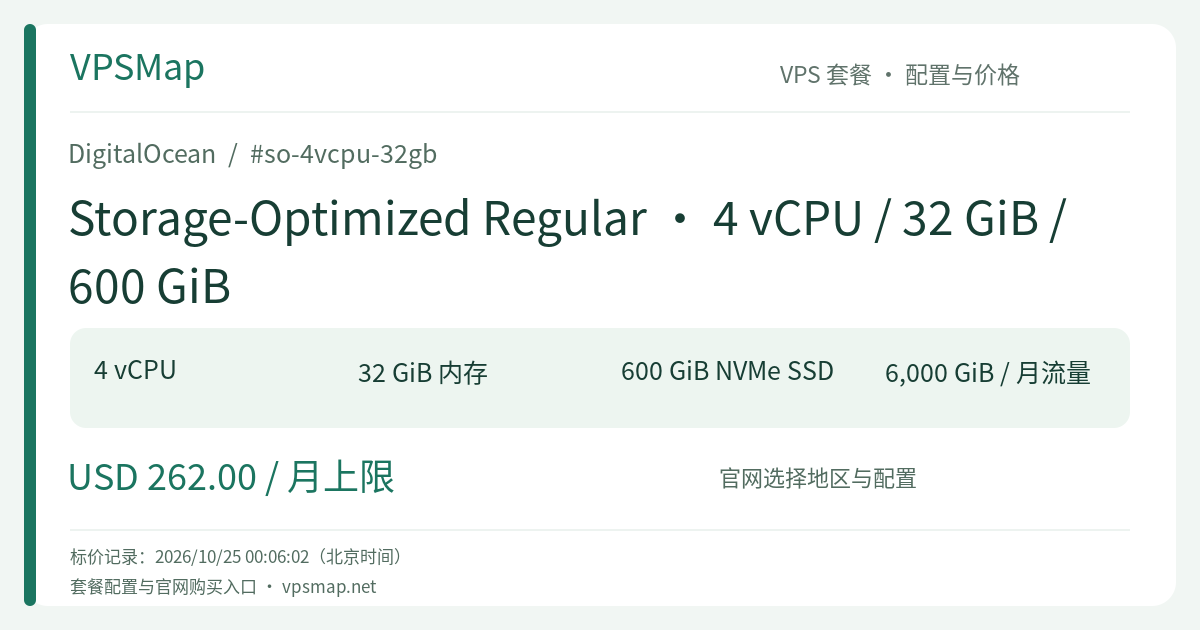
At this juncture, remaining on a 2-core machine risks severe CPU throttling during query bursts, while limited memory forces the operating system to continuously fetch cold data from disk. The DigitalOcean Storage-Optimized Regular · 4 vCPU / 32 GiB / 600 GiB plan (slug so-4vcpu-32gb) is engineered specifically as a resilient production backbone. By combining 4 dedicated compute cores, 32 GiB of RAM, and 600 GiB of direct-attached NVMe storage, it provides an unshakeable foundation for mission-critical services.
The Engineering Balance of 4 vCPUs, 32 GiB RAM, and 600 GiB NVMe#
In modern infrastructure engineering, a 4-core, 32-GiB specification is widely considered the sweet spot for stateful backend systems. This tier takes that balanced architecture and reinforces it with 600 GiB of host-direct physical NVMe flash:
1. 4 Dedicated Cores: Segregating Foreground and Background Tasks#
Relational engines must handle real-time customer transactions while continuously maintaining internal storage health. Having 4 dedicated compute threads allows clean operational isolation:
- 2 to 3 cores handle incoming client queries, query planning, and active transaction execution;
- The remaining cores manage background checkpointing, WAL flushing, and garbage collection, preventing heavy maintenance cycles from starving client connections.
2. 32 GiB System Memory: Maximizing Working-Set Residency#
For medium-to-large business applications, active working sets and frequently traversed indices typically range from 10 to 25 GB:
- Dedicated Buffer Pools: You can comfortably allocate 16 to 20 GiB to your database buffer pool (e.g.,
shared_buffersorinnodb_buffer_pool_size), ensuring high cache-hit ratios; - Kernel Page Cache: The remaining 12 to 16 GiB serves as OS-level file cache, allowing index misses to be resolved rapidly from memory without triggering physical flash reads.
3. 600 GiB Direct NVMe: Eradicating I/O Wait States#
Whether absorbing massive batch data imports or sustaining high-volume log ingestion, host-attached NVMe handles write bursts with microsecond response times. There are no virtualized storage network hops or shared hypervisor storage throttles.
Ideal Production Deployments#
- Primary Production Databases (PostgreSQL / MySQL Master): Workloads with 200 to 450 GB active datasets supporting demanding multi-tenant SaaS platforms or high-volume e-commerce transactions.
- Search and Log Aggregation Anchors (Elasticsearch / OpenSearch): Allocate 16 GiB to JVM heap (safely within compressed OOPs optimization limits) and reserve 16 GiB for Lucene filesystem caching. The 600 GiB local NVMe provides fast ingestion and responsive multi-field aggregate queries.
- High-Throughput Streaming Brokers (Apache Kafka / Redpanda): Dedicated cores handle SSL/TLS handshakes and message batching, 32 GiB RAM accelerates zero-copy socket transfers, and 600 GiB NVMe delivers sustained write throughput.
- High-Concurrency CI/CD Build Engines: Teams running intensive Docker build pipelines or large monorepo compilations benefit from local NVMe speed, slashing artifact unpack and container layer caching times.
Specification Matrix & Cost Economics#
| Specification | Details | Production Advantage |
|---|---|---|
| Compute Cores | 4 Dedicated vCPUs | Guaranteed physical hyper-threads; zero multi-tenant CPU stealing |
| Memory | 32 GiB RAM (8 GiB/vCPU) | Accommodates enterprise database buffer allocations and vast page caches |
| Storage | 600 GiB Host-Attached NVMe | 150 GiB/vCPU; direct PCIe bus connectivity; sub-millisecond response |
| Network Throughput | 2000 Mbps (2 Gbps) | High-bandwidth VPC interconnect for seamless replication |
| Bandwidth Quota | 6,000 GiB / month (Team Pool) | Free inbound data; substantial outbound quota pooled across your team |
| Billing Model | Monthly cap at 672 hours | Billed by the second with a 60-second minimum; zero contract lock-in |
Bandwidth Pooling Bonus: This plan contributes 6,000 GiB (nearly 6 TB) of outbound data transfer to your team's cumulative bandwidth pool each billing cycle. Inbound data is completely free, allowing this allowance to offset transfer costs across smaller front-end instances in your fleet.
Production Reliability & Disaster Recovery#
Deploying high-performance host-local storage requires appropriate resilience planning:
- Implement Read Replica Replication: Because direct NVMe is tied to the physical hypervisor, high-availability architectures should include at least one secondary replica in the same VPC via streaming replication.
- Enable Automated Droplet Backups: Turn on DigitalOcean's native backup system for automated, incremental disk images, enabling full-system restoration if configuration errors or operational mistakes occur.
- Automate Object Storage Snapshots: Take advantage of free intra-region VPC routing to DigitalOcean Spaces. Schedule regular database dumps directly to Spaces buckets for dependable off-site archival.
Summary#
When your operational requirements demand dependable multi-core compute, generous memory headroom, and uncompromised local I/O velocity, the DigitalOcean Storage-Optimized 4 vCPU / 32 GiB plan delivers the required stability. It eliminates cloud storage latency spikes and provides the headroom necessary to support sustained business growth.
Note: Physical server availability for Storage-Optimized plans is verified in real time within the DigitalOcean Control Panel upon creation.
Deploy the 4 vCPU / 32 GiB Storage-Optimized Droplet on DigitalOcean