DigitalOcean 4 vCPU / 32 GiB (900 GiB NVMe) Review: The Sub-Terabyte High-IOPS Sweet Spot for Data-Heavy Workloads
Updated
When architecting data-heavy systems, engineering leads often face an awkward trade-off:
As customer volume expands, single-node application data exceeds 500 GB, approaching 700 to 800 GB. Standard 4 vCPU / 600 GiB plans will soon exhaust their disk headroom. However, moving directly to an 8 vCPU / 64 GiB tier pushes recurring hosting costs beyond $500 per month. If your application only requires 4 cores and 32 GiB of memory, upgrading to an 8-core tier forces you to waste hundreds of dollars each month on unneeded compute and RAM overhead.
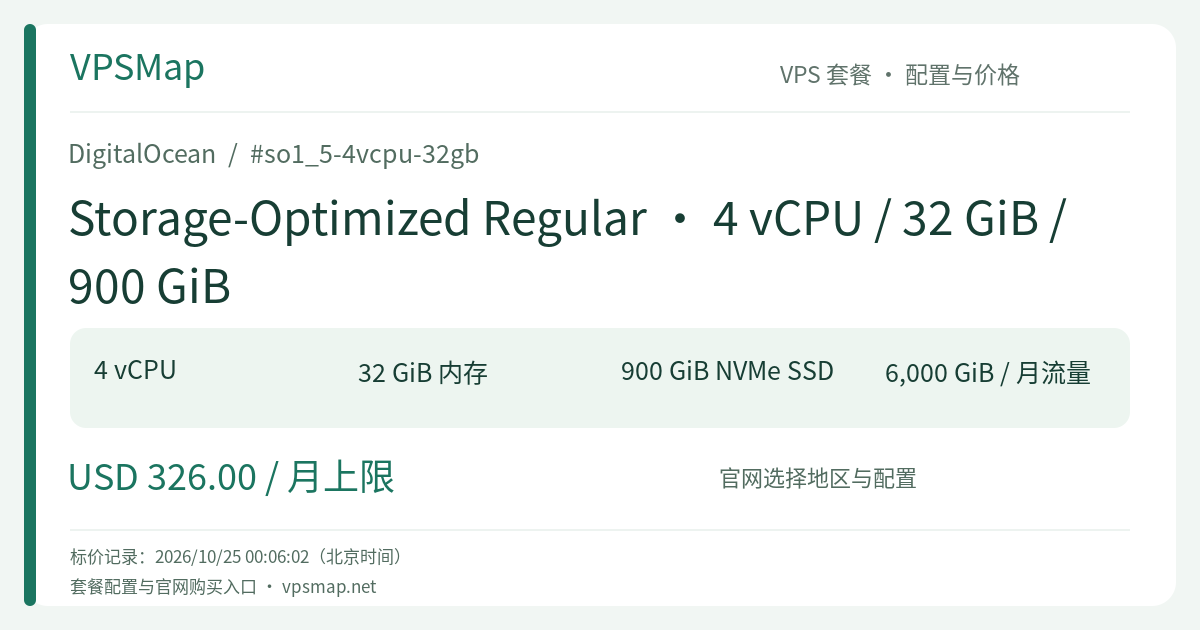
The DigitalOcean Storage-Optimized Regular · 4 vCPU / 32 GiB / 900 GiB plan (slug so1_5-4vcpu-32gb, the 1.5X SSD variant) is engineered precisely to resolve this challenge. Retaining 4 dedicated compute cores and 32 GiB of RAM while expanding host-direct NVMe capacity to 900 GiB, it delivers sub-terabyte high-speed local storage at a highly attractive marginal cost.
The Logic Behind the 900 GiB 1.5X Model: Pragmatic Scaling#
Comparing this 1.5X option with alternative infrastructure choices reveals clear practical advantages:
- Versus Standard 1X (600 GiB vs. 900 GiB): For a modest price difference, you obtain a full 300 GiB (+50%) of direct-attached physical NVMe flash. On a per-gigabyte basis for enterprise NVMe, this is significantly more cost-effective than provisioning external storage volumes.
- Versus Upgrading to 8 Cores (900 GiB vs. 1,170 GiB): An 8-core tier roughly doubles your infrastructure bill. If your operational bottleneck is strictly disk capacity and I/O latency,
so1_5-4vcpu-32gbgrants comfortable headroom immediately while saving thousands of dollars annually in unnecessary compute expenses. - Versus Network Block Storage (Volumes): Attaching external network block volumes introduces latency overhead and relies on network bus bandwidth. The 900 GiB host-direct NVMe maintains microsecond bus latencies without performance jitter.
Primary Production Use Cases#
This configuration is ideally suited for workloads with substantial data throughput and high storage demands paired with steady, moderate compute requirements:
1. Large Partitioned Relational Databases#
In mature multi-tenant SaaS or e-commerce backends, PostgreSQL and MySQL instances must retain 6 to 12 months of detailed transaction logs or audit trails. The 900 GiB disk allows teams to maintain unified operational tables without rushing into complex sharding architectures. Direct NVMe read throughput ensures multi-month reporting queries complete quickly.
2. Dedicated Elasticsearch / OpenSearch Compliance Clusters#
In regulatory and security (SIEM) contexts, event logs often require 90-day retention periods. Allocating 16 GiB to JVM heap and 16 GiB to OS page cache allows 900 GiB of local NVMe to ingest hundreds of millions of structured audit records while maintaining sub-second multi-field query responsiveness.
3. Enterprise Repository & Artifact Servers (GitLab / Nexus / Harbor)#
Self-hosted code and container registries place heavy demands on local storage throughput. Handling large monorepos, Git LFS assets, and multi-tenant Docker layer unpacks can easily bottleneck standard storage. The 900 GiB NVMe array, coupled with 4 dedicated cores, ensures concurrent pushes and pulls run without I/O stalling.
Detailed Hardware & Networking Specifications#
| Specification | Details | Production Significance |
|---|---|---|
| Compute Cores | 4 Dedicated vCPUs | Guaranteed access to physical hyper-threads; zero CPU contention |
| Memory | 32 GiB RAM | 8 GiB/vCPU ratio; sufficient for large database buffers and page caches |
| Storage | 900 GiB Direct NVMe SSD | 225 GiB/vCPU ratio; direct hypervisor connection; microsecond seek times |
| Network Port | 2000 Mbps (2 Gbps) | High-speed interface for VPC clustering and rapid data transfers |
| Transfer Quota | 6,000 GiB / month (Team Pool) | Inbound data is free; generous outbound bandwidth pooled across your team |
| Billing Cap | 672 hours / month | Billed by the second with a 60-second minimum; maximum budget predictability |
Operational Architecture & High-Availability Guidelines#
To ensure reliability when managing 900 GiB on direct-attached storage, follow established architectural best practices:
- Deploy High-Availability Replicas: Direct NVMe storage is bound to the physical hypervisor. For critical production databases, configure at least one secondary replica using DigitalOcean VPC networking (where intra-region internal traffic is completely free of bandwidth charges).
- Enable Automated Droplet Backups: Turn on DigitalOcean Backups during instance configuration. Its incremental snapshot mechanism creates fast, reliable restore points for disaster recovery.
- Offload Cold Snapshots to Spaces: Leverage private VPC resolution to DigitalOcean Spaces. Periodically dump database archives directly to object storage buckets, combining high-speed local operational flash with cost-effective cloud object storage.
Verdict#
The DigitalOcean Storage-Optimized 4 vCPU / 32 GiB (900 GiB) Droplet fills a crucial operational need: it is designed specifically for workloads where data volumes have surpassed 500 GB, yet CPU requirements remain well within 4 cores. It prevents unnecessary compute over-provisioning while supplying near-terabyte local NVMe performance.
Note: Datacenter capacity for Storage-Optimized plans is confirmed in real time within the DigitalOcean Control Panel upon creation.
Deploy the 4 vCPU / 32 GiB (900 GiB NVMe) Droplet on DigitalOcean