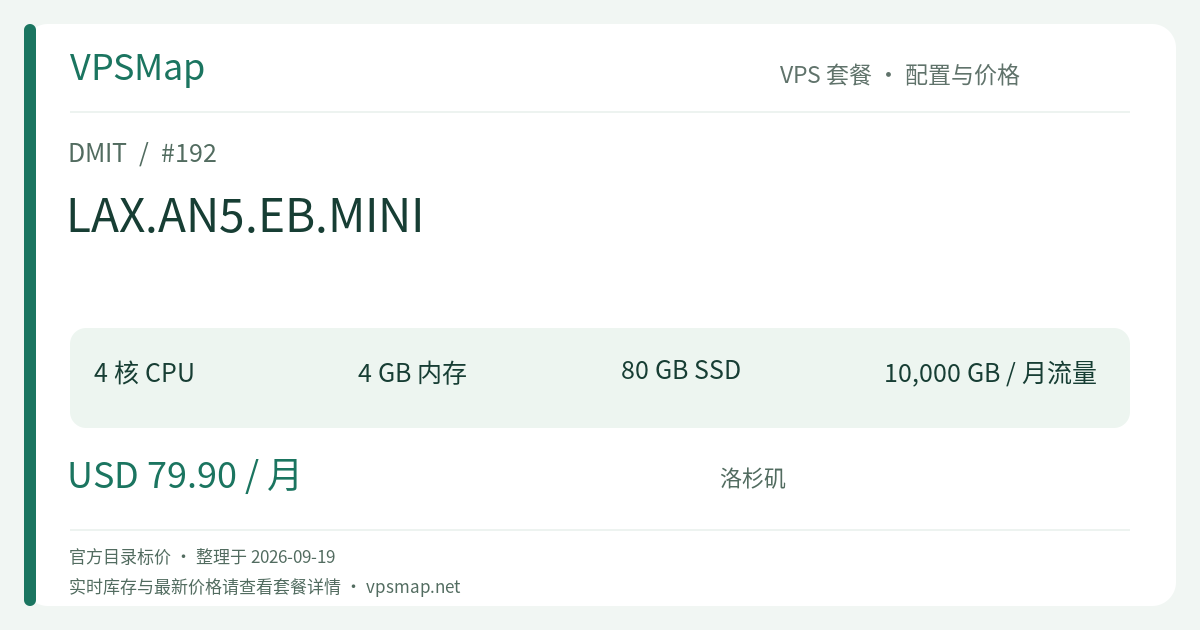
DMIT LAX.AN5.EB.MINI Guide: Zen 5 Raw Power Meets 10Gbps Carrier-Optimized Eyeball Bandwidth
Updated
Why Do You Need a Zen 5 Workhorse on an Eyeball Network?#
When evaluating high-performance cloud servers, buyers frequently face an annoying dilemma:
- Choosing the Premium (Pro) line (CN2 GIA/9929) guarantees pristine routing, but under a fixed budget, compute resources must often be scaled back.
- Opting for traditional budget high-transfer hosts yields large bandwidth pipes, but hosts are often tethered to aging legacy processors that choke on compilation, relational queries, or multi-threaded pipelines.
The DMIT LAX.AN5.EB.MINI [Buy direct ↗] bridges this exact gap. It breaks the misconception that cutting-edge hardware belongs solely to low-transfer VIP routing tiers by marrying AMD's newest AMD EPYC 9005 (Zen 5) infrastructure with a 10Gbps Eyeball carrier-optimized network.
This instance is tailor-made for compute-and-throughput-intensive operations. It equips you with 4 Zen 5 cores, DDR5 RAM, and Gen5 NVMe solid-state storage, backed by 5,000 GB of monthly quota on a 10Gbps burst pipeline—ensuring that computational outputs can be distributed worldwide in seconds without throttling.
Hardware Deep Dive: What the AN5 (Zen 5) Platform Delivers#
DMIT's Los Angeles platform hierarchy is distinct (AS3: Zen 3; AN4: Zen 4; AN5: Zen 5). Upgrading to AN5 provides clear architectural dividends:
1. AMD EPYC 9005 (Zen 5) Architectural Advancements#
- Generational IPC Gains: Zen 5 features a wider dispatch pipeline, refined branch predictors, and enhanced execution units. Intensive JSON parsing, cryptographic handshakes, and concurrent multithreading are completed in noticeably fewer CPU cycles.
- Enterprise Hypervisor Isolation: Running on production-grade KVM virtualization, your 4 vCPUs deliver deterministic, low-jitter performance free from noisy-neighbor contention.
2. High-Speed DDR5 RAM and PCIe Gen5 NVMe Storage#
- 4096 MB DDR5 Memory: Delivers approximately twice the channel bandwidth of DDR4, dramatically slashing latency when indexing large in-memory caches (e.g., Redis or complex application state).
- 80 GB PCIe Gen5 NVMe Storage: Gen5 protocol throughput guarantees blistering I/O operations. Code compilation, heavy SQL transactions, and container layer builds execute without I/O wait states.
Network Dynamics: The True Utility of Eyeball (EB) at 10Gbps#
Evaluating the Eyeball (dmit-eb) network profile ensures your deployment expectations match reality:
1. Carrier-Optimized Peering Pathways#
The Eyeball line delivers direct carrier optimization to Greater China and Asia-Pacific regions, primarily leveraging China Mobile CMIN2 and CMI channels. While official documentation states this is a best-effort service that does not promise identical continuous SLAs to the Premium tier, its practical throughput, latency characteristics, and stability far surpass unoptimized international BGP transit.
2. The Power of a 10Gbps (10,000 Mbps) Port#
Official terms state clearly: total backbone capacity does not equal guaranteed sustained bandwidth per instance. However, operating on a 10Gbps port yields real operational benefits:
- Massive concurrent requests are satisfied without interface-level packet queueing;
- Large remote backups and automated repository syncs finish in minutes, minimizing connection open time.
Practical Workloads: What Problems Does It Solve?#
- Continuous Integration & Heavy Compilation Nodes
Modern codebases (Go, Rust, C++, Node monorepos) place intense demands on CPU threads and disk I/O. Zen 5 cores and Gen5 NVMe drastically cut build times, while the 10Gbps port uploads artifacts to global mirrors instantly. - Media Processing & Micro-Transcoding Pipelines
Video slicing, dynamic image rendering, and audio streaming proxies demand both modern vector instruction execution and high-capacity data transit—a synergy this machine delivers out of the box. - High-Concurrency API & Microservice Hubs
Deploy full-stack Docker environments servicing end users across both Asia-Pacific and the Americas with responsive, snappy throughput.
Comparative Analysis and Buying Strategy#
Here is how LAX.AN5.EB.MINI compares to adjacent offerings in DMIT's Los Angeles datacenter:
| Plan Name | Hardware Stack | Network Type | Bandwidth / Port | Monthly Price | Strategic Fit |
|---|---|---|---|---|---|
| LAX.AN5.EB.MINI (Current) | 4-Core Zen 5 (DDR5/Gen5) | Eyeball (CMIN2/CMI) | 5,000 GB / 10Gbps | $79.9 | Compute first, high throughput: Peak single-core IPC and Gen5 NVMe storage |
LAX.AN4.EB.MINI | 4-Core Zen 4 | Eyeball (CMIN2/CMI) | 10,000 GB / 10Gbps | $72.9 | Bandwidth first: Costs $7 less while offering double the quota (10TB) on Zen 4 |
LAX.AN5.Pro.MINI | 4-Core Zen 5 (DDR5/Gen5) | Premium (CN2 GIA/9929) | 5,000 GB / 10Gbps | $79.9 | Routing first: Identical price and compute, but trades for VIP CN2 GIA/9929 transit |
LAX.AS3.EB.MINI | 4-Core Zen 3 | Eyeball (CMIN2/CMI) | 10,000 GB / 10Gbps | $62.9 | Budget-focused, but note AS3 Los Angeles is currently undergoing optimization |
Which should you pick?
- If your priority is zero-compromise route stability during peak evening hours, choose
LAX.AN5.Pro.MINIat the same price point; - If your application is a high-volume data drain that needs 8TB-10TB of monthly transfer without needing peak Zen 5 clock cycles, choose
LAX.AN4.EB.MINI; - If your workload demands uncompromising Zen 5 processing and Gen5 NVMe I/O paired with a high-capacity 10Gbps burst pipe, LAX.AN5.EB.MINI is the exact sweet spot.
Quick Start and Performance Validation#
Step 1: Validate Zen 5 Architecture and NVMe Hardware#
Connect via SSH and verify your host hardware specifications:
# Verify CPU platform details and Zen 5 architecture
lscpu | grep "Model name"

# Inspect attached NVMe storage devices
lsblk
Step 2: Confirm IPv6 Subnet Allocation#
Each DMIT instance comes standard with an allocated /64 IPv6 prefix. Verify interface status:
# Inspect assigned IPv6 addresses
ip -6 addr show

# Test outbound IPv6 transit
ping6 -c 4 2001:4860:4860::8888
Step 3: Enable TCP BBR for High-Throughput Efficiency#
echo "net.core.default_qdisc=fq" | sudo tee -a /etc/sysctl.conf
echo "net.ipv4.tcp_congestion_control=bbr" | sudo tee -a /etc/sysctl.conf
sudo sysctl -p
Official Policies: IP Health and Refund Protocols#
- Initial Connectivity Guarantee: Eyeball tier instances include guaranteed global initial reachability. If an assigned IP is blocked upon initial boot, open a support ticket on day one for an immediate free swap.
- Free IP Replacement Rules:
- The instance must be active for at least 7 days (eligible on day 8);
- At least 15 days have elapsed since the last replacement;
- Both ICMP and all TCP ports are completely blocked;
- At least 7 days of active service validity remain.
- Paid Replacement: An IP swap can be purchased anytime for $5 USD per request if partial ports are blocked or the free replacement conditions are not yet met (7-day cooldown applies).
- Refund Regulations:
- Full Refund (Within 3 Days): If traffic consumption is under 30GB, full refund minus payment processor charges is available (Alipay incurs zero deductions);
- Partial Refund (Within 30 Days): Calculated based on the remaining value, deducting whichever is higher between consumed traffic value and elapsed time;
- Exclusions: Non-refundable if 3 prior refunds have been issued on the same product line, if affected by DDoS attacks, or if justified by ungrounded network/geo-location claims.
Summary & Direct Purchase Link#
The DMIT LAX.AN5.EB.MINI is an enterprise-grade virtual workstation that refuses to compromise on hardware standards. Combining AMD EPYC 9005 (Zen 5) processing, PCIe Gen5 NVMe storage, and a 10Gbps carrier-optimized burst port, it provides a rock-solid, future-proof foundation for compute-intensive cloud services.