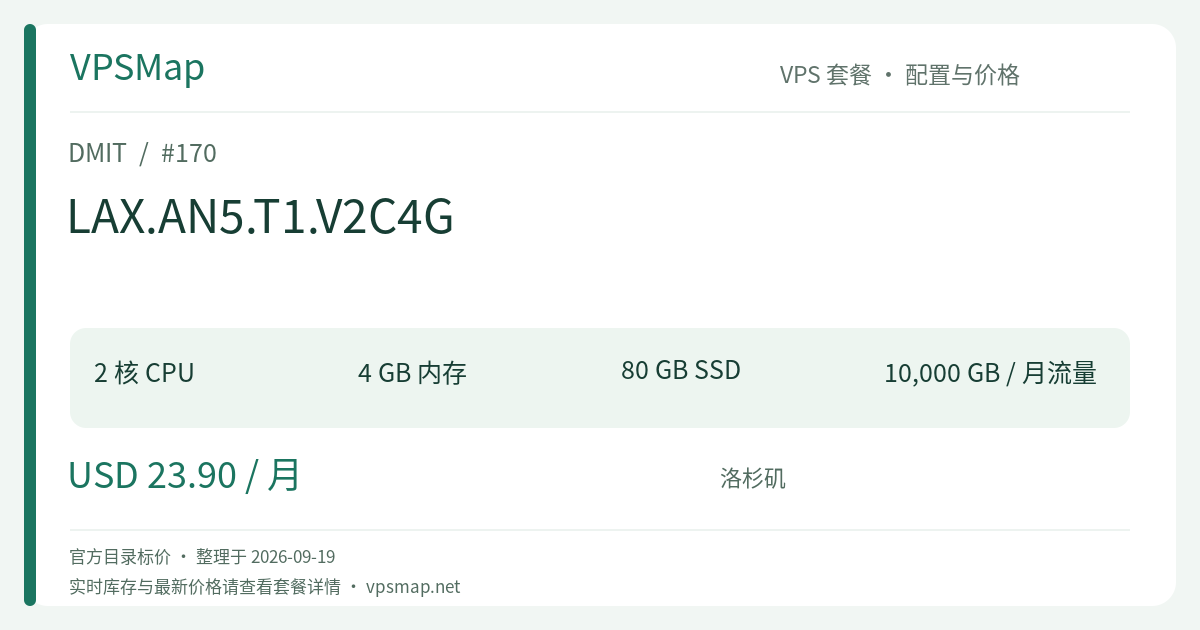
DMIT LAX.AN5.T1.V2C4G Review: 4 GB DDR5 with 10 TB Bandwidth on a 10 Gbps Port, Built for Heavy Throughput
Updated
The Core Value Proposition: When Elite Compute Meets a 10 TB Pipeline#
With most major public clouds, selecting 4 GB of RAM, 80 GB of SSD storage, and several terabytes of high-speed data transfer inevitably results in a monthly invoice scaling toward $50 or more. Conversely, in the budget hosting segment, plans advertising generous bandwidth allocations often pair them with outdated CPUs and throttled disk arrays, making them unsuitable for authentic commercial production workloads.
DMIT LAX.AN5.T1.V2C4G [Buy direct ↗] disrupts this paradigm. At an accessible price point of $23.90 per month, it delivers a balanced, high-performance package:
- Flagship Processing Core: Powered by AMD EPYC 9005 Series (Zen 5 architecture) dual-core computing matched with high-speed DDR5 memory;
- Next-Gen PCIe Gen5 NVMe: Provides 80 GB of PCIe 5.0 solid-state storage, completely eliminating local I/O wait times;
- Massive Data Pipeline: Uncapped 10 Gbps (10,000 Mbps) physical port speeds paired with a substantial 10,000 GB (10 TB) monthly bidirectional transfer quota.
This is a well-rounded server engineered specifically for developers and operations teams whose workflows demand high compute, resilient memory capacity, extreme I/O, and heavy throughput simultaneously.
Hardware Architecture: Built for Complex Workloads#
1. Dual Zen 5 Cores + 4 GB DDR5 RAM#
In production systems, 4 GB of memory represents a vital operational threshold. Within a 4 GB RAM footprint, you can reliably run container orchestration layers (such as lightweight Kubernetes / K3s), multi-container Docker Compose stacks, or integrated backend architectures including Elasticsearch indexers, Redis caching instances, and JVM / Go services without running into kernel out-of-memory crashes.
Concurrently, AMD's EPYC 9005 (Zen 5) architecture delivers top-tier per-core execution efficiency. Multithreaded scheduling remains responsive, maintaining low API response times even during sustained traffic loads.
2. 80 GB PCIe Gen5 NVMe Storage: Capacity and Speed#
Compared to entry-level 20 GB or 40 GB partitions, an 80 GB disk allocation grants true operational flexibility. Capitalizing on PCIe Gen5 NVMe read/write throughput and minimal access latencies, writing high-frequency audit logs, persisting relational database changes, and pulling multiple large container images happen smoothly without storage bottlenecks.
3. A 10 Gbps Uplink with 10 TB Monthly Throughput#
A 10,000 GB (10 TB) monthly quota represents serious network throughput. At $23.90 per month, the effective bandwidth cost translates to less than $2.40 per terabyte—delivered over a blazing 10 Gbps port. Even during concurrent burst traffic, the 10 Gbps pipe accommodates sudden demand spikes without packet queuing.
Primary Practical Applications#
- Global Content Distribution, Cache Mirrors, and Binary Storage: If you manage private package caches, Docker container registries, or static asset distribution nodes for distributed overseas teams, 10 TB of transfer over a 10 Gbps port provides resilient, high-speed delivery.
- Memory-Demanding Microservice Platforms: Deploying modern backend architectures on 2 cores and 4 GB of DDR5 memory gives you the overhead to ensure zero-downtime container lifecycles, with Gen5 NVMe enabling near-instant image pulls.
- Centralized Log Aggregation and Telemetry Processing: When serving as an overseas collection node, the 10 Gbps port comfortably handles incoming streams from dozens of client nodes simultaneously, formatting and filtering log batches before uploading to long-term storage.
- High-Throughput Web Scraping & Distributed Pipelines: For extensive data indexing and web mining operations, the 10 TB allocation removes bandwidth limitations, allowing continuous data ingestion without unexpected overage bills.
Comparative Analysis: The Value of V2C4G#
Within the Los Angeles T1 portfolio, several related configurations highlight the specific strengths of the V2C4G plan:
| Plan Name | CPU Platform | RAM | Storage | Transfer | Port | Monthly Price | Value Summary |
|---|---|---|---|---|---|---|---|
| LAX.AN5.T1.G2C4G | AMD Zen 5 | 4 GB | 80 GB | 4000 GB | 10 Gbps | $16.90 | Identical hardware with 4 TB bandwidth |
| LAX.AN5.T1.V2C4G | AMD Zen 5 | 4 GB | 80 GB | 10000 GB | 10 Gbps | $23.90 | +$7/mo delivers +6 TB traffic (+150%) |
| LAX.AS3.T1.MINI | AMD Zen 3 | 4 GB | 80 GB | 8000 GB | 10 Gbps | $21.90 | Older Zen 3 platform, 8 TB transfer |
| LAX.AS3.T1.MICRO | AMD Zen 3 | 4 GB | 120 GB | 16000 GB | 10 Gbps | $32.90 | Older Zen 3 platform, 16 TB transfer |
Strategic Insights:#
- Compared to G2C4G [Buy direct ↗] ($16.90): Both plans share the same foundational hardware (2C / 4GB / 80GB). However, for just $7 more per month, the monthly bandwidth expands from 4 TB to 10 TB—an increase of 6,000 GB. That additional capacity costs roughly $1.16 per terabyte, making V2C4G the clear choice for any data-heavy application.
- Compared to Legacy AS3.T1.MINI ($21.90): The AS3 platform relies on older Zen 3 chips and is officially designated as undergoing infrastructure optimizations. For an extra $2, stepping up to Zen 5, DDR5, and Gen5 NVMe storage provides noticeably faster per-core execution, reduced storage latency, and an additional 2 TB of bandwidth (10 TB vs 8 TB).
Terms of Service and Operational Guidelines#
To make the most of this high-capacity deployment, keep these official policies in mind:
1. Network Route Profile#
Tier 1 (T1) utilizes global tier-1 carrier routing. It delivers outstanding performance across North America, Europe, and major international exchange points, but includes no specialized direct mainland China route optimizations (no CN2 GIA, 9929, or CMIN2). If low-latency routing to mainland China is your main objective, DMIT's Pro Series is the appropriate choice. For international workloads, T1 offers exceptional throughput and bandwidth value.
2. IP Allocation and Replacement#
- Connectivity Availability: T1 plans do not guarantee first-time connectivity in sensitive regions.
- Replacement Guidelines: After an instance has been active for 24 hours, IP replacements are available for $5 per ticket, subject to a 3-day cooldown period and at least 3 days of remaining service validity.
- IPv6 Included: Every deployment receives a dedicated /64 IPv6 prefix by default.
3. Refund Terms#
- 3-Day Full Refund: Applicable within 3 days of purchase if overall network usage remains under 30 GB (payment processing charges deducted where applicable; no fee for Alipay or credit balances).
- 30-Day Prorated Refund: Available within 30 days, calculated against elapsed time or consumed bandwidth proportion.
- Testing Notice: With a 10 Gbps port, running continuous, multi-stream bandwidth speed tests can consume 30 GB in seconds. Keep initial operational tests lightweight to preserve full refund eligibility.
4. Server Management & Security#
DMIT's proprietary dashboard provides full VM management, direct SSH public key integration during provisioning, VNC console access, and live metric monitoring. Enabling Two-Factor Authentication (2FA) is strongly recommended for account security.
Conclusion & Direct Ordering#
DMIT LAX.AN5.T1.V2C4G provides a robust combination of compute performance, memory headroom, Gen5 storage speed, and bandwidth volume. Delivering 4 GB DDR5, Gen5 NVMe, and 10 TB of data transfer over a 10 Gbps port for $23.90/month, it is an outstanding candidate for bandwidth-intensive international workloads.
- Order DMIT LAX.AN5.T1.V2C4G
- For lower bandwidth needs: View LAX.AN5.T1.G2C4G