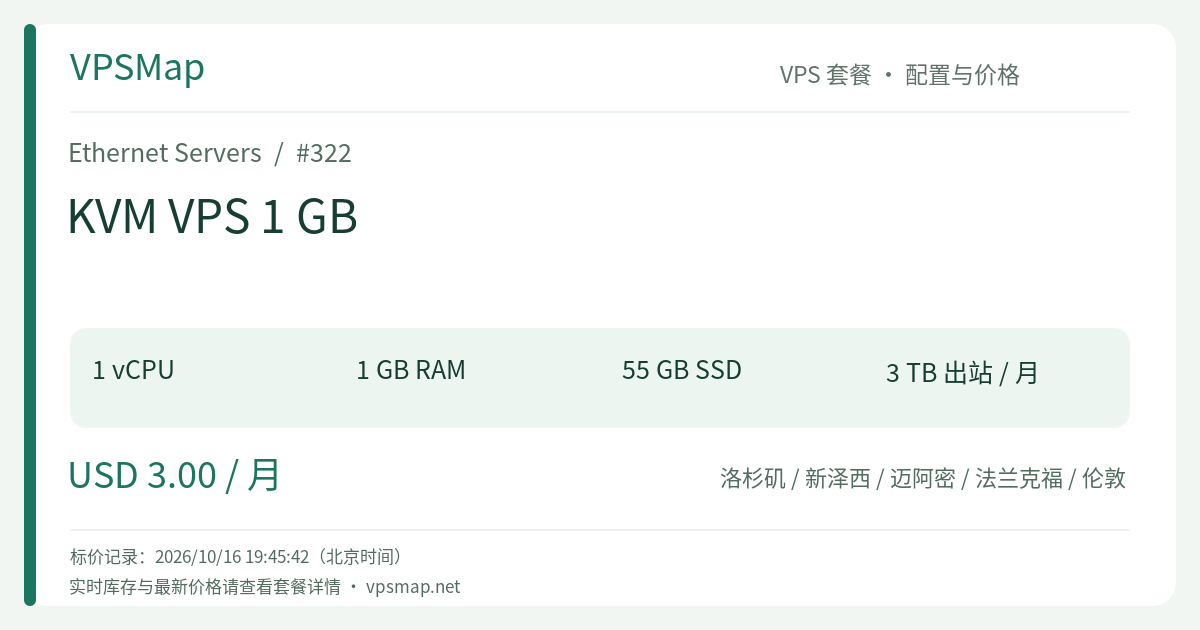
Ethernet Servers 1 GB RAM VPS Review: A Practical Entry-Level Pick at $3/Month
Updated
Priced at just $3 per month, this entry-level KVM VPS from Ethernet Servers stands out with 55 GB SSD storage and a generous 3 TB outbound bandwidth allocation. For budget-conscious developers, lightweight automation, and personal static blogs, it represents an exceptionally practical overseas hosting foundation.
Storage and Value Advantage: Generous 55 GB SSD on a Budget#
Within the $3/month price bracket, many hosting providers restrict initial disk space to just 15 GB or 25 GB, but Ethernet Servers provides a substantial 55 GB SSD. This means that after deploying a standard Linux distribution, you still retain over 40 GB of usable storage for lightweight databases, code repositories, or local task logs, saving you from constant storage cleanups right after system setup.
Network Specs and Bandwidth: 3 TB Outbound and Shared 10 Gbps Uplink#
The package includes 1 dedicated IPv4 and a /64 IPv6subnet, with unmetered inbound traffic and a generous 3 TB monthly outbound quota. The host node runs on a shared 10 Gbps uplink rather than a dedicated port, operating over standard international routing without specialized mainland China CN2 or GIA optimizations. For serving overseas audiences across North America or Europe, API bridging, or daily synchronizations, 3 TB effortlessly handles typical personal project throughput.
Control Panel and Safeguards: 7-Day Offsite Restore Points#
Management is handled through the modern VirtFusion control panel, allowing custom ISO mounting, seamless OS reinstallations, and rDNS configuration. The platform integrates automated daily offsite backups retaining up to 7 daily restore points, offering a convenient safety cushion against misconfiguration; however, official terms do not guarantee data recovery, so critical workloads still demand independent remote backups. Additionally, outbound port 25 is blocked by default and requires ticket authorization.
Performance Boundaries: Realistic Workloads for 1 GB RAM#
Powered by a single vCPU and 1 GB RAM, the physical resource ceiling is clearly defined. It excels at running lightweight web servers (such as Caddy with static sites), single-instance SQLite backends, Node.js utilities, RSS aggregators, or scheduled cron scripts. However, launching multiple heavy Docker containers or memory-hungry JVM stacks will quickly trigger out-of-memory errors. Configuring a proper Swap partition is essential for maintaining stability on this budget setup.
Tier Comparison: Sticking with 1 GB vs. Stepping Up to 2 GB#
Compared to the $6/month 2 GB plan, this 1 GB tier's primary advantage is its rock-bottom cost: you pay half the price while still securing over 65% of the disk capacity (55 GB vs. 80 GB) and a massive 3 TB outbound transfer. If your workload remains lightweight without strict memory requirements, staying here maximizes cost efficiency; however, if your workflow involves frequent dependency builds or MySQL instances, the 2 GB plan provides the necessary headroom to avoid operational headaches.
Billing Details and Purchase Advice: First-Cycle Promo and Refund Terms#
At checkout, applying the homepage coupon SAVETEN grants a 10% discount on your first billing cycle, though it does not recur upon renewal nor stack with multi-year savings. For long-term commitments, the official annual billing drops the total to $30.60; however, because Ethernet Servers allows tier upgrades butstrictly disallows downgrades, starting with monthly billing to verify latency and performance is the prudent strategy. A 60-day refund policy is available, strictly limited to first-time customers once.