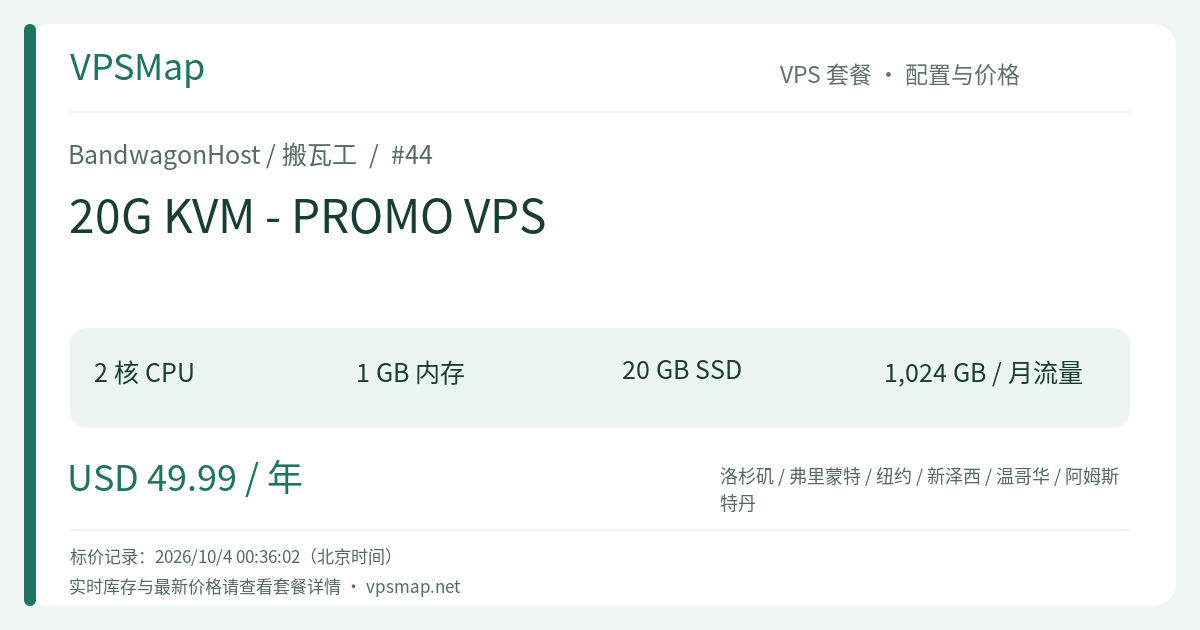
BandwagonHost 20G KVM PROMO VPS Review: Real Practical Value and Buying Guide for the $49.99/Year Base Plan
Updated
What is the 20G KVM PROMO VPS? Positioning and Core Specs#
Within BandwagonHost's (IT7 Networks) expansive lineup, the 20G KVM - PROMO VPS (Internal ID #44 [Buy direct ↗]) has long stood as the definitive standard entry-level plan. Priced at $49.99/year (roughly $4.17/month), it delivers a full-fledged KVM virtualization environment with 1Gbps uplink connectivity.
While BandwagonHost is globally celebrated for its premium CN2 GIA-E flagship tiers, this standard KVM promo plan represents an under-the-radar "productivity Swiss Army knife" for developers, global site administrators, and businesses seeking rock-solid overseas infrastructure without enterprise price tags.
Core Specifications#
| Specification Dimension | Official Configuration |
|---|---|
| vCPU Cores | 2 Cores |
| System RAM | 1024 MB (1 GB) |
| Storage (SSD) | 20 GB RAID-10 Enterprise Storage |
| Monthly Bandwidth | 1024 GB (1 TB) |
| Network Uplink | 1000 Mbps (1 Gbps) |
| Virtualization | KVM (Powered by proprietary KiwiVM control panel) |
| Available Datacenters | Los Angeles, Fremont, New York, New Jersey, Vancouver, Amsterdam |
| Standard Annual Price | $49.99 / Year (Live pricing & stock dynamically reflected on the page) |
Core Attractions: Multi-Datacenter Roaming and Enterprise Hardware#
Finding a cheap VPS is easy; finding one that is stable, self-owned, backed by proprietary tooling, and backed by a 20-year hosting veteran is remarkably rare. Here is why the 20G KVM PROMO VPS remains a staple:
1. Free, Non-Destructive Migration Across 6 Global Datacenters#
Through the proprietary KiwiVM control panel, this plan allows you to migrate your active instance for free, with zero data loss, across six distinct regions:
- US West Coast: Los Angeles (DC2, DC4, DC3 CN2 nodes), Fremont;
- US East Coast: New York, New Jersey;
- North America North: Vancouver, Canada;
- Europe Core: Amsterdam, Netherlands.
If your audience demographic shifts across the Atlantic or a specific route experiences upstream fiber disruption, you can shift datacenters with a couple of clicks in KiwiVM. The control panel automatically snapshots your container, moves disk blocks, and re-allocates an IP in the destination facility with your data completely intact.
2. Owned Infrastructure and Proprietary KiwiVM Management#
IT7 Networks operates its own autonomous system (ASN), controls its own IP space, and installs only enterprise-grade server hardware monitored 24/7. Beyond high hardware uptime, KiwiVM delivers essential management utilities out-of-the-box:
- Free Full Snapshots: Create complete server recovery points on demand and import/export them between instances;
- Emergency Shell & Interactive VNC Console: Regain access instantly even if you lock yourself out of SSH or corrupt network scripts;
- Self-Service rDNS (PTR) Configuration and real-time granular usage graphs.
Realistic Trade-offs: Network and Resource Boundaries#
A genuine recommendation requires total transparency regarding performance expectations:
1. Network Profile: CN2 GT and Standard International Transit (Not CN2 GIA)#
This is the most critical distinction for buyers to understand:
- CN2 GIA (e.g., Plan #87 [Buy direct ↗]): Carried over China Telecom's ultra-premium AS4809 VIP backbone, maintaining negligible packet loss during peak evening congestion at premium transit costs;
- This Plan (#44): Utilizes CN2 GT or standard ChinaNet 163 / direct international carrier peering. It performs exceptionally well during off-peak hours and across international corridors, but it is vulnerable to peak evening congestion (20:00 - 23:00 GMT+8) on cross-Pacific links.
Verdict: If your primary objective is low-latency interactive service for mainland China audiences, invest in the CN2 GIA-E series. If your workload targets North American, European, or global audiences—or consists of non-interactive backend tasks—this tier is more than sufficient.
2. CPU Fair Share Policy#
Under the official Terms of Service (TOS), all non-SLA shared instances operate under fair-use CPU allocations:
- Short bursts to 100% CPU capacity are fully permitted;
- The one-hour average CPU load should generally remain within permitted thresholds (typically around 50% of 1 core for the 20G tier);
- If sustained usage exceeds thresholds, KiwiVM gracefully throttles available cycles without terminating your service, restoring full clocks once load normalizes.
Practical Use Cases: What Can You Build with This Machine?#
- Developer Workstations and Web Microservices: Host lightweight stacks (Debian/Alpine with Nginx, Go, Rust, or Python microservices) running lean on 1GB RAM;
- Cross-Border Business Automation: Manage overseas storefront APIs, background transactional monitors, and localized compliance tasks;
- Offsite Backup and Secondary Disaster Recovery: Pair 1TB of monthly bandwidth with rsync, BorgBackup, or Rclone to mirror critical databases across oceans;
- CI/CD Self-Hosted Runners: Serve as continuous integration worker nodes for GitHub Actions or run automated notification bots.
Upgrade Matrix: When Should You Step Up?#
- If your applications require more headroom: Modern production deployments (Docker stacks, PostgreSQL, Redis, Java services) easily choke on 1GB RAM. Upgrading to the 40G KVM PROMO VPS (#45) doubles RAM to 2GB, expands SSD to 40GB, and doubles monthly transfer to 2TB for $99.99/year;
- If China traffic optimization is critical: Avoid battling international public congestion—go directly to the enterprise-grade SPECIAL 20G CN2 GIA ECOMMERCE (#87).
Purchasing and 30-Day Money-Back Policy#
BandwagonHost offers a clear 30-day refund policy for new service orders. You can request a refund in the client area provided:
- The service was ordered within the past 30 days (first purchase only, not renewals);
- The account is in good standing without chargebacks or disputes;
- The assigned IP address is clean and not blacklisted (verified clean upon delivery);
- Data transfer consumed is under 10% of the monthly quota.
This gives you a risk-free window to test hardware performance and datacenter migration firsthand.