DigitalOcean c-4-intel Review & Guide: 4 Dedicated Cores & 8 GiB RAM for High-Concurrency Microservices
Updated
Uncompromised Compute: Say Goodbye to Noisy Neighbors and the "RAM Tax"#
When sizing cloud servers, engineers frequently face an awkward architectural dilemma: shared-CPU instances (such as Basic Droplets) are budget-friendly, but when traffic surges, compute power gets throttled by neighboring workloads on the same physical host. On the other hand, traditional dedicated instances often force a 4:1 RAM-to-CPU ratio (like 4 vCPUs with 16 GiB RAM). If your workload is primarily compute-bound and memory-light, paying for all that idle memory amounts to an ongoing "RAM tax."
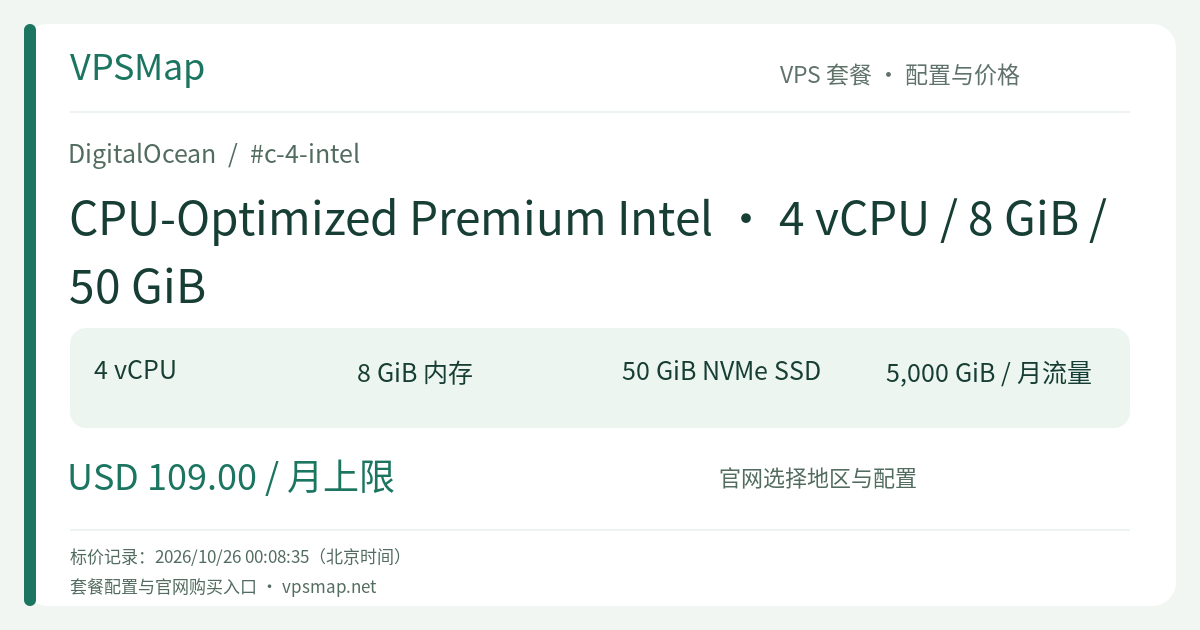
The DigitalOcean c-4-intel Droplet (part of the CPU-Optimized Premium Intel family) resolves this exact imbalance. Built with 4 dedicated vCPUs, 8 GiB of RAM, and a 50 GiB local NVMe SSD, its lean 2:1 memory-to-core ratio matches applications that demand continuous, predictable processing power without memory bloat.
The real game-changer here is guaranteed compute. Each vCPU is mapped directly to a dedicated hyper-thread on the underlying hardware. No matter what other virtual machines are doing on the node, your 4 cores remain 100% available without CPU steal or frequency throttling, providing rock-solid performance stability.
Under the Hood: Ice Lake Architecture, Direct NVMe, and 10 Gbps Networking#
As a member of the Premium Intel tier, c-4-intel provides noticeable infrastructure advantages over baseline machines:
- Processor Architecture: Powered by 3rd Generation Intel Xeon Scalable processors (Ice Lake) with base clock speeds exceeding 2.6 GHz. It delivers exceptional single-thread responsiveness and modern vector instruction efficiency for cryptographic tasks, high-frequency operations, and real-time processing.
- Storage Performance: Includes 50 GiB of local NVMe SSD storage. Communicating directly over PCIe without network virtualization hops, NVMe provides ultra-low I/O latency and massive parallel IOPS. OS startup, container initialization, and application state retrieval remain instantaneous.
- Network Throughput: Premium Intel Droplets unlock up to 10 Gbps of outbound and inbound network throughput—a 5x leap compared to the 2 Gbps cap on standard CPU plans. Whether handling bursty web spikes or transferring data over private VPCs, the network pipe will never throttle your CPUs.
Ideal Workloads: Maximizing Every Dollar on Dedicated Processing#
The 4 vCPU / 8 GiB footprint is an optimal fit for modern, stateless architectures:
- High-Concurrency API Gateways and Reverse Proxies: Deploying Nginx, Envoy, Traefik, or Kong. API proxies burn CPU cycles on TLS termination, header rewriting, routing tables, and rate limiting while consuming modest RAM. The c-4-intel handles thousands of concurrent connections with steady latency percentiles.
- High-Performance Stateless Microservices: Backend applications written in Go, Rust, Node.js, or C++. Because these runtimes are memory-efficient, their bottlenecks are strictly CPU-bound. Four dedicated cores ensure consistent request throughput under sustained load.
- CI/CD Build Nodes and Code Compilation: Serving as dedicated build agents running unit tests, static code analysis, and package compilation. Dedicated hyper-threads prevent random build slowdowns caused by host contention.
- Real-Time Communication and Message Brokers: Ideal for WebSocket hubs, push gateways, and lightweight MQTT brokers. The 10 Gbps throughput ceiling combined with guaranteed CPU cycles keeps message dispatching responsive and reliable.
Storage Trade-Offs: Architectural Tips for the 50 GiB NVMe Disk#
Understanding the purpose of the 50 GiB boot disk is critical to a sound architecture:
- The Advantage: Because the disk is directly attached to the hypervisor, you get maximum IOPS and sub-millisecond latencies for system packages, container runtimes, and local scratch space.
- The Trade-Off: 50 GiB is intentionally lean and not intended for storing massive database files or unpruned Docker images indefinitely. The recommended pattern is storage decoupling: offload build artifacts and static assets to DigitalOcean Spaces via the VPC-local DNS resolver (which avoids public bandwidth consumption); use Volumes or Managed Databases for persistent relational records.
If your build pipeline or local working set legitimately requires more than 50 GiB of raw local NVMe speed, explore the c2-4vcpu-8gb-intel (100 GiB) or c5-4vcpu-8gb-intel (250 GiB) models within the same family.
Billing Mechanics: Per-Second Precision, Monthly Caps, and Pooled Bandwidth#
DigitalOcean keeps compute billing transparent and predictable:
- Per-Second Billing with a 672-Hour Cap: Droplets are billed down to the second with an hourly rate cap set at 672 hours (28 days) per calendar month. In months with 29, 30, or 31 days, continuously running instances stop accruing compute charges after hour 672.
- Compute Reservation Rule: Because compute cores and NVMe sectors are strictly dedicated to your Droplet on the host, turning the server off (Powered Off) does not stop billing. To cease charges completely, you must Destroy the Droplet.
- Team-Level Pooled Bandwidth: The plan includes an allowance of 5,000 GiB of outbound transfer per billing cycle. Inbound transfer is completely free. Bandwidth is pooled cumulatively across all active Droplets at the team level, while private network transfers across VPCs remain free and do not touch your quota.
Verdict & Deployment Recommendation#
If your architecture requires zero CPU steal, high network throughput, and consistent execution times without paying for unused gigabytes of RAM, DigitalOcean c-4-intel represents an exceptionally focused and cost-efficient investment.
Regional capacity varies and is confirmed inside the console at the moment of provisioning. Launch your instance directly via the link below: