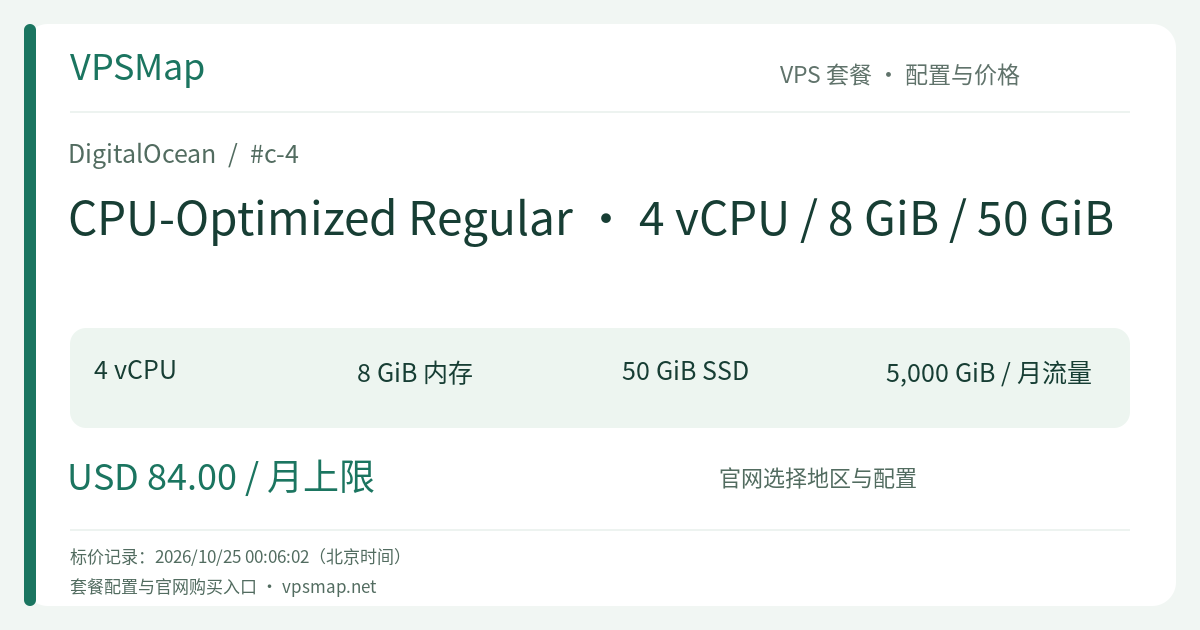
DigitalOcean c-4 Architecture & Buying Guide: High-Throughput 4-Core Dedicated Compute
Updated
The 4-Core Dedicated Threshold for Production Systems#
In concurrent backend architectures, dual-core and single-core nodes eventually encounter severe scheduling bottlenecks:
- Multi-Worker Web Stacks (Python / Ruby / PHP-FPM): In multi-process worker architectures (Gunicorn, uWSGI, Puma), CPU-intensive requests quickly saturate available hardware threads, creating request backlogs and inflating response latencies.
- Modern Asynchronous Engines (Go / Rust / Node.js): While non-blocking event loops handle vast numbers of concurrent connections, heavy background tasks (JSON serialization, crypto, hashing) can stall threads. Four dedicated hardware cores allow efficient thread pooling and context switching.
- High-Throughput Ingress Routing: Gateways balancing tens of thousands of requests per second require consistent CPU cycles for TLS negotiation, header manipulation, and access policy enforcement.
DigitalOcean c-4 provides 4 dedicated physical hyper-threads and 8 GiB of RAM running on Intel Xeon processors with base clock speeds exceeding 2.6 GHz. Operating without CPU overcommitment or neighbor interference, it provides a stable foundation for demanding concurrency.
The Strategic Value of 50 GiB Storage in Stateless Deployments#
Many cloud providers bundle 4-core virtual machines with 160 GiB or more of disk storage, inflating base hosting costs. Modern cloud-native design dictates: keep compute stateless and delegate persistence to managed infrastructure.
The c-4 Droplet features an intentional 50 GiB local SSD boot drive:
- Comprehensive Operating Footprint: A full Linux distribution, container engines, cached runtimes, and local application code require only 15–20 GiB, leaving comfortable headroom on a 50 GiB drive for ephemeral operational files.
- Elimination of Idle Disk Expenses: If your databases run on Managed Databases and user uploads live in Spaces object storage, purchasing massive local disks wastes capital. The
c-4tier concentrates your monthly budget entirely on dedicated 4-core compute. - Frictionless Horizontal Scaling: Placing multiple
c-4Droplets behind a Cloud Load Balancer creates a cost-effective stateless application cluster capable of absorbing significant traffic surges.
5,000 GiB Bandwidth Pool & Network Specs#
- 5,000 GiB Outbound Bandwidth: Stepping up from 2-core tiers, the
c-4instance contributes 5,000 GiB of free public outbound transfer per month into your team-level pool. Inbound data is completely free, and overages are priced at just $0.01 per GiB. - 2 Gbps Network Interface: Fully integrated with DigitalOcean's private Virtual Private Cloud (VPC) network, enabling secure, free, sub-millisecond east-west communication between internal application tiers.
Recommended Production Use Cases#
- Concurrent Production APIs: Multi-process frameworks (FastAPI, Django, Rails, Spring Boot) serving active consumer or B2B SaaS traffic.
- Parallel Continuous Integration Runners: GitHub Actions and GitLab CI worker agents running concurrent test matrices, code compilation, and container packaging.
- Media Ingestion & Audio/Video Transcoding: Handling concurrent media pipelines, live audio filtering, and on-demand video encoding.
Billing Best Practices#
- Second-by-Second Elasticity: Metered per second with a 672-hour monthly cap. For intermittent high-intensity workloads or scheduled batch processing, instances can be provisioned programmatically, executed, and destroyed immediately, keeping costs strictly proportional to work performed.
- Resource Monitoring: Configure DigitalOcean Monitoring alerts to deliver Slack or email warnings when memory exceeds 85% or CPU sustained usage passes 80%, providing early notice to scale out.
Notice: Datacenter availability is verified dynamically in the creation console based on live cluster capacity.
- Direct Link: Deploy a c-4 Droplet on DigitalOcean