DigitalOcean 3.6 TB NVMe Memory-Optimized Droplet Review: 48 Dedicated vCPUs and 384 GiB RAM for High-IOPS Heavy Storage Engines
Updated
The Strategic Value of 3,600 GiB Direct NVMe with 384 GiB RAM#
System architects building high-capacity, low-latency platforms frequently face an uncomfortable trade-off: deploy memory-rich virtual machines attached to network block storage volumes, or manage bare-metal infrastructure.
While networked block volumes offer elastic sizing and snapshot flexibility, they impose a non-trivial latency tax. Under heavy concurrent transactional workloads, large OLAP columnar sweeps, or multi-billion vector lookups, the networking abstraction creates microsecond-level latency penalties and IOPS saturation that can throttle downstream performance.
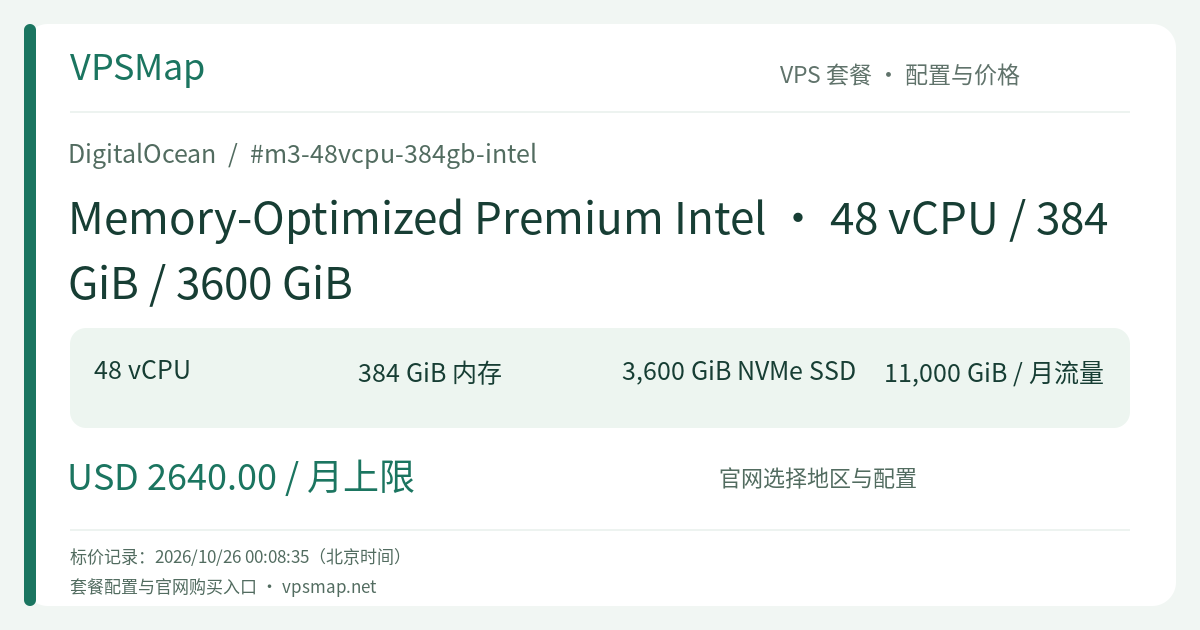
DigitalOcean's m3-48vcpu-384gb-intel eliminates this compromise by pairing pure in-memory scale with extensive hypervisor-attached storage:
- 48 Dedicated vCPUs backed by 3rd Gen Intel Xeon Scalable processors;
- 384 GiB of Physical RAM preserving an exact 8:1 memory-to-vCPU ratio;
- 3,600 GiB (3.6 TB) of Direct Host-Attached NVMe SSD storage;
- Up to 10 Gbps of dedicated network throughput.
By tripling the local NVMe capacity of the standard memory-optimized tier, this instance provides a massive local high-speed runway for workloads where data persistence must match RAM throughput.
Return on Investment: Triple the High-Speed Storage for an 11% Premium#
The architectural business case for the m3 tier becomes immediately apparent when comparing marginal cost against delivered capacity:
| Specification | Standard Tier (m-48vcpu-384gb-intel) | Storage-Enhanced Tier (m3-48vcpu-384gb-intel) | Architectural Gain |
|---|---|---|---|
| Dedicated vCPUs | 48 vCPU (Dedicated Premium Intel) | 48 vCPU (Dedicated Premium Intel) | 100% dedicated hardware threads |
| System Memory | 384 GiB (2,933 MHz) | 384 GiB (2,933 MHz) | Constant 8:1 RAM-to-core ratio |
| Direct NVMe SSD | 1,200 GiB | 3,600 GiB (3.6 TB) | +2,400 GiB of local NVMe (+200%) |
| Network Throughput | Up to 10 Gbps | Up to 10 Gbps | 5x speed of standard droplets |
| Included Egress | 11,000 GiB (Pooled) | 11,000 GiB (Pooled) | $0.01/GiB for excess overage |
| Monthly Billing Cap | $2,376.00 / month | $2,640.00 / month | Marginal difference of $264.00/mo (+11.1%) |
Attempting to bridge this 2.4 TB storage gap by attaching networked block volumes not only incurs additional storage fees, but also sacrifices the raw PCIe bus transfer speeds and ultra-low latencies native to hypervisor-attached NVMe arrays. Paying an 11% total instance premium to obtain 3.6 TB of local NVMe storage is one of the most efficient hardware investments available in the cloud.
Targeted Production Workloads#
This high-density configuration is engineered specifically for four demanding operational profiles:
1. High-Performance Analytical & Time-Series Engines (ClickHouse, TimescaleDB)#
Analytical databases running wide-table aggregations require abundant RAM to hold intermediate hash tables and state arrays, alongside continuous multi-gigabyte disk read throughput to scan raw partitions. A single node with 384 GiB of RAM and 3.6 TB of local NVMe can comfortably ingest, index, and query billions of log lines or financial ticks without the complexity of prematurely orchestrating a multi-node distributed cluster.
2. Distributed NoSQL Backbones (Apache Cassandra, ScyllaDB, MongoDB)#
LSM-tree-based distributed engines rely heavily on sustained write bandwidth for Memtable flushing and continuous background SSTable compactions. The 3.6 TB local NVMe subsystem eliminates disk saturation during intensive compactions, ensuring consistent tail latencies, while the 48 dedicated cores provide stable multi-threaded query execution.
3. Vector Databases and Multimodal Retrieval (Milvus, Qdrant)#
High-dimensional approximate nearest neighbor (ANN) vector graphs (e.g., HNSW) require massive memory allocations. When vector datasets expand past available physical RAM, systems must spill over into disk-backed quantization or memory-mapped files. On standard storage, spilled disk lookups introduce crippling latency penalties; on 3.6 TB of high-speed NVMe backed by 384 GiB of system RAM, vector recall remains sub-millisecond even at enterprise scale.
4. Monolithic Vertical Scaling for High-TPS Relational Databases#
Many engineering teams fracture their databases with complex sharding strategies simply because their datasets reached 1 to 2 TB. Choosing the m3 platform allows a 2+ TB PostgreSQL or MySQL installation to remain unified on a single host. With hundreds of gigabytes allocated to the buffer pool and 3.6 TB of NVMe storage accommodating tablespaces and write-ahead logs, the system effortlessly processes tens of thousands of transactions per second while drastically simplifying application logic.
Network Scale and Billing Clarity#
- 11,000 GiB Shared Egress Pool: Includes 11,000 GiB of outbound public bandwidth. DigitalOcean aggregates bandwidth allowances across all active Droplets at the team level, allowing high-throughput database nodes to leverage unused quotas from lightweight front-end droplets. Outbound overages are billed at a predictable $0.01 per GiB, and inbound ingress is entirely free.
- 10 Gbps Interconnect & Zero-Cost VPC: Intra-datacenter communication across your private VPC interface is completely free and never counts toward your transfer pool. The 10 Gbps interface ensures cross-node replication and backup synchronizations execute with maximum speed.
- Per-Second Billing with a 672-Hour Monthly Cap: Droplet charges accumulate per second with a 672-hour (28-day) ceiling per billing cycle. Continuous operations are never billed for more than 672 hours in any calendar month, eliminating unexpected overage charges for 30- and 31-day months.
Deployment & Operational Considerations#
- High-Availability Planning: Local NVMe storage is physically attached to the hypervisor, providing optimal performance. For production resiliency, complement local storage with an active replication replica (e.g., PostgreSQL streaming replication or replica sets) and enable automated weekly or daily snapshot backups.
- Resource Reservation Rule: Powering down a Droplet does not pause billing. Hypervisor resources—including all 48 dedicated cores, 384 GiB of RAM, and the full 3.6 TB NVMe array—remain strictly reserved for your instance. To terminate charges completely, the Droplet must be destroyed via the console or doctl CLI.
- Capacity Verification: Units of this physical scale are subject to datacenter chassis availability. Because a public catalog price does not represent a perpetual capacity guarantee, confirm live stock in your desired datacenter region (e.g., SFO3, NYC3, FRA1, or AMS3) before architecting deployment pipelines.
👉 Check Regional Stock and Deploy the m3-48vcpu-384gb-intel Droplet