DigitalOcean Storage-Optimized Flagship: 48 Cores, 384 GB RAM, and 7 TB Local NVMe for Heavyweight Workloads
Updated
In modern cloud infrastructure design, engineering teams frequently hit a frustrating wall: CPU cores sit half-idle, memory is not fully saturated, but database latencies swing wildly and iowait numbers spike to critical levels. The culprit almost always traces back to storage subsystem architecture—even the fastest network-attached block volumes struggle to sustain hundreds of thousands of low-latency random I/O operations per second under peak production load.
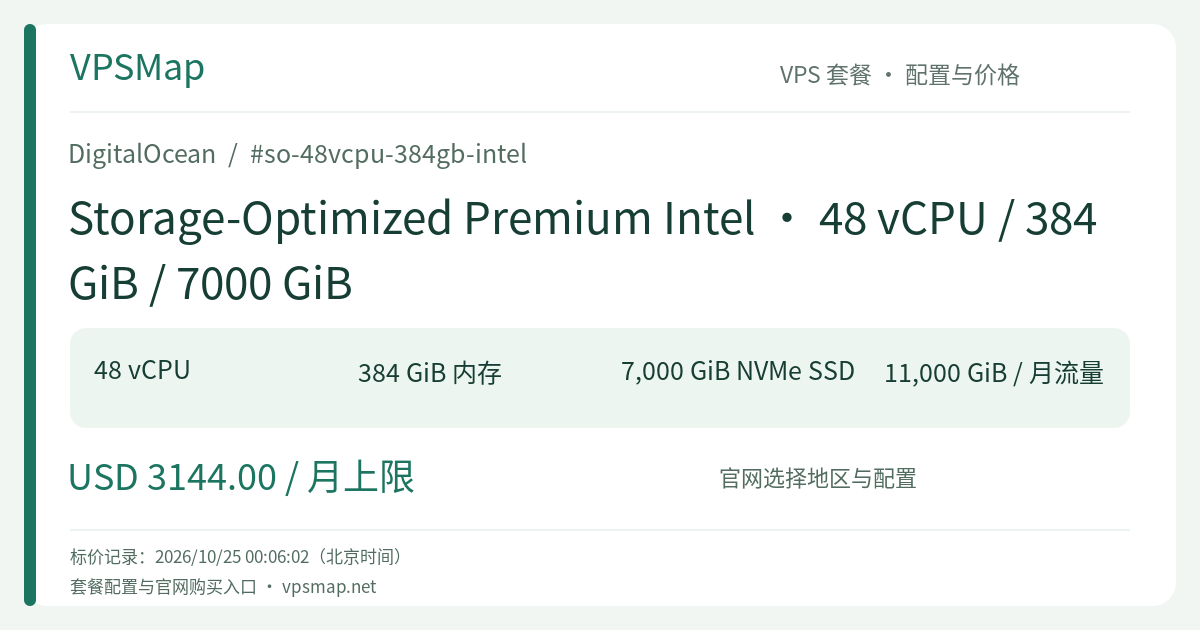
When standard cloud instances fail to meet stringent I/O requirements, DigitalOcean's top-of-the-line storage monster offers a definitive answer: Storage-Optimized Premium Intel · 48 vCPU / 384 GiB / 7,000 GiB (Slug: so-48vcpu-384gb-intel). It is not just an oversized compute node; it is a purpose-built, high-throughput appliance designed to obliterate I/O bottlenecks.
The Direct-Attached NVMe Edge: Why It Changes Everything#
Most common cloud virtual machines rely on network-attached block volumes (such as Volumes or AWS EBS). While network storage offers flexibility and easy volume detachment, it introduces network packet encapsulation, switch hops, and aggressive virtual IOPS ceilings.
The defining feature of so-48vcpu-384gb-intel is its 7,000 GiB (7 TB) physical hypervisor-attached local NVMe SSD:
- Microsecond PCIe Bus Latency: The storage volume communicates directly over physical PCIe lanes on the bare-metal host. Write-Ahead Logs (WAL) commit almost instantly, and unpredictable page read spikes are resolved with microsecond turnaround times.
- Massive Parallelism Without Queue Choke: The NVMe specification is natively architected for parallel multi-queue processing. Paired with 48 dedicated hyper-threads, your operating system can dispatch hundreds of concurrent I/O operations simultaneously without hitting virtualization queuing penalties.
- True Compute Unlocking: Free from blocking I/O calls, the 48 dedicated CPU cores spend their cycles on computational throughput, indexing, query execution, and serialization rather than waiting on storage responses.
Hardware Balance: 48 Dedicated Cores, 384 GiB RAM, and 10 Gbps Pipeline#
Raw disk speed requires balanced compute and networking to unlock its full potential. This tier provides exceptional symmetry:
- 3rd Generation Intel Xeon Scalable Dedicated Cores
Operating on DigitalOcean's dedicated CPU infrastructure, each vCPU maps to a dedicated hyper-thread on the underlying processor. You get zero CPU steal time and dependable clock frequencies. The Premium Intel lineup provides robust single-thread performance alongside AVX-512 extensions, ideal for heavy in-memory operations and JSON processing. - 384 GiB High-Density Memory (8:1 RAM-to-Core Ratio)
Memory sizing is crucial for I/O performance. In PostgreSQL, MySQL, or MongoDB, 384 GiB allows huge buffer pools and vast Linux page caches. Hot datasets remain resident in memory, while cold data lookups hit 7 TB of microsecond-fast NVMe. - Up to 10 Gbps Premium Network Outbound Throughput
Unlike standard instances limited to conservative network limits, Premium Intel Droplets feature up to 10 Gbps of outbound bandwidth. Multi-node database replication, cluster rebalancing, and streaming snapshots complete up to 5x faster, preventing cross-node lag during traffic bursts.
Workloads That Thrive on This Flagship Tier#
This instance is built for mission-critical production workloads where compromises are not an option:
1. Distributed Search & Observability Engines (Elasticsearch / OpenSearch / ClickHouse)#
When ingesting billions of daily telemetry records or enterprise-wide logs, index generation demands relentless write bandwidth. With 7 TB of fast local NVMe capacity, this Droplet functions as a powerhouse hot node, while 384 GiB of RAM powers JVM heaps and OS-level Lucene memory mapping for real-time sub-second queries.
2. High-Frequency Transactional & Time-Series Datastores (MongoDB / PostgreSQL / TimescaleDB)#
E-commerce flash sales, fintech ledger tracking, and high-density IoT ingest pipelines cannot tolerate I/O stalls during transaction commits. Direct-attached NVMe eliminates write bottlenecks, enabling tens of thousands of committed writes per second.
3. High-Throughput Message Hubs (Apache Kafka / Redpanda)#
Streaming platforms rely extensively on zero-copy transfers, sequential disk I/O, and massive OS page cache buffering. This machine's 10 Gbps network pipeline absorbs massive ingress streams, while the local NVMe layer guarantees steady, low-latency disk writes across multiple partitions.
Architecture Best Practices and Necessary Trade-Offs#
Leveraging direct-attached storage requires deliberate design practices:
- Application-Level High Availability: Because the 7 TB NVMe array is tied directly to the physical hypervisor, hardware maintenance or unexpected node failure cannot be resolved via instant network-volume reattachment. Always deploy this instance as part of a replicated topology—such as a 3-node MongoDB Replica Set, a multi-broker Kafka cluster with
min.insync.replicas, or a streaming PostgreSQL primary/replica pair. - Automated Backup Workflows: Use DigitalOcean's automated backup service (daily or weekly schedules) or SnapShooter to maintain point-in-time recovery images. For application databases, stream continuous WAL archives and snapshots directly over private networking into DigitalOcean Spaces object storage.
- Traffic Optimization: This instance contributes 11,000 GiB (11 TB) of outbound bandwidth to your team's monthly pooled allowance (inbound is completely free). Keep all internal cluster communication, replication feeds, and backup pipelines strictly inside the private VPC network to conserve your transfer pool for client-facing egress.
Cost Flexibility & Provisioning Strategy#
Deploying a machine of this scale on traditional bare-metal often demands multi-year leasing commitments. DigitalOcean's transparent billing delivers enterprise horsepower on agile cloud terms:
- Second-by-Second Billing with 672-Hour Monthly Cap: Billed at approximately $4.68 per hour with a hard monthly cap of 672 hours (28 days). Once your active droplet hits the cap in a calendar month, usage beyond 672 hours is not billed. This makes it viable not only for multi-year primary database anchors, but also for temporary 48-hour data migrations, seasonal data reprocessing, or stress-testing drills.
- Regional Capacity Verification: Because a 48-core / 7 TB NVMe footprint requires dedicated hypervisor capacity, regional availability can fluctuate based on real-time datacenter demand across locations (e.g., NYC, FRA, AMS, SGP). Always verify available stock in your intended target region directly via the DigitalOcean Cloud Console.
Quick Deployment with doctl#
You can configure and provision this plan directly in the Cloud Console under the Storage-Optimized tab, or deploy it programmatically via the doctl command-line utility:
# Check availability in your target datacenter (e.g., fra1)
doctl compute size list | grep so-48vcpu-384gb-intel

# Launch the instance with monitoring and private networking enabled
doctl compute droplet create db-cluster-primary-01 \
  --region fra1 \
  --image ubuntu-24-04-x64 \
  --size so-48vcpu-384gb-intel \
  --enable-monitoring \
  --enable-private-networking \
  --ssh-keys <YOUR_SSH_KEY_FINGERPRINT>
If your architecture is straining under heavy I/O constraints or preparing for orders-of-magnitude scale, the so-48vcpu-384gb-intel configuration provides the raw power, memory density, and local disk throughput required to keep your data tier fast, stable, and responsive.